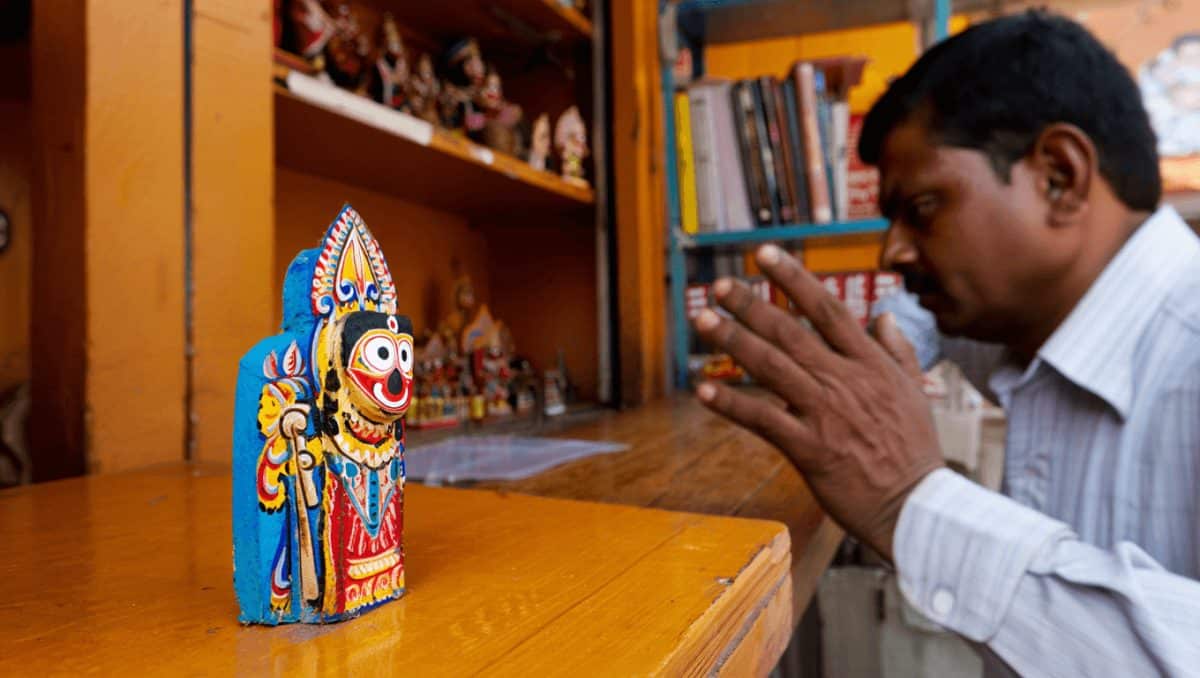
As the United States observes its 250th year, a small painted wooden figure discovered in a San Francisco shop in 1967 offers an unexpected window into how Hindu devotional practice quietly took root in American life. That three-inch idol set in motion a chain of events that helped launch an enduring temple community and public festival on the West Coast.
When a 70-year-old ascetic arrived from India in the late 1960s, he carried little more than translations of sacred texts and a clear mission: to share his devotional tradition with Western seekers. The man, later known widely as A.C. Bhaktivedanta Swami Prabhupada, reached New York after a difficult 37-day voyage—his entry made possible in part by the liberalized immigration rules enacted in the 1965 Immigration Act.
In San Francisco, a young couple associated with the swelling countercultural interest in Eastern spirituality found an unusual item at a neighborhood import store: a small, black-painted wooden figure with an open, smiling face and no arms or legs. Drawn by a “Made in India” label, they brought it to the apartment above the temple where the Swami lived.
Tarun Bhattacharya: santoor maestro calls music India’s chief cultural envoy
Kashi to Kedarnath costs revealed: how much a Sawan pilgrimage will set you back
The Swami’s reaction was immediate and reverent. He identified the little statue as Jagannatha—a compassionate form of Krishna—and treated the discovery as sacred. He told the devotees the figurine represented a trio: Jagannatha with his brother and sister, and he encouraged the community to create larger, worship-ready images for the temple.
The story the Swami recounted traces Jagannatha’s origin to an ancient coastal legend: a king sought an especially grand form of Krishna, a felled reddish log was found on the shoreline, and only a mysterious artisan (revealed as the deity in disguise) could mark the wood. The work was left unfinished when the king broke the artisan’s privacy, which explains why Jagannatha and his siblings appear without arms or legs.
One devotee, a trained carpenter, answered the Swami’s request. He sourced a single large timber salvaged from a dismantled barge, cut it into three sections, and carved the deities—each about four feet tall. The new images were installed on a temple altar on March 23 and became the congregation’s first formally consecrated deities in the United States.
- Year of discovery: 1967 (San Francisco)
- Key figure: A.C. Bhaktivedanta Swami Prabhupada
- Legal catalyst: 1965 Immigration Act expanded entry for non-European immigrants
- Temple name: New Jagannatha Puri (San Francisco)
- Outcome: The installation set the stage for ISKCON’s first public Ratha Yatra in America
The episode matters now because it reframes a common assumption about American religious history. Rather than arriving as fully formed institutions, many immigrant faiths took root through small, tangible moments—an imported trinket, a determined elder, a local craftsman. Those moments ripple forward: public processions, temple communities, and ongoing worship practices visible in cities across the country.
For the city’s nascent Hare Krishna community, the carved deities and the public ceremonies that followed created a durable bridge between Indian devotional forms and a diverse American audience. What started as a private act of reverence quickly found expression in street festivals and temple life, shaping how Hindu traditions appear in the contemporary U.S.
Chance encounters like this one complicate tidy narratives about America’s origins, reminding us that religious pluralism has long been part of the nation’s story—even in small, surprising ways.