Show summary Hide summary
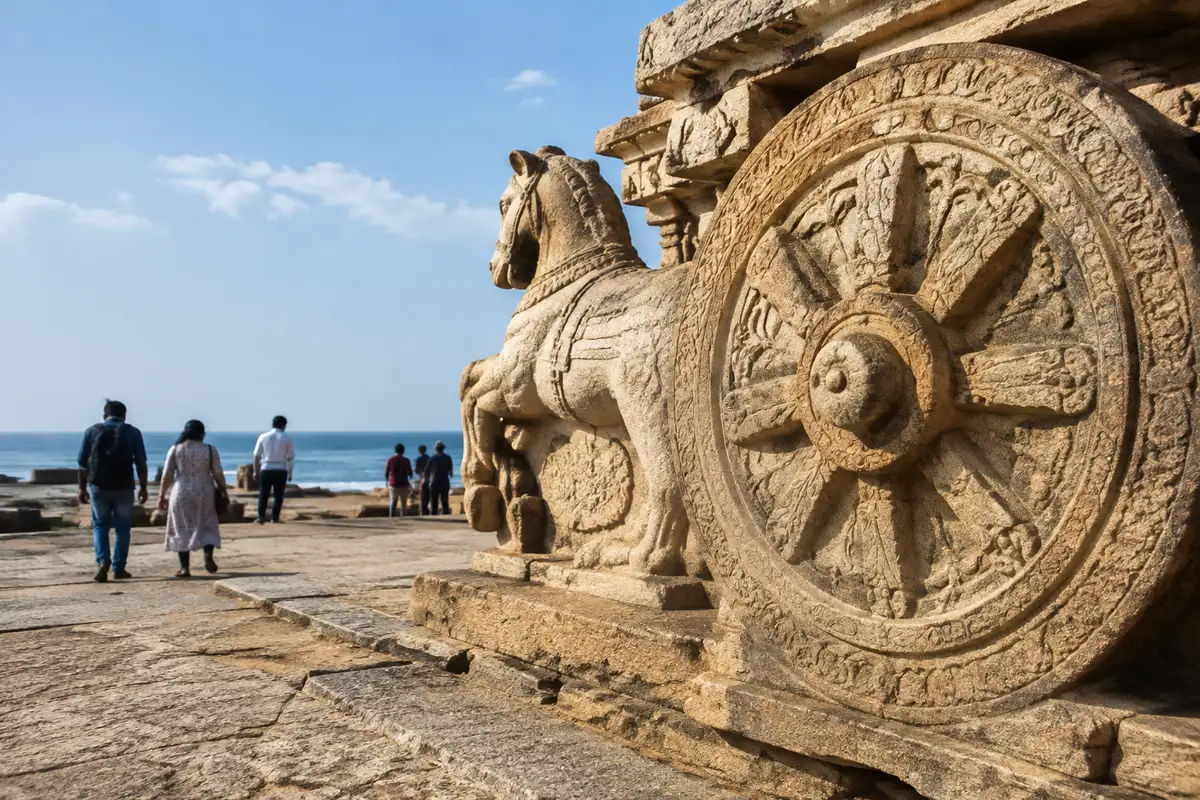
Along Odisha’s sunlit coast stands a 13th‑century monument that reads more like a monumental vehicle than a conventional temple: a carved stone chariot meant to carry the Hindu Sun God across the sky. Its survival—part ruin, part living archive—still shapes how historians, conservators and visitors understand medieval Indian art and engineering today.
The royal project behind the stone chariot
The temple was raised under the patronage of Narasimhadeva I, a ruler of the Eastern Ganga dynasty, during a period when his kingdom commanded significant resources and artistic talent. The commission brought together masons, sculptors, engineers and other specialists to realize an ambitious civic and religious statement.
Govardhan Puja 2026: Annakut draws pilgrims as parikrama and special darshans kick off
Diwali: crucial updates on travel, markets and celebrations
Rather than a single, isolated shrine, the structure exemplified the regional Kalinga tradition of temple-making—one that fused ritual program, public spectacle and finely carved ornamentation into a single monumental form.
Why 24 wheels and seven horses?
The monument’s most arresting feature is its chariot silhouette, complete with rows of carved wheels and a team of horses. These elements are not decorative afterthoughts but symbolic anchors of the temple’s meaning.
24 wheels—arranged in twelve paired sets—are widely read as a visual reference to the passage of time, linking the structure to months, cycles and seasonal movement. Many of the wheels bear intricate motifs and radial patterns; some visitors and scholars have pointed out their potential as shadow‑casting devices, although treating every wheel as a precise timepiece would be speculative.
Seven horses pull the chariot in the sculptural program, a motif that resonates with older Vedic images of the sun’s progress across the sky. Over time these horses have been associated with temporal and cosmological ideas—days of the week or aspects of light—underscoring the temple’s role as an architectural expression of celestial order.
What the stones tell us about belief
The foundation of the monument’s iconography is the long tradition of sun worship in the subcontinent. Texts from the Vedic period praise solar deities and rites that link light, life and the workings of the mind; in that cultural horizon, the chariot motif becomes a logical and potent symbol.
At Konark, that theological inheritance is literalized: the entire layout treats Surya’s journey as the organizing concept, turning a scriptural image into a landscape of stone.
- Vimana — the sanctum that once rose into a dominant tower; much of this superstructure has not survived.
- Jagamohana — the assembly hall, which remains one of the temple’s most intact and visually powerful sections.
- Natamandira — the dance pavilion, richly decorated and historically linked to ritual performance.
Sculpture as social record
Konark’s carved surfaces form a vast pictorial program: gods and celestial beings sit alongside dancers, musicians, animals and depictions of everyday life. These panels are more than ornament; they preserve details about clothing, instruments, and social practices that are otherwise poorly documented for the period.
The site also contains sensuous imagery that fits within a long South Asian tradition of including themes of fertility and human experience alongside sacred iconography. While these reliefs connect culturally to later performing arts in Odisha—such as Odissi dance—they should not be read as a literal blueprint of modern practice.
Legend: Dharmapada and the price of a solution
Local folklore supplies a memorable human story linked to the temple’s construction: the tale of Dharmapada, a young apprentice said to have solved a critical structural problem but who then met a tragic fate to preserve the reputation of senior artisans. The episode survives in oral tradition and regional storytelling rather than in court records, and it speaks to values—skill, responsibility and sacrifice—that communities associate with the monument.
Collapse, conservation and contemporary value
The central tower of the temple did not survive the centuries intact. Causes cited by historians and conservators include natural weathering, structural failures and shifting historical circumstances; the precise sequence remains debated. What stands today—the Jagamohana and other substantive fragments—still communicates the original scale and artistry.
Conservation efforts have been intermittent: colonial‑era interest gave way to more systematic protection under Indian authorities, and in 1984 the site was inscribed on the UNESCO World Heritage List. That designation recognized Konark as a masterpiece of medieval architecture and an important source for studying the subcontinent’s cultural history.
Today the temple is both an archaeological site and a living destination for visitors. Its coastal location poses ongoing challenges—salt spray, erosion and heavy seasonal weather require continuous monitoring—so the question of how to preserve the fabric for future generations is a practical priority as well as a scholarly one.
Why Konark still matters
Beyond myth and monumental form, Konark matters because it is a tangible record of a sophisticated regional culture that married ritual, political authority and high craftsmanship. The site offers historians and conservators a concentrated body of evidence about medieval temple-making, social life and visual language.
Although the original tower no longer crowns the complex, the temple’s surviving stones continue to illuminate the ambitions and artistry of the society that built it—an enduring reminder that architecture can encode religion, power and everyday life in a single, evocative composition.