Show summary Hide summary
Perched on a hill north of Mathura, the Shriji Temple in Barsana draws visitors searching for a different shade of devotional life — one centered on Radha, the female figure at the heart of Krishna worship. As pilgrimage and heritage tourism rebound, Barsana’s temple matters today for devotees and cultural observers alike: it preserves a living tradition of bhakti centered on the figure of Radharani, and it raises questions about conservation, ritual practice and communal memory.
Barsana sits about thirty miles northwest of the town most people name first in discussions of Krishna — Vrindavan — but its spiritual identity has always been distinct. Where Vrindavan celebrates the scenes of Krishna’s childhood broadly, Barsana is understood within the tradition as the place where Radha — often called the beloved and the guiding force of devotion — grew up and expressed an intense form of love that devotees regard as the highest model of bhakti.
The temple now known as Shriji Temple is built on the site traditionally associated with Radharani’s childhood home. According to devotional histories, an original shrine was founded in antiquity and later fell into disrepair. Centuries later, in the late medieval period, a wandering devotee and sage — venerated in local accounts as Narayana Bhatta and identified by some as an incarnation of the sage Narada — is said to have recovered the lost images and re-established their worship.
Shah Rukh Khan used the name Abinav to ease in-law worries: Gauri adopted Ayesha during nikaah
Javed Akhtar hails Hindu festivals as cultural glue: throwback of atheist celebrating resurfaces
How the story is remembered
The popular narrative describes an early episode in which Radharani, as an infant, did not open her eyes. Kings and sages in the story bring her before the saint, who, touched by a sudden surge of devotional feeling when he holds the child, foretells a future in which her life will be defined by an overwhelming love for Krishna. When the young Krishna is later brought near the cradle, tradition says, Radharani opens her eyes for the first time and fixes her gaze on him. This moment has been retold for generations as an emblem of a devotional bond that shapes the temple’s spiritual focus.
Following those events, the recovered deities — affectionately known in local usage as Ladli (the dearly beloved daughter) and Lal (the dearly beloved son) — were reinstalled where worship continues to this day. The current temple complex, set on a hill known as Bhanugarh, crowns that site and can be reached by climbing a long flight of steps that punctuate the journey from village to shrine.
Architecture, artistry and atmosphere
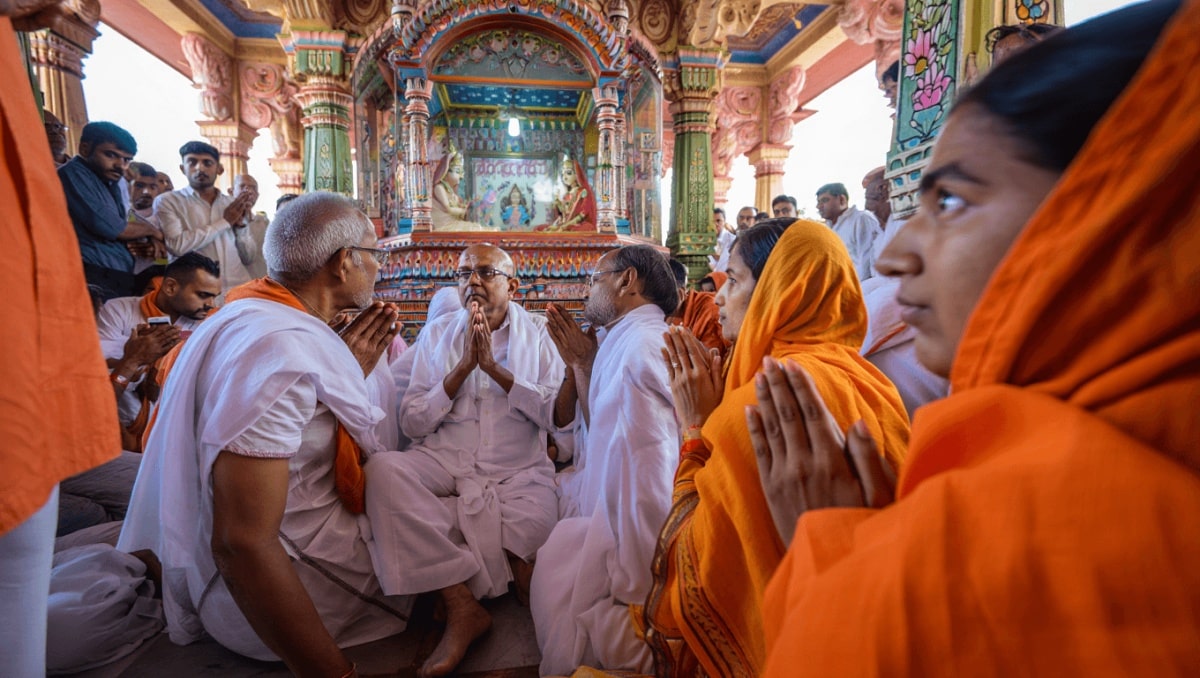
The temple’s appearance is deliberate: contrasting stones and ornate detailing express a visual vocabulary of love and reciprocity. Domes, carved arches and painted panels invite close viewing; visitors frequently describe the ascent as part ritual, part pilgrimage, with the elevated vantage point offering a sweeping view of Barsana and the surrounding countryside.
On major festival days the hill becomes saturated with ritual: bright processions, music, and the playful colors of Holi revive stories of the divine couple’s youthful pastimes, while Radhashtami — Radharani’s birthday — and Janmashtami — Krishna’s birthday — draw particularly large gatherings. During these moments the temple’s devotional atmosphere intensifies and many pilgrims say the emotional charge is unlike that of other local shrines.
- Location: Barsana, about 30 miles northwest of Vrindavan/Mathura.
- Principal deities: The images referred to locally as Ladli and Lal, representing Radharani and Krishna.
- Historical claims: Traditions trace the site to ancient times and describe a re-discovery in the late medieval period by a Gaudiya devotee.
- Architecture: Red-and-white stonework, carved domes, decorated arches and painted interiors; access involves a steep stair climb to the hilltop gate.
- Peak times: Radhashtami, Janmashtami and Holi are the busiest, with year-round flows of pilgrims and seasonal surges.
For visitors and researchers alike, Barsana offers a complementary perspective to Vrindavan’s sprawling devotional landscape. Where Vrindavan is often read as the stage on which many episodes of Krishna’s life unfold, Barsana is read through the lens of Radha’s singular devotion — a devotional mood that devotees sometimes describe as the most intimate expression of love in the Krishna tradition.
That distinctiveness has practical consequences. Conservation efforts in and around the temple must balance the needs of active worship with the pressures of tourism; festivals require local infrastructure and crowd management; and the temple’s rituals continue to be a vital source of identity for many communities who travel there each year. In other words, Barsana is not simply a heritage site to be admired at a distance: it is a living center of practice whose rhythms remain central to how many people understand Krishna-centered devotion today.