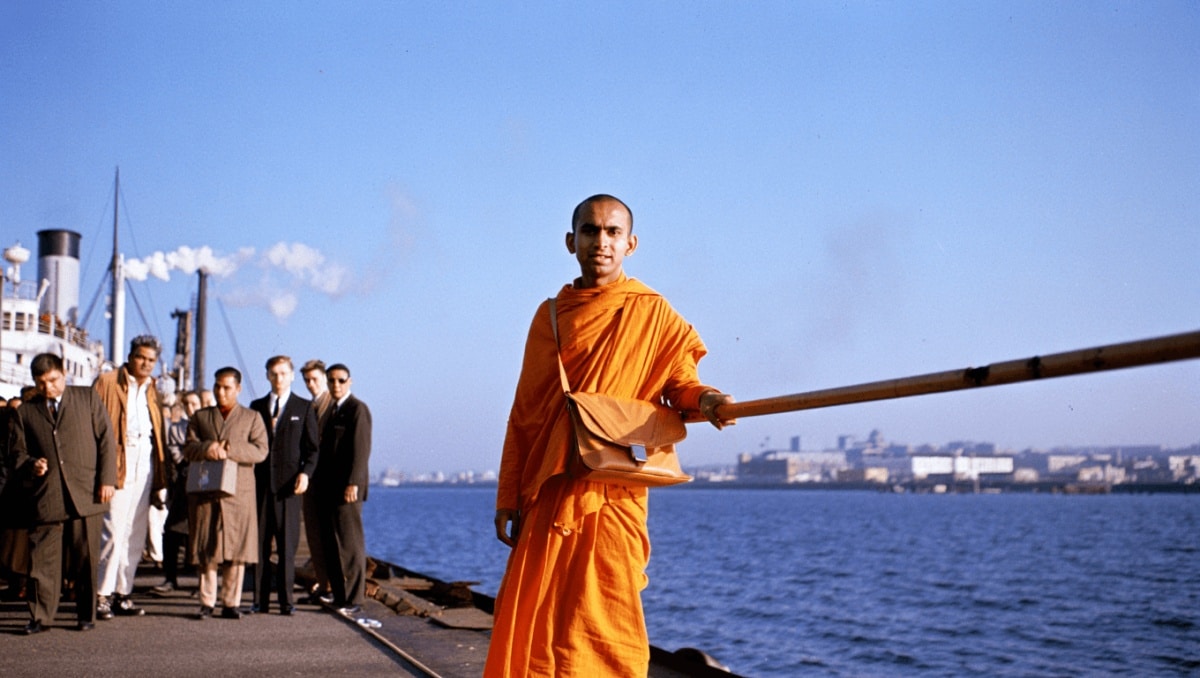
As the United States reaches its 250th year, the arrival of a solitary Indian monk in 1965 helps explain how new religious currents quietly remade the American spiritual map. His ocean crossing and subsequent work seeded a movement that still shapes how many Americans encounter Hindu ideas, devotional practice, and Indian scripture today.
On August 13, 1965, an elderly ascetic boarded the freighter Jaladuta in Kolkata for a month-long voyage to New York. The passenger cabin was spare, the ship built for cargo, and the traveler — A.C. Bhaktivedanta Swami Prabhupada — carried only a small suitcase, some dried food to keep to his strict diet, and trunks of self-translated scriptures and commentaries in English.
Prabhupada’s trip was not an accident of tourism. Decades earlier, a chance meeting with the teacher Bhaktisiddhanta Saraswati had changed his outlook. Where he had once framed his interests through Indian nationalism and cultural pride, that encounter reframed his vocation as spreading the practice of **bhakti yoga** — devotional service to Krishna — beyond regional and political boundaries.
Shah Rukh Khan used the name Abinav to ease in-law worries: Gauri adopted Ayesha during nikaah
Javed Akhtar hails Hindu festivals as cultural glue: throwback of atheist celebrating resurfaces
He spent years preparing in India: teaching, writing an English commentary on key texts and, after the death of his guru, committing to carry the tradition forward in English. Financial setbacks and family responsibilities delayed a full-time focus on the spiritual mission, but as his material pursuits faltered, his religious work intensified. By the time he sailed, he believed he had substantive material to offer Western readers and seekers.
Prabhupada’s Atlantic crossing was physically brutal. He suffered severe seasickness, repeated heart attacks, and bouts of dizziness — yet he continued, buoyed by a personal conviction that his journey was protected and necessary. When the ship reached a Brooklyn pier on September 19, 1965, the man in a simple cotton dhoti and shaved head stepped ashore with no funds and no network in a city that already felt like the center of the modern world.
He built momentum quickly. In the years that followed he founded the International Society for Krishna Consciousness — ISKCON — authored and translated dozens of volumes of scripture and commentary, and established temples and centers around the globe. What began as the effort of a near-seventy-year-old expatriate became an organized movement with a lasting institutional presence.
Why this matters now: the arrival of Prabhupada and the rise of ISKCON illustrate how postwar migration and cultural exchange broadened American religious life. Practices and texts once confined to South Asia entered public view, influencing not only devotees but also wider cultural trends — from vegetarianism and kirtan to scholarly interest in Sanskrit and Vedanta.
At a glance
- Date of departure: August 13, 1965 (from Kolkata aboard the Jaladuta)
- Arrival in New York: September 19, 1965
- Age of the traveler: nearly 70
- Core mission: translating and teaching the Vaishnava devotional tradition in English
- Institution founded: ISKCON, which went on to publish extensive literature and open numerous temples worldwide
Prabhupada’s approach combined disciplined scholarship with accessible outreach. He produced English-language editions of the Bhagavad Gita and other texts, formatted to reach Western readers unfamiliar with Indian religious frameworks. His insistence on clear, plain-English explanation helped lower a linguistic barrier that had kept many South Asian traditions confined to diasporic communities or academic circles.
The movement’s growth had ripple effects. Devotional chanting and temple-centered communities introduced Americans to forms of collective worship that contrasted sharply with the dominant Protestant model. Vegetarian ethics, communal kitchens, and a strong emphasis on scriptural study all entered the public sphere through the work initiated by Prabhupada and his followers.
Today, ISKCON and related Vaishnava institutions operate internationally, with hundreds of centers and an enduring presence in the cultural imagination. Their longevity prompts a larger question about how immigrant religious traditions become woven into national life — not merely tolerated, but practiced, adapted and sometimes transformed by new social contexts.
Prabhupada’s story is one strand in a broader narrative of how America’s religious landscape diversified in the 20th century. As the country marks its 250th year, that diversification — and the communities it produced — are part of the nation’s evolving identity.