Show summary Hide summary
As the United States marks its 250th year, a lesser-known influence on the nation’s spiritual and cultural life is worth revisiting: the arrival of an Indian monk in Chicago in 1893 whose words and work helped open American minds to non‑Christian faiths. That moment—often credited with jump‑starting the interfaith movement—still echoes in how the country talks about religion, yoga, and social reform today.
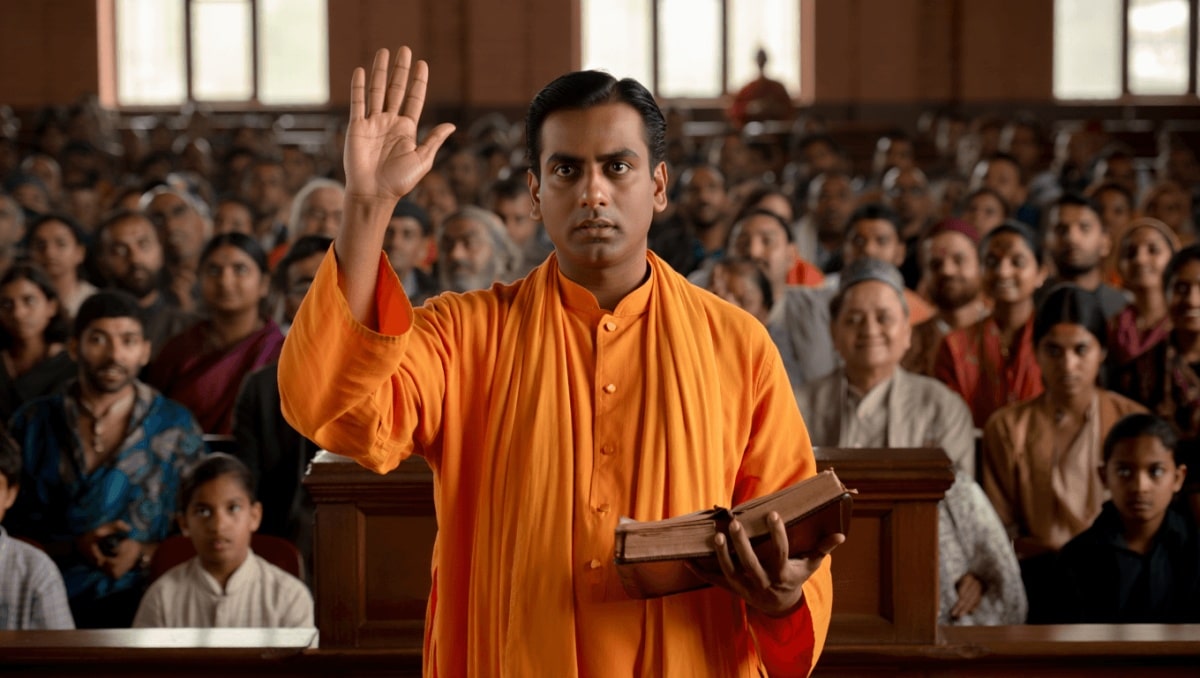
The scene was the inaugural Parliament of the World’s Religions at the Art Institute of Chicago. A 30‑year‑old speaker in saffron robes stepped to the podium and greeted the assembly with a short, direct address that broke with the decorum of previous speakers and drew an immediate, sustained ovation.
A different voice on a public stage
The monk—born Narendranath Datta and later known as Swami Vivekananda—presented Hinduism not as an exotic curiosity but as a living spiritual tradition with moral and intellectual heft. He emphasized tolerance, pluralism, and a practical spirituality rooted in texts and practices that were unfamiliar to most Americans at the time.
Shah Rukh Khan used the name Abinav to ease in-law worries: Gauri adopted Ayesha during nikaah
Javed Akhtar hails Hindu festivals as cultural glue: throwback of atheist celebrating resurfaces
That speech did more than earn applause. It offered a new vocabulary for talking about religious diversity in the United States and helped legitimize comparative religion as a subject of serious public discussion.
From Calcutta classrooms to Chicago’s lecture circuit
Narendranath’s upbringing combined rigorous intellectual training with deep spiritual curiosity. He studied Western philosophy and science in college, while also absorbing Hindu scriptures and teachings. His encounters with the mystic Sri Ramakrishna reoriented him toward a life of practice and service.
After accepting Ramakrishna as his guru and taking monastic vows, Vivekananda traveled across India. He saw poverty and social dislocation firsthand and became convinced that spiritual teaching needed to be accompanied by social action. That conviction shaped both his message abroad and the institutions he later founded.
What he brought to America — and what stuck
Following Chicago, Vivekananda spent months on a lecture tour in the United States, attracting intellectuals, artists, and ordinary citizens to talks on Vedanta, meditation, and ethical action. He founded the Vedanta Society in New York, taught meditation, and authored a concise, accessible guide to meditative practice titled Raja Yoga, which framed yoga as a spiritual discipline rather than merely a set of physical exercises.
On returning to India he established the Ramakrishna Mission, an organization that combined monastic training with relief work. Its model—spiritual formation tied to social service—spread globally and contributed to how religious bodies engage in humanitarian work today.
- Religious pluralism: Vivekananda’s public presence helped normalize the idea that multiple faiths could be legitimate sources of truth.
- Yoga and meditation: His writings and classes reframed practices from South Asia in terms that appealed to Western intellectuals and lay practitioners.
- Interfaith institutions: The Parliament and the Vedanta societies seeded networks that expanded interreligious dialogue in the 20th century.
- Social reform: The Ramakrishna Mission modeled how spiritual organizations could combine contemplative life with organized charity.
These outcomes may seem abstract, but they have concrete downstream effects: the mainstreaming of meditation in healthcare, academic programs in comparative religion, the global spread of yoga schools, and faith‑based nonprofits that deliver social services in diverse communities.
Why this matters in 2026
As the nation reflects on its 250th year, conversations about identity, pluralism, and civic belonging are central. Vivekananda’s example illustrates an early, non‑European influence on American public life—one that encouraged religious tolerance and practical spirituality at a moment of rapid social change. Recognizing this history reframes how we understand the evolution of American religiosity and the roots of today’s spirituality industry.
His arrival in Chicago was not an isolated spectacle but a hinge: it helped shift elite and popular attitudes toward non‑Western traditions, and it set in motion organizations and conversations that persist. For readers interested in the cultural sources behind current debates about religion, wellness, and social responsibility, the 1893 Parliament remains a useful touchstone.
In short, the legacy of that brief appearance and the movement it propelled shows how a single public encounter can alter a nation’s religious imagination—and why those shifts still matter as America charts its next 250 years.