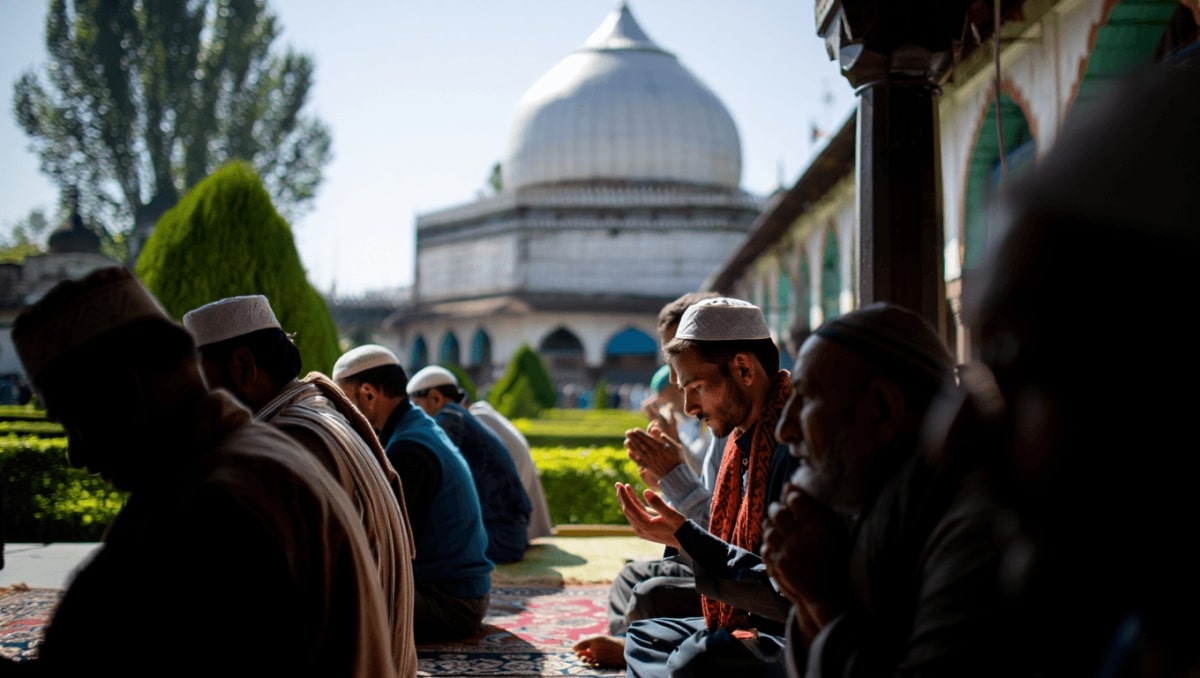
Sitting quietly among worshippers at Srinagar’s Hazratbal Shrine, I watched ordinary prayers unfold in a place that critics say is under siege — a scene that underscored how much of the Kashmir debate is contested reality versus amplified narrative. What happens in Kashmir matters now not only for residents across the valley but for international diplomacy, investment flows, and how democracies like the United States engage with a rising India.
The shrine, which houses a relic many locals revere, felt like any active place of worship: unhurried, routine and densely attended. Armed central police were visible around the city, a reminder that security forces remain a prominent presence. Yet inside the mosque, life proceeded as it often does — a contrast that repeated itself during conversations across neighborhoods, markets and guesthouses.
The backdrop to these everyday scenes is a political earthquake that began in 2019 when New Delhi revoked Article 370, which had granted Jammu and Kashmir a special autonomous status. That decision, combined with the 2019 Pulwama attack and longstanding cross-border rivalry with Pakistan, has reshaped narratives about the region and accelerated investment and security initiatives.
Shah Rukh Khan used the name Abinav to ease in-law worries: Gauri adopted Ayesha during nikaah
Javed Akhtar hails Hindu festivals as cultural glue: throwback of atheist celebrating resurfaces
Visitors and residents I spoke with gave mixed accounts. Some described economic opportunity and a quieter street life; others pointed to the heavy-handedness of counterinsurgency measures, including extended internet shutdowns that disrupted daily life and business. Both impressions are part of the current reality.
Tourism remains visible: houseboats and shikaras on Dal Lake still attract families and travelers from across India, and a handful of foreign visitors. Yet local attitudes toward outsiders are nuanced. Short-term visitors are welcomed; permanent demographic shifts are far less straightforward than some international critics claim.
Return of displaced communities adds complexity. A small number of Kashmiri Hindus — the Kashmiri Pandits who fled violence in 1990 — have come back, often taking posts in education. Their presence is symbolically significant, but numerically limited: only a few thousand have resettled in a region of over ten million people, according to recent reporting. This scale suggests neither mass demographic engineering nor the wholesale erasure of Muslim identity.
Security improvements have reduced routine unrest in many parts of the valley: stone-pelting has declined and large-scale militant strikes have been less frequent since Pulwama. Yet targeted violence persists. Both minority communities and Muslims who oppose separatism remain at risk from militant actors.
Religious dynamics are also layered. Shia Muslims, who form a notable minority, express distinct fears about radical Sunni groups and report instances of intimidation. Local Shia leaders point to a need for clearer protection and political voice, while also noting visible cultural and ideological influences from outside the subcontinent.
Economic signals are telling. After the constitutional change, investment from elsewhere in India has flowed into infrastructure and services. Earlier this year the valley recorded its first sizeable foreign direct investment with a planned mall backed by Gulf capital, a change that locals connect to new jobs and digital work opportunities.
But better roads, malls and megaprojects do not automatically translate into restored political autonomy. Kashmir remains a Union Territory under New Delhi’s administrative control, and promises to reinstate statehood are conditional on a return to “normalcy” — a term that carries political as well as security implications.
Conversations with journalists, local activists, government officials and ordinary residents produced two consistent takeaways: the ground reality in Kashmir is complex and many of the most extreme international claims—framing events as genocide or wholesale ethnic cleansing—do not match everyday observations; and the long-term outcome will depend on the ability of authorities to couple security gains with tangible civic and economic inclusion.
- Security: Reduced mass unrest and fewer large attacks, but persistent targeted violence.
- Demographics: Small-scale returns of displaced Pandits; no evidence of large, immediate population replacement.
- Economy: Growing investment and jobs, including first direct foreign projects, but poverty and unemployment persist in places.
- Civil liberties: Internet shutdowns and heavy security measures remain controversial and have real social costs.
- External influence: Pakistani propaganda and some transnational ideological ties shape parts of the conflict; Iranian cultural influence appears in Shia areas.
For policymakers and observers abroad, the immediate lesson is pragmatic: Kashmir’s future will be won or lost in the valley itself — through policing and courts, but also through schools, jobs and durable political arrangements. Simplified portrayals that treat Kashmiri society as monolithic do a disservice to residents and to international partners trying to assess how best to engage.
That matters to Washington because U.S.-India ties are increasingly strategic, and misreading Kashmir risks clouding cooperation on everything from economic partnerships to regional security. Careful, on-the-ground reporting and sustained diplomatic engagement are essential if outside actors are to help foster stability rather than inflame division.
Ultimately, Kashmir today looks neither like a place liberated nor a place erased. It is a region in transition — a contested mix of normal life and persistent grievances — where the next few years of governance, investment and local reconciliation will determine whether change broadens opportunity or entrenches new forms of alienation.