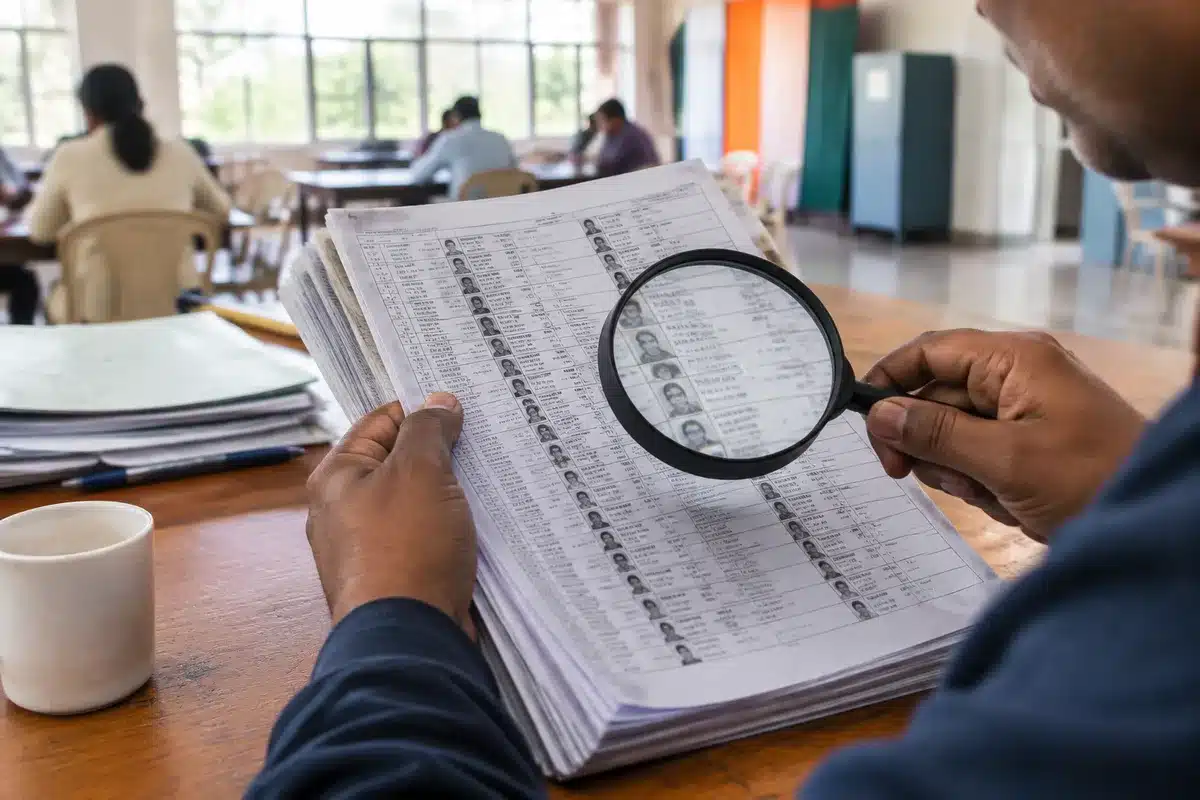
The Uttar Pradesh chief electoral officer on Tuesday pushed back against claims that the state’s voter rolls show deletions concentrated by religion, saying the Election Commission does not collect or publish data broken down by faith or caste. The clarification comes amid a heated political exchange after the publication of the draft electoral roll under the ongoing revision exercise ahead of the 2027 assembly polls.
Navdeep Rinwa told reporters the official voter database contains names, ages, gender, family relationships and house numbers, but no fields for religion or caste. That, he said, makes any official “religion-wise” analysis impossible — a point that directly challenges assertions by political leaders about large-scale removals of Hindu voters and reported increases in Muslim-registration rates after the Special Intensive Revision.
Outside groups and media, Rinwa explained, can still produce apparent religion-based statistics by downloading the publicly available electoral rolls (PDFs), converting them into digital tables and using name-analysis software to infer likely faith from names. Such third-party studies — cited in press coverage of places like Tarabganj, Pilibhit and Kundarki — are not the same as official Commission data.
EC has no voter breakdown by religion, UP CEO says: Yogi and Akhilesh trade barbs
Keerthy Suresh says she misinterpreted Radhika Apte’s muraimaaman comments: urges cultural respect
Why apparent discrepancies appear, and what they do — and do not — mean:
- Official limits: The Election Commission only releases age- and gender-wise figures from its database; it does not provide or verify religion- or caste-based breakdowns.
- Third-party inference: Researchers can convert published electoral rolls into datasets and apply algorithms that assign probable religious affiliation by name; such methods carry uncertainty and are not endorsed by election authorities.
- Population vs. registration gap: A shortfall of about 2.58 crore between Uttar Pradesh’s projected adult population and registered voters reflects under-registration as well as removals — it does not automatically point to mass deletions.
- Local investigations: Booth-level verification often finds routine causes for mismatches — deaths, migration, marriages, or registrations at neighbouring polling stations — as well as people who were never registered in the assembly roll.
Rinwa illustrated the distinction with a ground-level example from Rae Bareli’s Makhdumpur gram panchayat. Officials compared the panchayat electoral list with the assembly roll and found 1,987 names on the local list but only 1,539 on the assembly list. A subsequent door-to-door check — prompted by a public interest petition — turned up a variety of reasons for the gap and identified 92 eligible residents who had simply never been registered for the assembly list. Election workers then helped those people file Form-6 applications to be added.
The CEO said district-level reports show no evidence of a systematic programme to exclude voters on the basis of religion, caste or community. At the same time he acknowledged a sizeable pool of eligible adults remains unregistered: current estimates put coverage at roughly **84–85%**, leaving significant numbers to be enrolled.
For the immediate future, officials say the Special Summary Revision for 2027 will intensify outreach and verification to identify and register eligible citizens ahead of the assembly elections. That effort, Rinwa argued, involves not just election staff but active co-operation from citizens, booth-level officers and political parties to close the registration gap.
What this means for voters and politics now: claims based on inferred religious trends should be treated cautiously unless backed by Commission-sanctioned data; gaps between population estimates and the electoral roll are often explained by administrative and demographic factors, not always by removals; and the success of the SSR 2027 will be measured both by how many names are added and how transparently discrepancies are explained by officials.