Show summary Hide summary
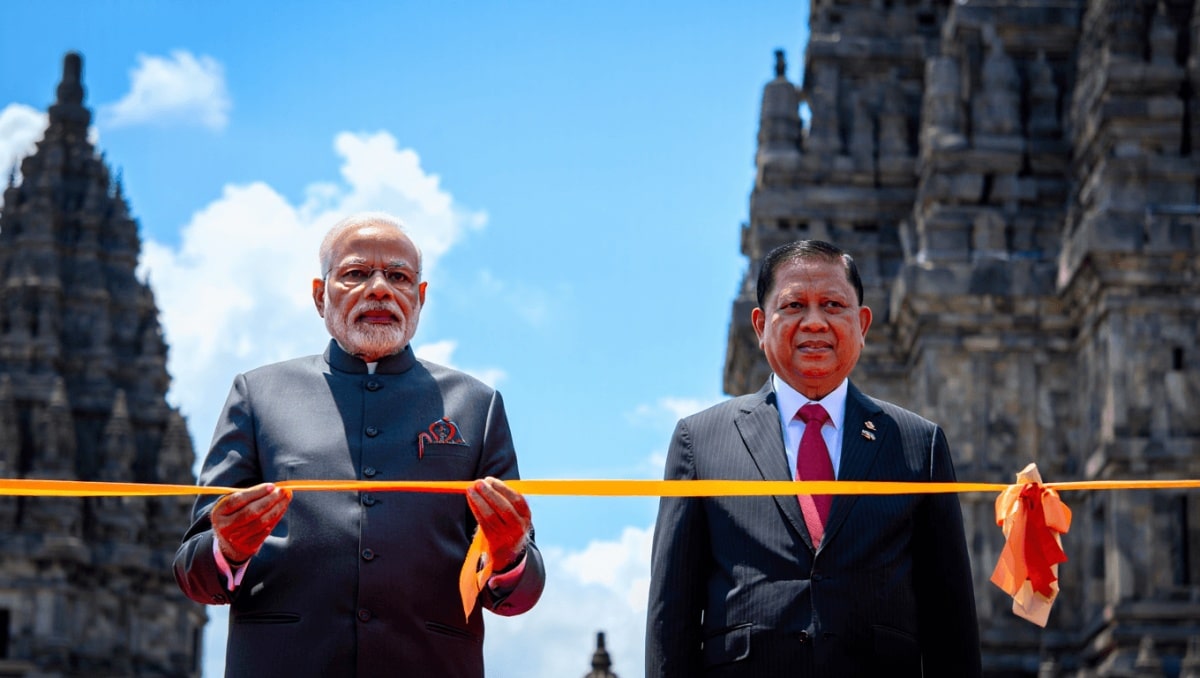
On July 8, 2026, Prime Minister Narendra Modi and Indonesian President Prabowo Subianto jointly opened a restoration project at the 9th-century Prambanan temple complex, a sweeping effort led by the Archaeological Survey of India (ASI). The move is more than conservation work: it is a deliberate act of cultural diplomacy that reconnects two nations to a common historical landscape — and raises questions about why India is taking the lead in rebuilding a monument more than 5,000 kilometres from its capital.
The site and its significance
Prambanan rises on Java as one of Southeast Asia’s finest Hindu monuments. Built around 850 CE for the Mataram Kingdom, the complex is dominated by three principal towers dedicated to the Trimurti — Brahma, Vishnu and Shiva — with the Shiva shrine reaching roughly 47 metres. Relief panels along the inner walls do not merely allude to the Ramayana; they render long passages of the epic in stone, carved with intimate familiarity.
CAA urgency spikes after South Asia unrest: what citizens need to know
Glass shard in school snack sparks probe: book from another faith fuels parent outrage
Over centuries the compound fell into disuse as political centers shifted and natural disasters took their toll. Modern conservation began in the 20th century, and a powerful earthquake in 2016 exposed lingering structural fragility. The ASI’s new role is therefore technical as well as symbolic: conservation teams plan to reconstruct parts of the complex by reassembling original fragments, not by wholesale replacement.
Why India is involved
At first glance the choice seems diplomatic: a high-profile Indo-Indonesian project that cements bilateral ties. But the roots run deeper. The Indonesian archipelago absorbed ideas, languages and religious practices from the Indian subcontinent for over a millennium. Elements such as the national emblem Garuda, Sanskrit-derived vocabulary and the prominence of the Ramayana in local culture show a historical continuity rather than borrowed ornament.
Restoration as long-term diplomacy. Heritage projects have become one of India’s subtle but enduring tools overseas, operating alongside trade, defense and maritime engagement. A refurbished temple remains visible for centuries, a permanent reminder of cooperation even as governments and policies change.
Technical capacity matters. The ASI brings specialist experience — previously deployed at sites from Angkor Wat to My Son and Bagan — and prefers anastylosis, the method of rebuilding from original masonry. Indonesian authorities have signalled openness to using digital tools, including AI, to match scattered stone blocks and conserve the broader archaeological landscape around Prambanan, Sewu and Plaosan.
A regional pattern
India’s conservation footprint in Asia is not new. In recent decades the ASI and Indian funding have contributed to restorations in multiple countries, forming a recognizable pattern of cultural outreach:
- Cambodia — long-term work at Angkor Wat and related sites.
- Laos — phased restoration of Vat Phou.
- Vietnam — conservation efforts at My Son, the Champa sanctuary.
- Myanmar — post-quake repairs and rebuilding at Bagan.
- Nepal — multi-site reconstruction following disasters.
- Sri Lanka, Bahrain, Bangladesh — targeted grants and redevelopment of historic Hindu sites.
Seen together, these projects make Prambanan less an isolated donation and more a continuation of India’s role as a regional custodian of shared cultural heritage.
Visiting Prambanan: what travellers should know
Prambanan is not only a monument to view at a distance. Since a 2022 agreement restored ritual use of the complex, the site functions again as a living temple where local Javanese and Balinese Hindu communities conduct worship.
Location and nearby sites. The complex sits near Yogyakarta, making it a compact hub of sacred architecture. Within easy reach are the Buddhist Sewu complex, the twin temples of Plaosan, the hilltop remains of Ratu Boko and, about 40 km away, Borobudur — the world’s largest Buddhist monument.
Transport and timing. Most international visitors connect to Yogyakarta via Jakarta, Kuala Lumpur or Singapore. The dry season (April–October) offers the best weather and coincides with performances of the Ramayana Ballet staged beside the lit towers on select evenings.
Entry and ceremony. Darshan and informal personal prayer at the main shrines are part of a normal visit; worshippers may buy simple offerings on-site. For more formal puja participation, local priests or guides typically accept a small dakshina in lieu of fixed fees.
Major observances to plan around
- Maha Shivaratri — Prambanan hosts month-long Shiva observances culminating in intense night worship and ritual chanting; an especially meaningful moment for devotees.
- Tawur Agung Kesanga and Nyepi — pre-New Year rites and a day of silence; note that the complex closes for Nyepi itself.
- Galungan and other Balinese-Hindu calendar festivals — periodic events that animate the shrine through the year.
- Vesak (Waisak) — at Borobudur, an important day for Buddhist pilgrimage with candle and lantern ceremonies.
Etiquette is straightforward: dress modestly, follow the congregation’s lead in rituals, and treat active worship as the primary experience rather than a photo opportunity.
Practical cost guide (5-day sample itinerary from Delhi)
The figures below are indicative for 2026 and intended as a planning reference. Prices change with seasonality and exchange rates; always reconfirm before booking.
- Return air travel (Delhi–Yogyakarta, one stop): ₹40,000–₹55,000
- Visa on arrival: ~₹2,600 (IDR 500,000, 30 days)
- Accommodation (4 nights, twin-share, mid-range): ₹14,000–₹20,000
- Private car with driver (2–3 days, shared): ₹8,000–₹12,000 per person
- Prambanan entry (foreign visitor): ~₹2,150 (IDR 400,000)
- Borobudur entry (ground level): ~₹2,500 (IDR 455,000)
- Ratu Boko and Ramayana Ballet: ₹2,000–₹3,500
- Pujas, offerings and spiritual participation: ₹1,500–₹5,000
- Meals (5 days): ₹4,000–₹8,000
- Local transport, tips, shopping: ₹5,000–₹8,000
Estimated total per traveller: roughly ₹82,000–₹120,000 for a five-day trip; lower-cost options and shared logistics can reduce the budget toward ₹60,000–₹78,000.
The wider meaning
When artisans and conservators fit Prambanan’s stones back into place, they will be repairing more than walls. They will be restoring a set of cultural memories: epic narratives carved in relief, ritual forms alive in local practice, and a visual language that once linked distant shores.
For India, the project reads as remembrance rather than mere foreign aid. For visitors — especially those tracing devotional routes — Prambanan offers an unusual experience: a temple built in the Indonesian heartland in which the gestures, stories and ritual echoes feel unexpectedly familiar.
Practical note: details and costs are current as of 2026 and should be checked again before travel.