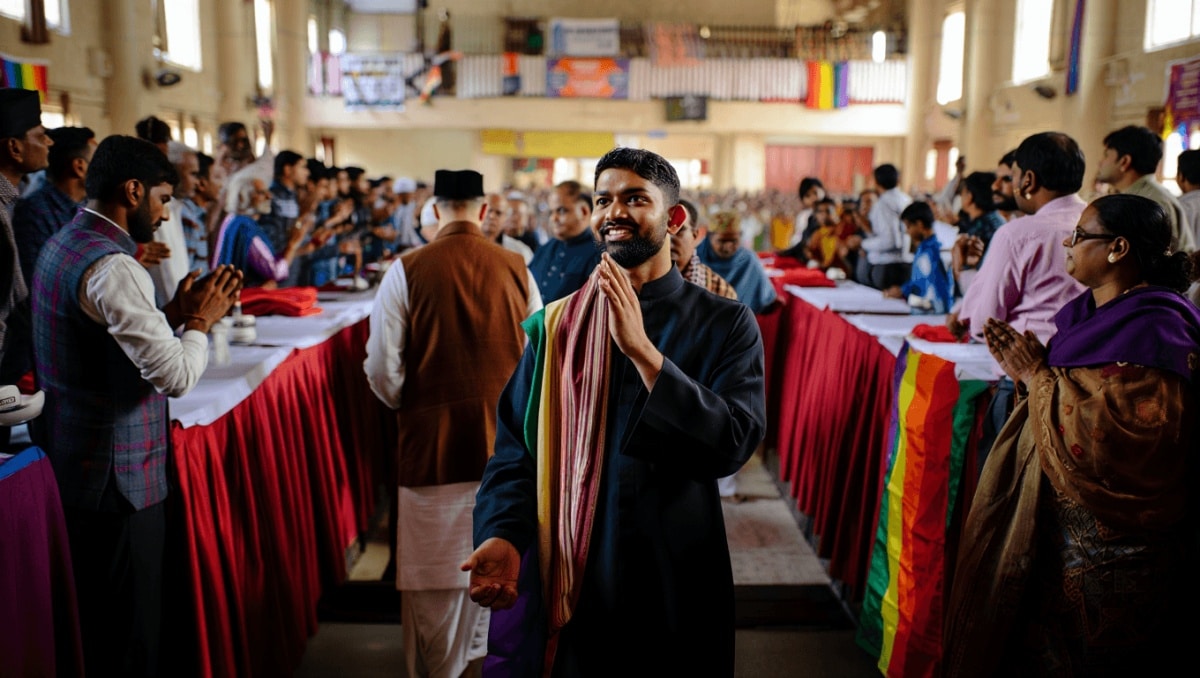
At a crowded hall in Madhapur this week, Pride Month took on a different shape: an interfaith gathering that deliberately threaded conversations about religion, caste, disability and gender into LGBTQIA+ life. The Interfaith Pride Fest 2026, hosted by Rubaroo and Dragvanti, positioned those intersections as urgent — and practical — concerns for activists and everyday people alike.
The evening mixed performances, storytelling and panel talks to probe how identity and exclusion overlap in India today. Participants said the goal was not only celebration, but also recovery and reckoning: finding the queer histories that have been sidelined, and naming the barriers that still shut people out.
Aeina, a non-binary artist who trains in classical Kathak, told the audience that many queer narratives are already present within spiritual traditions but have been erased over time. Their performance and remarks aimed to reintroduce those threads rather than separate faith from queer life.
Shah Rukh Khan used the name Abinav to ease in-law worries: Gauri adopted Ayesha during nikaah
Javed Akhtar hails Hindu festivals as cultural glue: throwback of atheist celebrating resurfaces
The programme included a session titled Faith Across Caste, which examined how religious belonging and caste identities combine to shape exclusion. Deepti, one of the speakers, said young people she knows are increasingly sceptical about religion because they mostly witness exclusionary practices rather than inclusive ones.
“When caste and religion are the frameworks for exclusion, the conversation is really about power,” Deepti said, arguing that addressing caste and religious hierarchies is also about dismantling uneven access and privilege across society.
Accessibility was another central focus. Priya, who has achondroplasia, described the persistent practical challenges of reaching and using public spaces. She said accessibility remains an often-discussed topic that rarely translates into accessible venues or transport, leaving many excluded from events and services.
Phoenix, a non-binary activist working at the intersection of queer rights, mental and sexual health, emphasized the role of community networks. They described mutual care — sharing food, holding space for grief and joy — as the primary strategy for survival and progress.
- Intersectionality mattered: Faith, caste, gender and disability were treated as overlapping drivers of inclusion and exclusion.
- Recovery of histories: Artists and speakers highlighted forgotten queer stories found within religious traditions.
- Practical barriers: Accessibility gaps remain wide, affecting participation and visibility.
- Collective action: Community solidarity was presented as both a refuge and a political force.
The festival’s tone was steady rather than polemical. Panels and performances alternated, giving space to both policy-minded critique and personal testimony. That balance helped make structural problems — like caste-based exclusion or inaccessible infrastructure — feel immediate, not abstract.
For readers, the takeaway is twofold. First, Pride in 2026 in Hyderabad is being reshaped into an explicitly intersectional movement: celebrations now sit beside debates about who facilities serve and whose histories are remembered. Second, the conversations point toward concrete changes communities and institutions could pursue, from enforcing accessibility standards to broadening religious narratives to include marginalized identities.
On stage and off, the message returned to self-worth and solidarity. Aeina urged queer people to accept themselves and to hold respect for others as part of everyday practice. In a city where public life still excludes many, those small acts of recognition and collective support may be as consequential as any policy change.