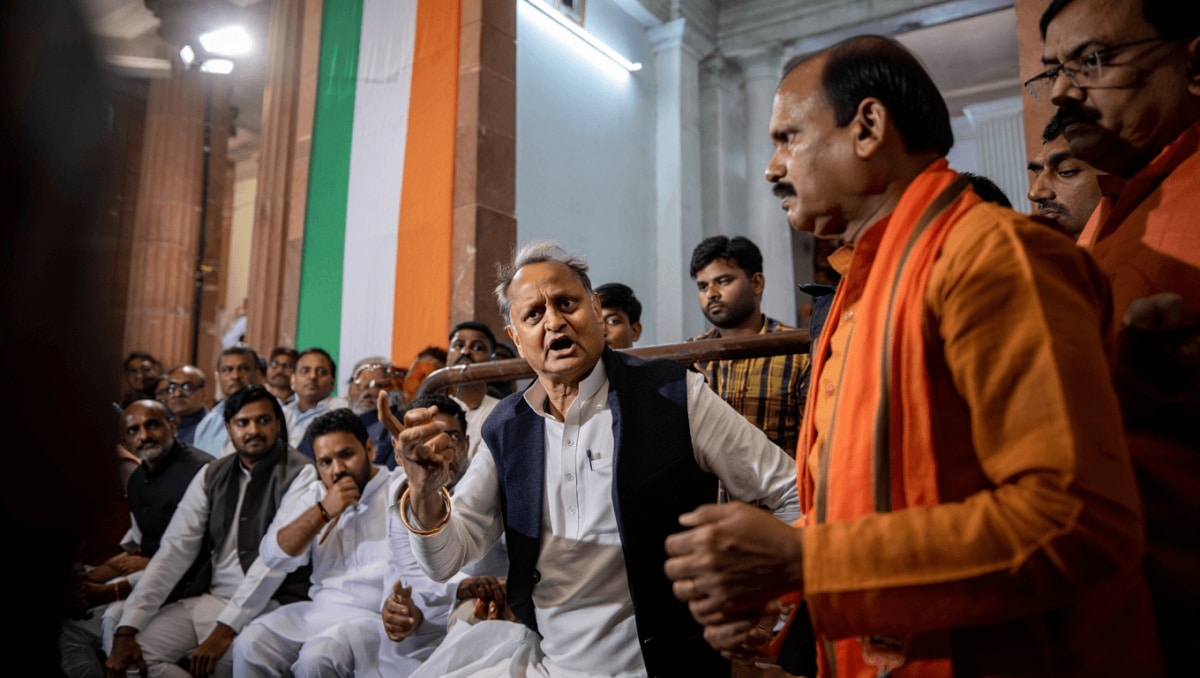
Former Rajasthan chief minister Ashok Gehlot’s remark that former prime minister Indira Gandhi would have acted against today’s ruling party has set off a sharp exchange between Congress and the BJP, underscoring how sensitive references to religion and state power remain in current Indian politics. The dispute — voiced publicly in Jaipur on Monday — highlights immediate stakes for debates over Hindutva, party conduct and democratic norms.
Speaking at an event in Jaipur, Gehlot suggested that a leader of Indira Gandhi’s stature would not have tolerated a party that, in his view, bases its politics on religion. He argued that the Constitution does not allow political activity framed in religious terms, a line that re-opened questions about the role of faith in public life.
The BJP responded swiftly. Party officials framed Gehlot’s comments as revealing more about the Congress’s disposition than about their own conduct. Amit Malviya, who leads the party’s social media strategy, described the remark as evidence of what he called the Congress’s recurring tendency toward authoritarian responses to political opposition. Another BJP spokesperson, Shehzad Poonawalla, accused Congress figures of adopting a mindset similar to the emergency period, saying the comments betrayed intolerance toward expressions of Hindu identity.
Shah Rukh Khan used the name Abinav to ease in-law worries: Gauri adopted Ayesha during nikaah
Javed Akhtar hails Hindu festivals as cultural glue: throwback of atheist celebrating resurfaces
- When: Monday, at a Jaipur public event.
- What was said: Gehlot argued a past leader like Indira Gandhi would have banned a party that centres politics on religion.
- Immediate reaction: BJP leaders rejected the claim and characterised it as proof of Congress’s alleged authoritarian instincts.
- Broader issue: The exchange returns the spotlight to the constitutional question of religion’s place in politics and the boundaries of party rhetoric.
Political and legal implications
Even without new legislation or legal action, the episode matters because it intensifies a national conversation about the limits of political speech, religious identity in campaigning and the safeguards of the Constitution. References to bans or state action against parties can quickly inflame partisan debate and shape electoral messaging.
The controversy may also affect how both parties position themselves to voters. For the BJP, pushback is framed as defending democratic legitimacy and the right to advocate for cultural or religious themes in public life. For Congress leaders, the remarks are presented as a warning about the dangers of mixing religion and electoral politics — an argument aimed at voters who prioritise secular governance.
| Actor | Position |
|---|---|
| Ashok Gehlot / Congress | Suggested a leader like Indira Gandhi would have taken action against a party grounded in religion; warned the Constitution does not permit politics based on religion. |
| BJP | Rejected the claim, calling it an indication of Congress’s alleged authoritarian instincts and accusing the party of intolerance toward expressions of Hindu identity. |
What happens next is likely to be a continuation of public statements and social media rebuttals rather than immediate legal consequences. Still, the exchange sharpens a fault line in Indian politics: how parties present religion to voters and how opponents characterise those presentations.
Watch for follow-up comments from national Congress leaders and any formal clarification from Gehlot’s office. With the issue now in the open, it will be a touchstone for debates on secularism, party behaviour and democratic norms in the coming days.