Show summary Hide summary
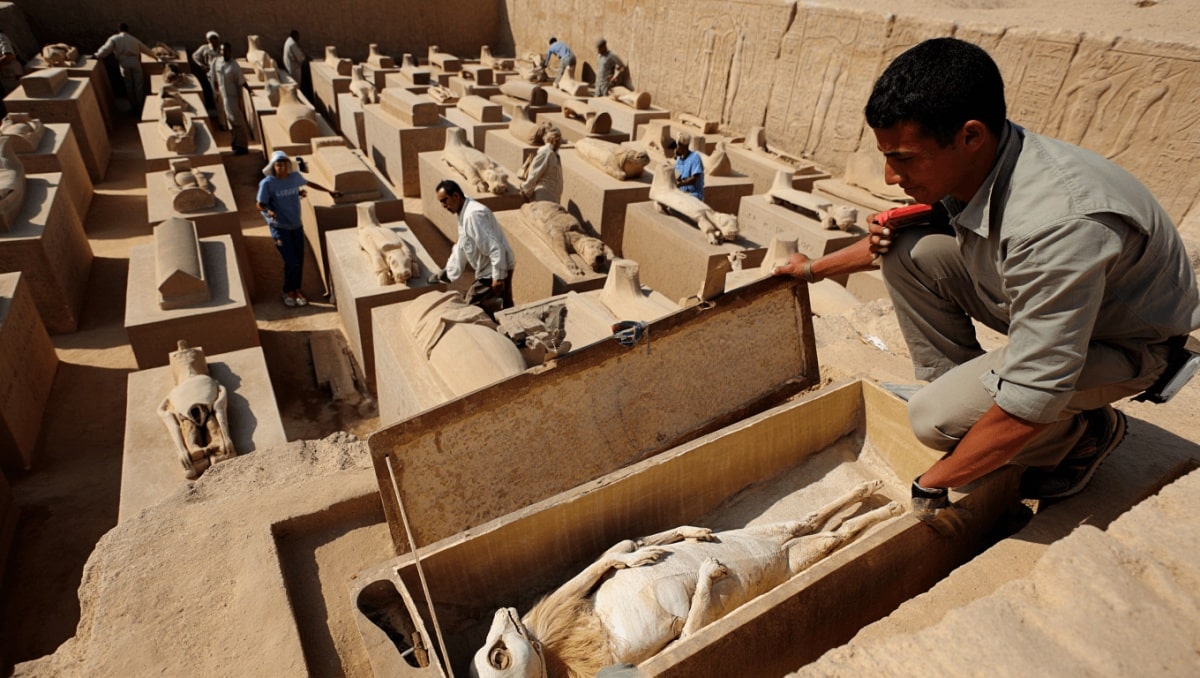
New fieldwork at Saqqara has begun to change how archaeologists view animal worship and burial in ancient Egypt. Excavations and surveys are revealing that the underground funerary architecture extends far beyond the famous Serapeum and contains mass interments of a variety of sacred species.
What this means now: the finds reshape the scale and complexity of animal cults, suggesting a long-term, institutionalized system for consecrating and interring animals that played key roles in Egyptian religion.
Archaeologists working at the necropolis report a maze of chambers and passages carved beneath the desert surface. While the Serapeum — long known as the repository for the sacred Apis bulls — remains a prominent feature, recent work is uncovering parallel galleries and caches filled with other consecrated creatures.
Shah Rukh Khan used the name Abinav to ease in-law worries: Gauri adopted Ayesha during nikaah
Javed Akhtar hails Hindu festivals as cultural glue: throwback of atheist celebrating resurfaces
Among the best-documented new discoveries are extensive ibis burials. Thousands of ibis bones and carefully placed offerings indicate ritualized treatment on a scale previously unappreciated, pointing to a dedicated infrastructure for animal cults rather than incidental or isolated burials.
Scale, species and ritual practice
The emerging picture is one of institutional burial grounds designed for repeated, long-term use. Some chambers appear to have been reopened and reused over centuries, while adjacent corridors may have served processional or storage functions. The evidence implies central coordination—possibly linked to temple administrations that managed animal breeding, cult performance, and funerary rites.
Species identified in the deeper complexes so far include the sacred Apis bulls and large numbers of ibis, but traces of other animals associated with specific gods also appear. The burial protocols—for example, wrapping, placement, and associated votive goods—show standardized practices rather than ad hoc disposal.
- Expanded footprint: New galleries extend beyond the traditionally mapped Serapeum area.
- Mass interments: Large concentrations of ibis remains alongside Apis burials suggest parallel cultic pathways.
- Organized reuse: Stratigraphy and repeated deposits indicate long-term ritual scheduling.
- Religious economy: Findings hint at coordinated breeding and sacrificial systems sustained by temples and local institutions.
These revelations alter how scholars interpret the social and economic investment in animal worship. Rather than small-scale votive offerings, the burial complexes imply significant resources devoted to maintaining divine animals as living symbols, then treating them with formal funerary rites when they died.
For modern audiences, the discoveries carry several practical consequences. They add pressure on heritage authorities to prioritize conservation of subterranean spaces that are now understood to be more extensive than maps suggested. They also broaden the narrative museums and educators use to explain the relationship between humans and animals in ancient religious life.
What archaeologists still need to answer
Key questions remain. How were animals sourced and managed across regions? Which institutions funded and controlled these mortuary systems? How did practices change over time and in response to political or economic shifts? Ongoing analysis of bone assemblages, associated artifacts, and stratigraphy will be central to answering these points.
In the short term, researchers are prioritizing detailed recording, targeted conservation, and non-invasive surveys to trace the full extent of the underground network. As the project continues, new publications and museum displays are likely to update public understanding of Saqqara’s role in shaping animal cults across millennia.
The upshot is clear: the subterranean landscape beneath Saqqara is not just a single monumental tomb but a complex, evolving mortuary system that reflects the depth and longevity of animal-centered devotion in ancient Egypt.