Show summary Hide summary
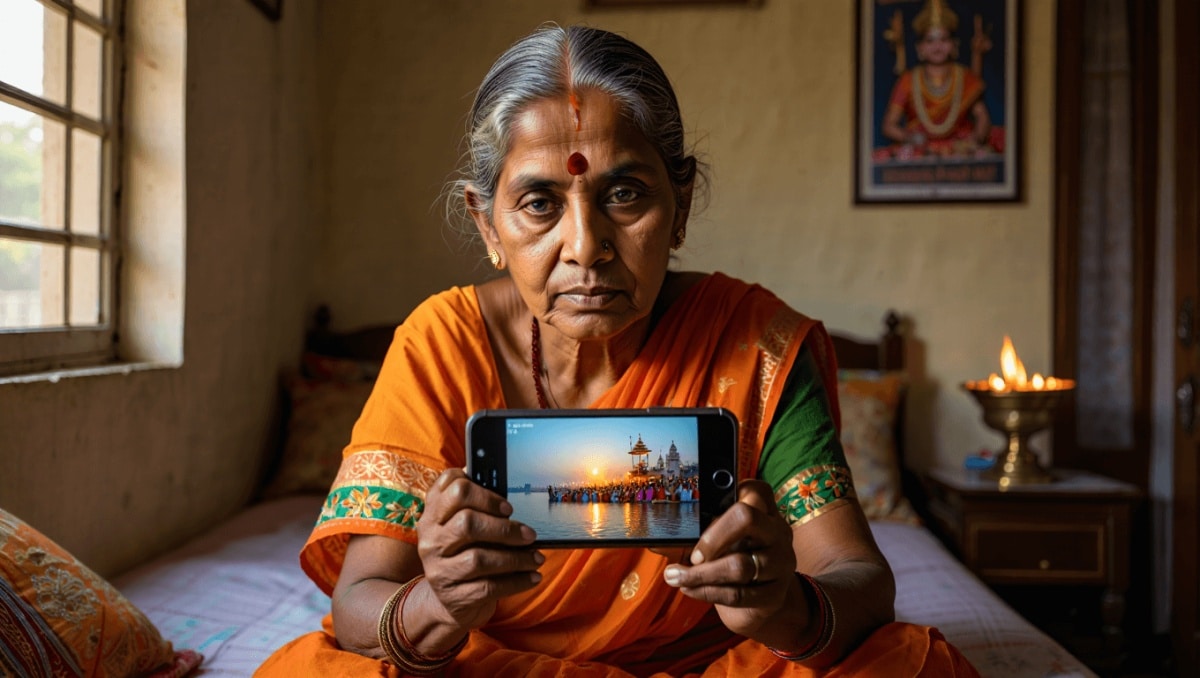
A scene in a Patna living room captures the shift: a 72-year-old woman, unable to travel to Varanasi, watches the morning Ganga Aarti on her phone, types a question in Bhojpuri and moments later receives a translated verse and a spoken explanation on screen. She may not call it “AI,” but the answer arrives — and that immediacy is changing how millions practise faith in India today.
Why this matters now
India’s religious market is moving rapidly online, reshaping ritual practice, pilgrimage and temple economics just as mobile internet reaches deeper into small towns and villages. The organised portion of the faith economy is already valued in the tens of thousands of crores and is expanding at double-digit rates; the implications touch donors, priests, overseas communities and the platforms that connect them.
Annamalai applauds Bhagwat’s message on Muslim inclusion in India
Navratri in Times Square goes viral: social media splits over Indian celebrations abroad
The scale and the drivers
Measured conservatively, the broader faith economy sits around $58 billion, with the organised sector accounting for several thousand crores of rupees and projected to grow substantially by the end of the decade. Four broad trends explain the momentum.
1. Smartphones in every pocket. Rural and semi-urban handset adoption surged during the last half decade. What were once foot journeys to shrines are now a tap away.
2. A pandemic-era habit that stuck. Lockdowns forced live-streams and remote rituals into daily life. The spike in demand for virtual darshan and online poojas did not retreat once domestic travel resumed.
3. Young users monetise devotion. Platforms report that a large share of revenue comes from users in their mid-20s to mid-30s — people who blend digital lifestyles with faith practice and are willing to pay for convenience and curated experiences.
4. A global diaspora market. Tens of millions of Indians abroad now expect to sponsor ceremonies, receive prasad or book priests back home from their living rooms. That steady cross-border demand is a major revenue source.
How platforms are organising faith
Three types of digital services have emerged as central nodes: comprehensive consumer apps, provider-facing marketplaces, and AI-driven guidance systems. Each plays a different role in converting tradition into a structured, payable service.
- End-user super-apps — combine temple discovery, ritual streaming, bookings and curated yatra packages in one interface. These aim to be a one-stop spiritual marketplace.
- Provider platforms — help priests, guides and ritual specialists list services, accept secure payments, manage schedules and collect verified reviews.
- AI and scripture engines — use language models trained on classical texts to deliver contextual responses, ritual explainers and itinerary planning in regional languages.
What these apps offer — a practical look
Across the leading services you will find similar building blocks, shaped for different users. Core features commonly include:
- GPS-enabled temple discovery with practical details such as darshan times, queue estimates and dress-code notes.
- Verified priest and astrologer listings bookable by language and specialisation.
- Curated pilgrimage planning, from budget circuits to premium, end-to-end luxury yatras.
- Live-streamed aartis, bhajan libraries and festival-specific audio for daily practice.
- AI-powered Q&A rooted in scripture, multi-language voice interaction and senior-friendly navigation.
Platforms differ in emphasis: some prioritise scale and temple partnerships, others monetise through high-end concierge services aimed at affluent devotees and NRIs. A growing number combine both approaches.
Money, models and microeconomies
Revenue strategies mirror the recurring nature of religious practice. Typical monetisation channels include:
- Freemium access with premium tiers for private darshan streams and exclusive consultations.
- Monthly subscriptions for devotional content and daily rituals.
- E-commerce for sacred goods, from textiles to ritual implements.
- Integrated donations via UPI and cards that simplify giving across borders.
- Luxury concierge services targeting high-net-worth customers seeking private darshan, helicopter transfers or curated heritage stays.
Platforms and players
A number of startups and established organisations now form a connected ecosystem. Consumer-facing super-apps and specialised marketplaces coexist with scripture-focused chatbots and institutional initiatives that deploy AI to shape outreach. Each node adds capacity: temples can reach donors globally, priests can build a wider client base, and devotees gain more ways to participate remotely.
Ethical and cultural questions
These advances raise hard questions that require public scrutiny.
Is virtual darshan equivalent to a temple visit? Many traditionalists say no: the multi-sensory, communal energy of a physical shrine cannot be fully reproduced. Digital offerings generally present themselves as a supplement, not a surrogate.
Can AI interpret sacred texts responsibly? Automated systems risk flattening nuance. The central challenge is to use technology to increase access without substituting for learned human interpretation; the most careful products position AI as a first port of reference, not the final authority.
Who falls through the cracks? Despite rapid rollout, unequal connectivity and digital literacy gaps mean elderly, poorer and remote communities may be slower to benefit. Design choices — regional languages, voice interfaces and simplified UIs — matter for inclusion.
Whose traditions are being digitised? At present, much of the activity is concentrated around Hindu practices. Extending similar infrastructure in culturally sensitive ways to other faiths remains both an ethical duty and a business opportunity.
What’s next
Expect practical innovations rather than abstract experiments. Wearables could offer discreet, context-aware devotional prompts; augmented and spatial reality may make remote presence feel more immediate; and AI may play a role in grief support and end-of-life ritual planning, where guidance is most needed but practitioners are scarce.
Cross-border cultural export is another frontier: Indian spiritual content already attracts global curiosity, and platforms are preparing multilingual and localized offerings for new audiences in Europe, Latin America and beyond.
A final note
Technology is not replacing centuries of practice; it is reshaping the ways those practices are transmitted and sustained. For many devotees the result is greater accessibility — for priests and guides it is a pathway to livelihood formalisation — and for the diaspora it offers a tangible link to home. Digital faith is converting ritual act into a set of services, and that conversion has consequences both practical and profound.
The faith-tech wave brings convenience and new revenues, but it also requires continued attention to authenticity, equity and cultural sensitivity if it is to serve the plural, lived traditions of India responsibly.