Show summary Hide summary
As the United States marks its 250th year, everyday encounters with religious imagery reveal how much remains unknown about immigrant traditions. One common question — why Hindu gods are often shown with extra arms or multiple heads — matters now because these images carry layered meanings that shape how millions of Americans understand (or misunderstand) a living faith.
At a recent local Hindu festival I attended, curiosity about a particular deity’s iconography resurfaced again. Explaining those symbols helps more than satisfy idle interest: it offers a practical way to reduce cultural distance and to see why such images still resonate, both spiritually and intellectually, across continents.
Why a dance?
The figure known as Nataraja — Shiva in his form as the cosmic dancer — expresses a worldview in which the universe itself is rhythmic motion. Unlike a painting or a piece of music that can be observed from a distance, dance requires a living performer; that immediacy becomes a metaphor for the belief that the divine and the world are inseparable.
Annamalai applauds Bhagwat’s message on Muslim inclusion in India
Navratri in Times Square goes viral: social media splits over Indian celebrations abroad
For many Hindus, the goal of life is not simply reward in an afterlife but liberation — a direct, experiential realization of the self beyond ego. Presenting the divine as a dancer captures both the dynamic processes of the cosmos and the possibility of transcending them.
Fire, time and balance
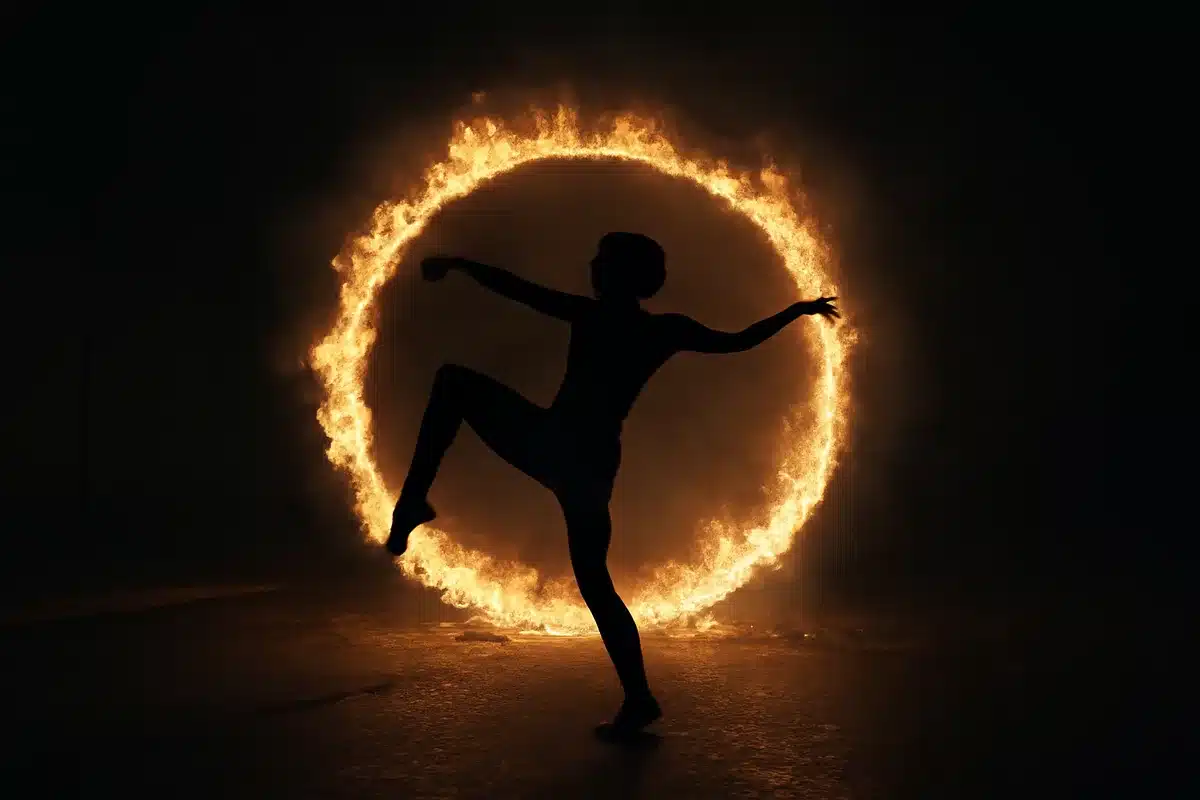
Nataraja is typically placed inside a circular halo of flames called the prabha mandala. That ring represents cyclical time — an unending sequence of formation, maintenance and dissolution — rather than a single linear history.
Inside that cosmic frame, different elements of the posture and attributes each point to a key concept in Hindu thought. Below is a concise guide to the five ideas often read into the image:
- Srishti — creation: the small drum (damaru) in the upper right hand symbolizes the primordial sound or vibration that brings the world into being.
- Sthiti — preservation: the lower right hand often shows the abhaya mudra, a gesture of protection and reassurance that sustains the cosmos.
- Samhara — destruction: the upper left hand holds a flame (agni), signifying the transformative aspect of dissolution that makes renewal possible.
- Tirobhava — veiling or illusion: the dancer’s right foot often presses down on a dwarf figure representing the ego or ignorance, indicating how ordinary perception obscures ultimate reality.
- Anugraha — grace and release: the raised left foot, together with a hand that gestures toward it, points to the possibility of liberation (moksha) offered by spiritual insight.
These motifs operate on symbolic, philosophical and practical registers simultaneously. For example, the image of creation as sound has attracted modern thinkers who draw parallels between classical metaphors and discoveries in physics; a bronze Nataraja now stands at CERN in Geneva as a nod to those resonances between ancient symbolism and contemporary science.
Other details carry complementary meanings: a serpent coiled around the figure may signify both dangerous impulses and the dormant spiritual energy called kundalini; the differing earrings on each ear hint at fluidity in gender and the divine’s capacity to transcend singular identities.
Reading these symbols matters because they are not static museum pieces. They appear in festivals, family altars and public art, and they shape how millions of people experience ritual, community and meaning. Misunderstanding the images risks reducing complex traditions to exotic curiosities — a subtle form of cultural distance that becomes more consequential as Hindu communities grow and participate in public life.
Encountering a Nataraja at a local celebration can be an entry point: a chance to ask questions, follow the details and, in the process, learn why a figure with many arms is not an oddity but a condensed visual language about life, death, balance and the path beyond both.