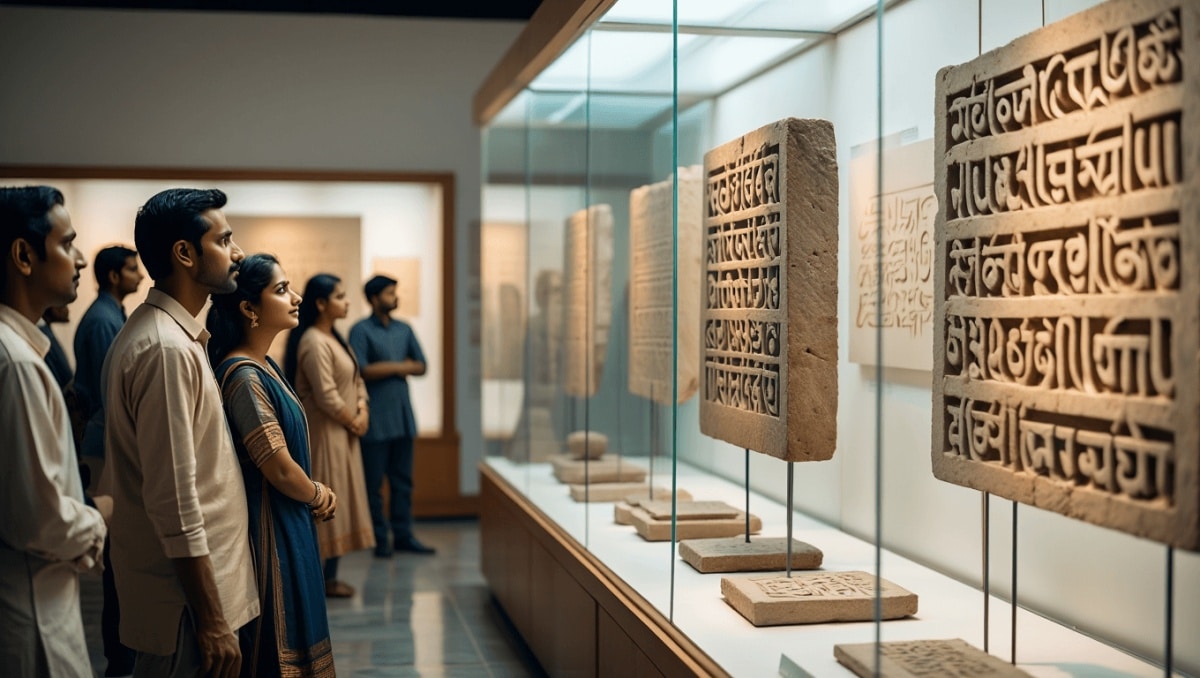
The Indian Museum in Kolkata opened a new exhibition this week that places ancient inscriptions and modern art in conversation, drawing attention to ethical ideas that have shaped the subcontinent for millennia. By pairing contemporary calligraphy with rare epigraphic finds, the show argues that long-standing moral concepts remain relevant to cultural life and public discourse today.
The project, titled Mā Lipi: Virtues of Bhārat in Brāhmī, presents a series of original calligraphic pieces by Nilanjan Bandyopadhyay that interpret the 26 virtues listed in chapter 16 of the Bhagavad Gītā. Those modern works are executed in Aśokan Brāhmī, the earliest fully deciphered script of South Asia and the ancestor of many regional writing systems.
The exhibition deliberately pairs these new artworks with archaeological objects from the museum’s collection to create a visual and historical dialogue. The aim is not only aesthetic: curators seek to show how script, inscription and ethical teaching intersect across time.
Hinduism gains ground in Africa: new communities reshape culture and commerce
Shah Rukh Khan used the name Abinav to ease in-law worries: Gauri adopted Ayesha during nikaah
Key items on display
- Mahasthangarh plaque — A Mauryan-period inscription from eastern Bengal often cited as some of the earliest written evidence in the region; presented here for its governance-related content.
- Eran stone inscription — An epigraphic record associated with Samudragupta, reflecting ideals tied to rulership and moral authority.
- Kosam inscription — Linked to the Kalachuri ruler Maharaja Vaisravana, this text highlights the classical virtue of charity (dāna) in public life.
- Bharhut medallions — Carved panels illustrating Jataka tales and devotional scenes that underscore compassion, courage and generosity.
Officials present at the opening included Ishikawa Yoshihisa, Consul General of Japan in Kolkata, who formally inaugurated the show, and Anirban Dash, Director of the National Mission for Manuscripts, who introduced the project. Indian Museum director Sayan Bhattacharya described the exhibition as an effort to balance contemporary development with preservation of cultural memory, saying the display links ancient ideals to present-day creative practice.
The curatorial approach matters now for several reasons. First, it foregrounds an early script—Brāhmī—that underpins much of South Asia’s written heritage, making script history accessible to a broad audience. Second, by translating ethical categories from a classical text into visual calligraphy, the exhibition offers a new route for public engagement with classical literature and epigraphy.
For scholars, artists and casual visitors alike, the show creates fresh pathways into questions about continuity and change: how values travel across centuries, how inscriptions inform contemporary identity, and how museums can pair research with artistic interpretation to expand public understanding.
Beyond the gallery, the exhibition gestures toward a wider cultural conversation about keeping heritage visible amid rapid urban and economic change. By combining stone inscriptions and modern calligraphy, Mā Lipi invites audiences to reconsider familiar texts and objects from an aesthetic and civic perspective.
The exhibition is currently on view at the Indian Museum. Visitors can expect a compact but layered presentation that moves between archaeology, script studies and contemporary art, encouraging reflection on the traditions that continue to shape India’s public and cultural life.