Show summary Hide summary
A small but growing wave of Indian studios is mining local history and city life for game stories, aiming to give players an authentic window into Tamil culture. From visits to the Keeladi excavation to field-recorded street ambience in Chennai, developers say the goal is immersion grounded in research — and they believe global audiences are ready for it.
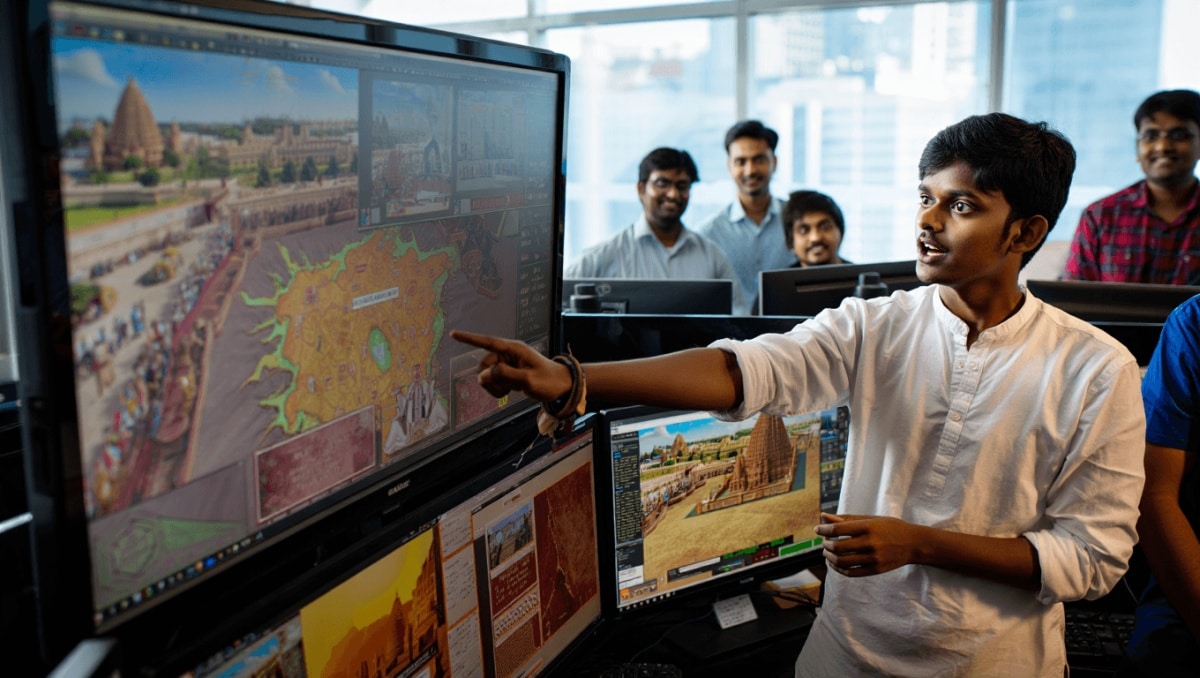
Toronto-based developer Abhijeeth Swaminathan has been one of the more visible proponents of that approach. He has visited the Keeladi archaeological site in Sivaganga and consulted with researchers as part of preparing a game rooted in the early Tamil period. His studio is attempting to recreate a village from the Sangam era, complete with historically informed music: the team commissioned replicas of an ancient yazh harp and a pot drum tailored to period specifications.
Bringing regional pasts into play
The momentum comes from a mix of creative ambition and technical care. Ayelet Studio’s upcoming title, Son of Thanjai, is billed as the first fully Tamil-voiced commercial game from that developer. Set in the 11th century, it follows a wayward Thanjavur prince who must survive in the streets of the Chola realm and confront external threats after losing his rank.
Kashi to Kedarnath costs revealed: how much a Sawan pilgrimage will set you back
Hinduism gains ground in Africa: new communities reshape culture and commerce
Developers say the game aims to be more than a backdrop. Players will be able to watch folk performances, take part in village pastimes, listen to elders’ tales, and accept culturally grounded side quests — while exploring detailed reconstructions of Chola architecture. The team also emphasize historically accurate combat, designing and testing multiple prototypes of traditional weapons such as the valari, aruvaal and the coiled surul vaal to balance authenticity with playability.
“We wanted combat that feels rooted in the period,” the project’s creative lead explains, noting the careful prototyping behind weapon mechanics. The game’s writer spent months researching folklore, infrastructure and daily routines to keep dialogue and scenarios believable.
City as character: Namma Chennai in a game world
Not all projects look to distant centuries. Project Madras, a semi-linear open-world title, focuses on present-day Chennai. Creative director Royston Cinemo says his team built the game around the city’s rhythms — its beaches, busy railway hubs and arterial roads — and recorded hours of ambient sound across neighborhoods to capture local weather, traffic patterns and street banter.
“Chennai can’t be a mere backdrop,” Royston says. “We’re trying to portray its humour, its pace and small civic details that reveal personality.” The studio cites experience with large open-world simulators as inspiration, adapting techniques to a deeply local setting rather than copying a familiar template.
Why this matters now
There are three immediate stakes: representation, cultural accuracy and market reach. For players from Tamil-speaking communities, faithful portrayals matter for recognition and respect. For others, well-researched games offer an introduction to everyday life and history beyond stereotypes. And for developers, authenticity has become a competitive differentiator.
- Representation: Accurate language use and regional customs matter to native players and shape how cultures are perceived internationally.
- Authenticity: Field research — from archaeological sites to street recordings — is being used to ground narratives and mechanics.
- Audience: Indies point to surprising international interest in titles with local roots, suggesting broader commercial potential.
That last point has precedent. Venba, a 2023 indie game created by Abhijeeth’s team, centered on a Tamil family and culinary traditions and found a large share of its audience outside India. Its success convinced some developers that local stories can travel if presented with care.
But representation hasn’t always been handled well. Players have criticised past mainstream titles for using Tamil dialogue without native speakers or cultural advisors, producing lines that sounded stilted or inauthentic. Those missteps have pushed newer teams to involve local writers, musicians and historians early in development.
Practical challenges and creative choices
Reconstructing a historical environment or a living city in game form raises practical questions: how much to dramatize, how to balance accuracy with fun, and how to source authentic assets. Teams describe long research phases, consultations with archaeologists and historians, and iterative testing of mechanics and sound design.
One studio acquired period-accurate musical instruments; another recorded street ambience to ensure the sonic landscape feels lived-in. Writers comb source material for idioms, rituals and domestic details that can be woven into quests and character interactions without reducing culture to props.
Developers also face technical limits. Open-world fidelity, high-quality voice acting in regional languages, and accurate weapon physics are resource-intensive. Many teams mitigate this by focusing on smaller, denser worlds or embracing semi-linear structures that allow more detail per scene.
What to watch next
If these projects reach release, they will be a test of how well locally grounded games can compete globally. Success will likely depend on sustained attention to language quality, community involvement, and the willingness to trade broad strokes for texture and specificity.
For readers interested in regional game-making, the coming year will offer an opportunity to see whether careful cultural research — from Keeladi digs to ambient recordings across Chennai — translates into games that feel both authentic and fun for diverse audiences.