Show summary Hide summary
Hindu ritual tradition classifies forty sacraments—known as samskaras—that map a person’s spiritual and social life from conception through major life milestones. While some of these rites are woven into daily domestic practice, others are observed at set intervals or even only once, a distinction that still shapes how families and priests allocate time and resources today.
The forty rites fall into several clear groups: life-stage sacraments, daily duties for householders, and a series of ceremonial sacrifices that vary by frequency and difficulty. Below is a concise guide to those groupings and what they entail for practice and timing.
Core life-stage rites and daily duties
Kashi to Kedarnath costs revealed: how much a Sawan pilgrimage will set you back
Hinduism gains ground in Africa: new communities reshape culture and commerce
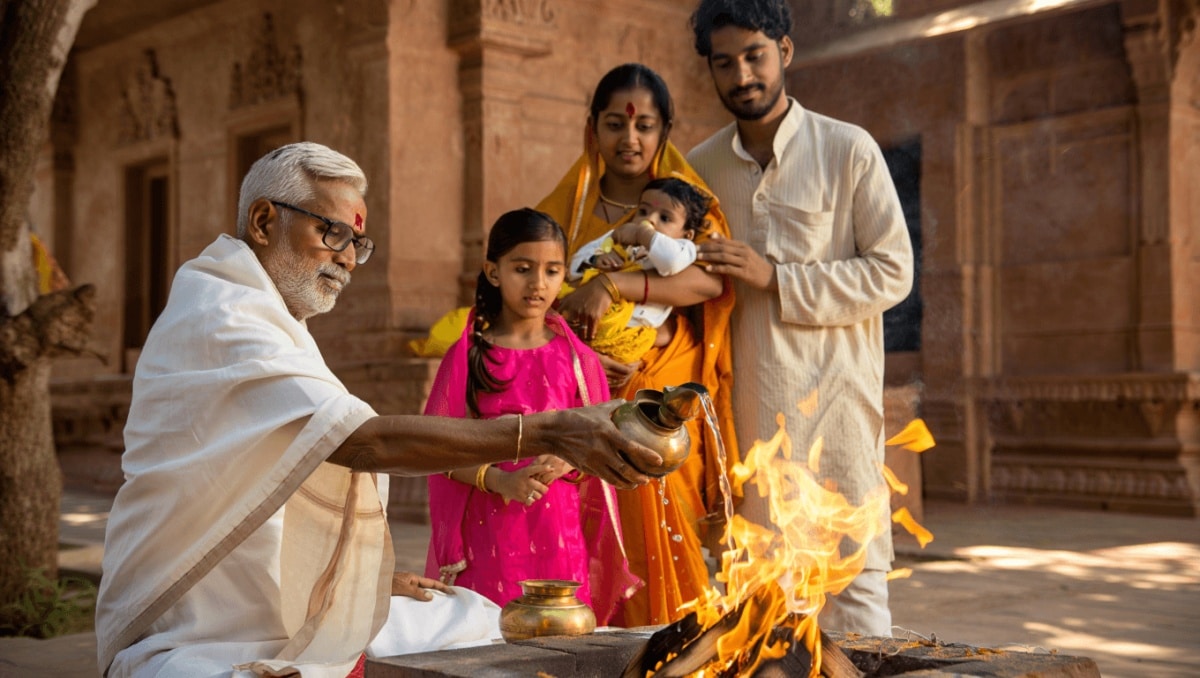
At one end are rites tied to birth, childhood and initiation—conception rites, naming, first solid food, the head-shaving or tonsure ceremony, and the sacred-thread initiation for the student. Marriage is included among these milestone sacraments. Alongside these life-cycle rituals, traditional households are expected to perform a set of daily religious duties known collectively as the pañca-mahayajñas.
- Pañca-mahayajñas (daily obligations)
- Brahmayajña — study or recitation of the Vedas
- Devayajña — offerings and worship to deities
- Pitrayajña — rites for ancestors (tarpana)
- Manushyajña — hospitality and feeding guests
- Bhutayajña — offerings to living beings
- Aupasana and agnihotra are also treated as daily elements of household devotion, the latter being one of the core fire-sacrifices.
Ceremonial sacrifices: smaller, seasonal and complex rites
Beyond daily duties, the tradition recognizes three clusters of sacrificial rites performed with varying frequency: the pakayajnas, the haviryajnas, and the somayajnas. Together these form the remainder of the forty sacraments when counted alongside the life-stage and daily rites.
| Category | Typical frequency | Common examples |
|---|---|---|
| Pakayajnas | Monthly or yearly (one is fortnightly) | Astaka/anvastaka, sthalipaka, parvani (monthly sraddha), sravani, agrahayani, caitri, asvayuji |
| Haviryajnas | Fortnightly to yearly | Agnihotra, darsa‑purnamasa (fortnightly), agniyadhana, agrayana, caturmasya, nirudha‑pasubandha, sautramani |
| Somayajnas | Yearly or once in a lifetime (often the latter) | Agnistoma, atyagnistoma, uktya, sodasi, vajapeya, atiratra, aptoryama |
The practical scheduling follows a traditional logic: the daily mahayajñas, plus agnihotra and aupasana, are ongoing commitments; certain haviryajnas such as darsa‑purnamasa recur every fifteen days; parvani‑sraddha aligns with the lunar month; while many havir and somayajnas are expected annually or, for the most demanding somayajnas, permitted only once in a lifetime as a concession to their scope.
Another doctrinal point: rites performed with Vedic chanting are traditionally considered more potent than unaccompanied acts. This creates a gradient of obligation—some tasks are routine and communal (like feeding guests), others require specialist knowledge, priestly accompaniment, or significant resources.
Why this matters now
Understanding the distribution and timing of these sacraments helps explain how ritual life adapts to modern constraints. Many households today prioritize the daily social obligations—hospitality, ancestor rites and basic puja—while complex soma ceremonies are rarely undertaken except by religious institutions or on special family patronage.
There is also a practical parallel with agrarian rhythms: just as different crops demand watering or harvest at different intervals, ritual duties were prescribed with comparable periodicity. That ancient system allowed for flexibility: some rites are daily, some seasonal, and a few reserved as once‑in‑a‑lifetime undertakings—an arrangement that eased communal burden while preserving religious continuity.
For researchers, priests and families trying to maintain or revive practices, these classifications clarify what is expected, what is optional, and where adaptation has historical precedent. The forty samskaras thus function both as a moral-ritual map and as a timetable for communal life.