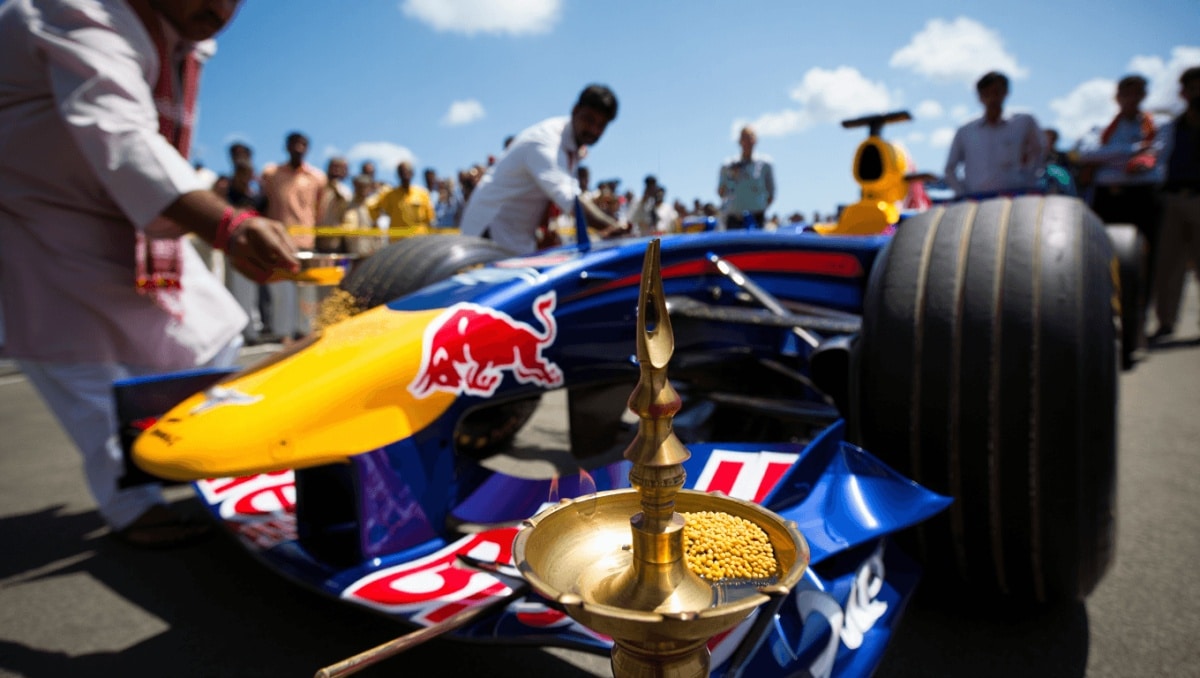
A short video that surfaced on March 19, 2026 shows a Red Bull Formula 1 car receiving a traditional Indian blessing, a striking moment where high-tech motorsport met ritual practice. The clip — shared widely across social platforms — frames the ceremony as both a cultural tribute and a gesture aimed at local fans in the run-up to this season’s Indian events.
Team members began with a formal puja, then placed a floral garland and applied a red tilak on the car’s nose. A small string of lemon and chilies — known locally as nimbu mirchi — was draped across a suspension arm, followed by an aarti: a brief ritual of circling a lit lamp. The sequence ended with a coconut-breaking rite, a customary act intended to invite good fortune.
Why this matters now: Formula 1’s calendar increasingly includes venues outside its traditional European core, and teams often adopt local customs to build ties with host communities. The clip quickly attracted attention because it blends two very different worlds — precision engineering and longstanding ritual — at a time when F1’s presence in India is expanding.
Kashi to Kedarnath costs revealed: how much a Sawan pilgrimage will set you back
Hinduism gains ground in Africa: new communities reshape culture and commerce
A quick breakdown of what was performed and what these elements represent:
- Puja — a formal offering and prayer to seek blessings.
- Garland — a mark of respect and adornment for the object being honored.
- Nimbu mirchi (lemon-chili) — a talisman believed to ward off bad luck and the “evil eye.”
- Tilak — a ceremonial mark applied to convey protection and auspiciousness.
- Aarti — a brief devotional ritual using light to honor and purify.
- Coconut breaking — a symbolic act intended to inaugurate a venture with good fortune.
Ritual element Typical symbolism Garland Respect, blessing, completion of the ritual Nimbu Mirchi (lemon & chili) Protection from negative influences; common talisman Tilak Auspicious mark, invocation of divine favor Aarti Purification via light; communal blessing Coconut breaking New beginnings; symbolic sacrifice to secure success Online reaction was broadly positive: users praised the gesture as a respectful acknowledgment of local tradition, and many fans noted the visual contrast of ceremonial elements beside carbon fiber and sponsor liveries. The clip also sparked conversation about how global sports teams navigate cultural engagement when competing abroad.
From a practical standpoint, teams typically carry out such gestures with safety and operational limits in mind — ceremonies are short, and the car is checked afterwards before any track activity. Taken together, the footage is a reminder that major international sporting events increasingly involve local cultural exchanges as part of their public-facing moments.
Whether intended primarily as a sincere cultural observance or as a moment of fan outreach, the viral video highlights how Formula 1’s expanding footprint has created new intersections between local tradition and global sport.