Show summary Hide summary
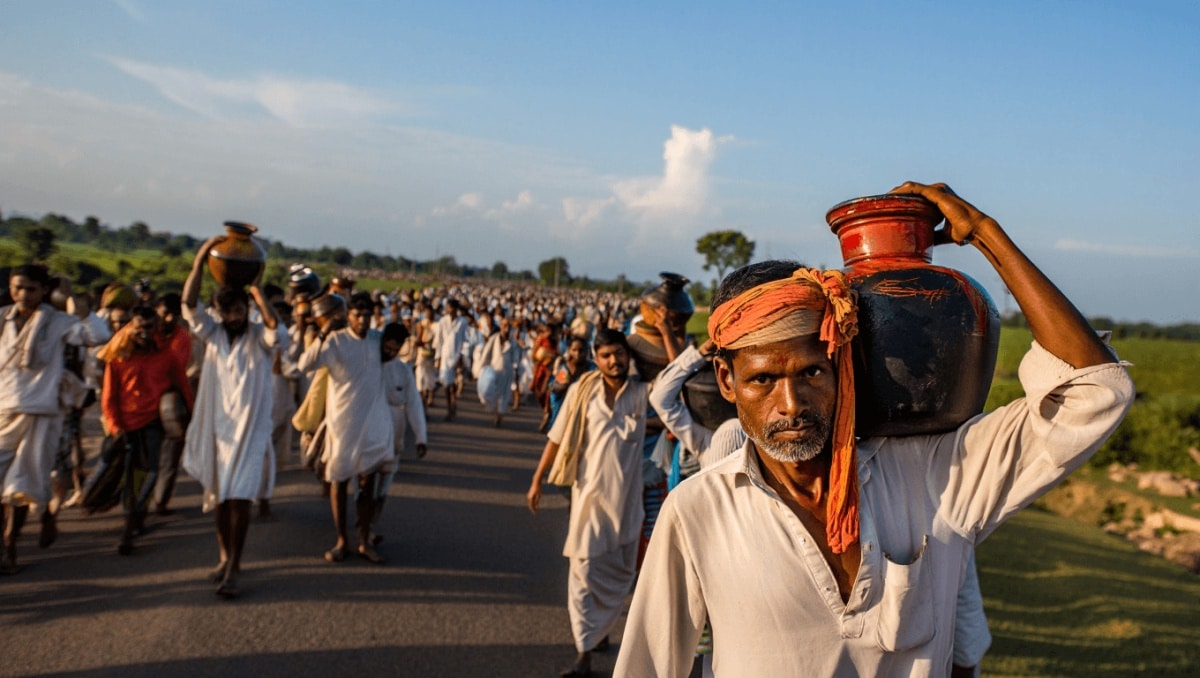
Sawan has begun and with it one of India’s most sweeping seasonal movements has returned to the roads: the Kanwar Yatra. For more than a week devotees across North India will collect sacred water from the Ganga and travel long distances to offer it at Shiva shrines — a ritual whose scale and social impact make it a live event for communities and authorities alike.
Why this matters now: Sawan 2026 opened on Thursday, 30 July, and the core period culminates on Sawan Shivratri, 11 August 2026. The compressed calendar concentrates travel, public services and crowds into a short, intense window that affects transport, policing and local economies.
The scene on the highways
Roads linking Haridwar with Delhi and western Uttar Pradesh are once again lined with pilgrims bearing decorated bamboo frames and clay lotas. Where speakers recently played film tracks, calls of Bol Bam now compete with the steady click of sandals and the murmur of volunteers. Temporary shelters, medical tents and community kitchens appear along major routes, creating a parallel seasonal infrastructure that supports millions.
Annamalai applauds Bhagwat’s message on Muslim inclusion in India
Navratri in Times Square goes viral: social media splits over Indian celebrations abroad
Estimates vary, but in peak years some ghats and corridors attract tens of millions of visitors; authorities and civic agencies prepare months ahead to manage movement, water supply and emergency care.
The origin in myth and meaning
The ritual traces back to the Samudra Manthan, the cosmic churning that, according to Hindu tradition, released both poison and elixir. When Shiva contained the deadly vapour in his throat, devotees later poured cooling waters over him — an image evoked every year by those who carry river water long distances to anoint a Shivling. For many pilgrims the physical hardship is part of the offering: exertion becomes devotion.
Major routes and destination temples
- Haridwar → Delhi-NCR & Western UP: Water taken from Har Ki Pauri is carried to hundreds of neighborhood Shiva temples across the capital region and neighbouring states.
- Haridwar/Rishikesh → Neelkanth Mahadev: The forested ascent to the Neelkanth shrine near Rishikesh is regarded by many as the most symbolic route, returning devotees to the spot traditionally linked to Shiva’s blue throat.
- Sultanganj → Deoghar: In eastern India, pilgrims walk from Sultanganj in Bihar to Baba Baidyanath Dham in Jharkhand — a journey that forms the centerpiece of the Shravani Mela.
- Glacial sources — Gaumukh/Gangotri: Some devotees start at the river’s Himalayan headwaters, taking water from the Ganga’s sources for their offerings.
Variation in austerity: four common practices
Not all kanwariyas observe the same intensity. The yatra contains an internal vocabulary of disciplines that pilgrims select according to personal vow and capacity.
Some move steadily at their own pace with the vessel supported on rests. Others run in relay-style non-stop legs between temples. A stricter practice requires the kanwar remain upright and in motion at all times, so participants pair up and rotate. At the most austere extreme, pilgrims cover distances through repeated prostrations, turning weeks of walking into months of effort condensed into a single vow.
Community, identity and service
Travelling with a kanwar often erases ordinary social divisions. Strangers greet each other as Bhole and offer hospitality without expectation. Along the routes, volunteer-run seva shivirs provide food, rest spaces and medical help free of charge; many organize bandages, blister treatment and night-time massage for exhausted feet.
This seasonal network — ad hoc but reliably recurrent — is as much logistical as it is spiritual. Local administrations set up dedicated lanes, control rooms and emergency teams; volunteers set up temporary dhabas and sleeping arrangements. In effect, governance and grassroots charity combine to enable the movement.
What pilgrims typically observe
- Keep the vessel off the ground: The water must remain unspilled and the kanwar is not set directly on soil during the vow.
- Dietary discipline: Most follow a satvik diet during the yatra — fruit, light meals and abstention from meat, alcohol, onion and garlic are common.
- Purity and conduct: Bathing before handling the kanwar, speaking calmly and treating fellow pilgrims with respect are widely practiced norms.
- Follow designated routes: States deploy special lanes, surveillance and patrols to manage flows and safety; pilgrims are expected to use assigned corridors.
Practical advice for participants
If you plan to join this season, experienced pilgrims advise breaking in footwear well before departure and carrying a lightweight rain poncho — Sawan showers are frequent. Pack oral rehydration salts and blister-care supplies, move conservatively on Day 1 to find a sustainable pace, and carry photo ID for checkpoints. Those with heart or blood-pressure concerns should consider vehicle support for steep stretches; intention matters more than extremes.
| Event | Date (2026) |
|---|---|
| Sawan / Kanwar Yatra begins | Thursday, 30 July |
| Sawan Somwar 1 | Monday, 3 August |
| Sawan Somwar 2 | Monday, 10 August |
| Sawan Shivratri (major jalabhishek) | Tuesday, 11 August |
| Sawan Somwar 3 & 4 | 17 August and 24 August |
| Shravan Purnima / Sawan concludes (Raksha Bandhan) | Friday, 28 August |
(Note: in states that follow the Amanta calendar — Maharashtra, Gujarat, Karnataka, Andhra Pradesh, Telangana, Goa and Tamil Nadu — Shravan runs from 13 August to 11 September 2026.)
The question the pilgrimage answers
At its core the Kanwar Yatra asks what devotion looks like in practice. The offerings requested of Shiva are simple — water, a leaf, sincerity — yet many pilgrims deliberately choose a taxing route. For them, the hardship is the form devotion takes: endurance becomes proof of intention.
That is why every Sawan the highways fill with people who have decided the act of walking itself is the true gift. In the concentrated days ahead, the ritual will test services and compassion alike — and reveal, as it always does, a seasonal city made of strangers helping strangers toward a shared destination.