Show summary Hide summary
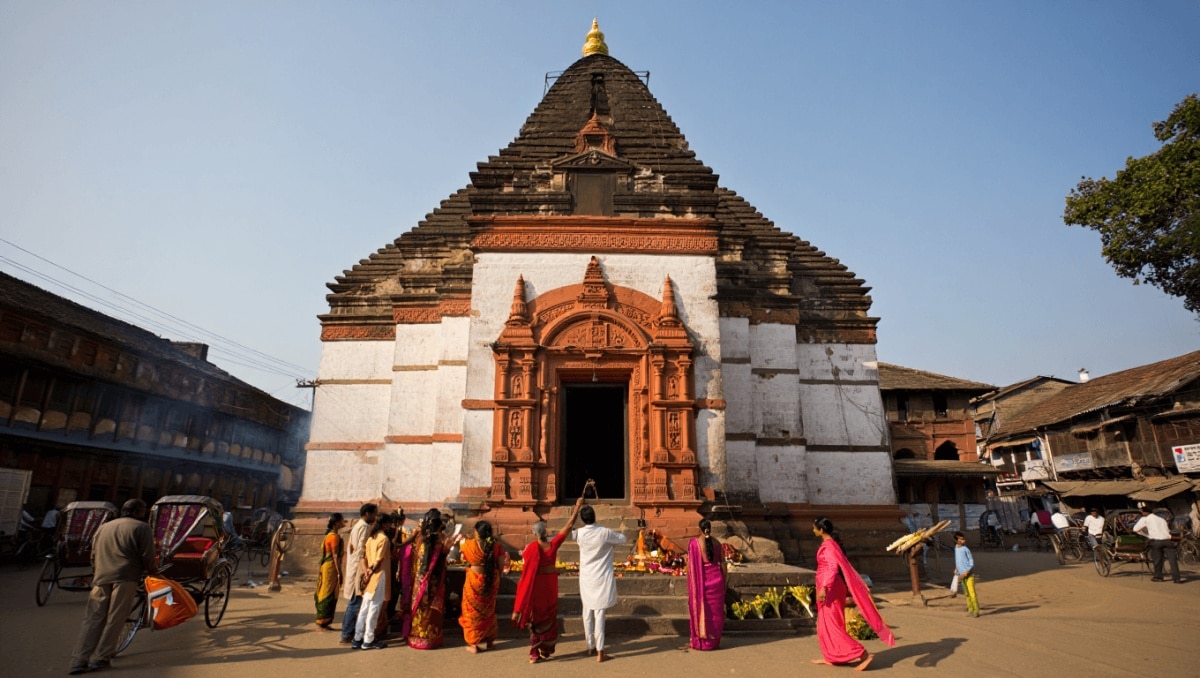
Dhaka’s name may have many possible origins, but one story keeps surfacing: a centuries-old temple at the city’s heart that has shaped religious life, civic memory and contested claims over property and heritage. Today the Dhakeshwari site stands as both a living place of worship and a symbol of Bangladesh’s complex handling of minority culture and national identity.
Scholars and local traditions offer several explanations for how the capital acquired its name. Linguists point to a possible Sanskrit root meaning “watchtower,” reflecting the area’s defensive role for nearby settlements. Others link the name to the loud, boundary-marking dhak drum or to a native tree long known as the dhak. But the most persistent narrative connects the city with its central shrine, the Dhakeshwari Temple.
According to tradition, a ruler of medieval Bengal discovered a buried image of the goddess Durga in a forested patch and consecrated it on the site. The deity was called Dhakeshwari — roughly, “the concealed goddess” — a name said to reflect the temple’s origin beneath a canopy of trees. That origin story has shaped how generations of residents and pilgrims think about the site, even as the structure itself was rebuilt and altered many times.
Annamalai applauds Bhagwat’s message on Muslim inclusion in India
Navratri in Times Square goes viral: social media splits over Indian celebrations abroad
From local shrine to national symbol
Written records complicate the legend. Early 20th-century district gazetteers and nineteenth-century travelers note a temple at the location but point to later reconstructions, including significant work in the 18th century. Whatever its precise date of foundation, the temple became a major pilgrimage destination and cultural hub well before the modern era, attracting worshippers and visitors who saw it as a key shakti pitha within the Shaktism tradition.
In the decades after British India’s partition in 1947, the temple’s fortunes shifted with political upheaval. Fearing desecration amid rising communal violence, temple caretakers removed the original Durga idol and transported it to Kolkata in 1948, where it remains in a temple in the Kumartuli neighborhood. A replacement idol was later installed in Dhaka; its more heavily armed iconography is often read as reflecting the turbulent history that followed.
State policies also altered the temple’s material base. During the 1960s many religious properties were affected by laws enacted under what was then called the Enemy Property regime; later renamed the Vested Property Act, those measures resulted in large-scale government appropriation of land belonging to minority communities, including parts of the Dhakeshwari complex.
Violence, rebuilding and recognition
1971 marked a particularly violent chapter. During the Liberation War, Pakistani military operations caused extensive damage to Hindu sites across what became Bangladesh; accounts record that portions of the Dhakeshwari complex were destroyed and that the main worship hall was repurposed by soldiers.
After independence, restoration efforts revived the temple’s physical presence. Still, communal tensions reappeared in the 1990s: the demolition of the Babri Masjid in India triggered reprisals and attacks on Hindu sites in Bangladesh, and Dhakeshwari again faced unrest.
Following sustained advocacy by Hindu organizations to safeguard the temple’s place in national life, the government conferred a new status on the shrine in the 1990s. In 1996 Dhakeshwari was officially recognized as the jatiya mandir — the national temple — and later gestures by state leaders, including a 2018 land grant from Prime Minister Sheikh Hasina, were framed as efforts to compensate for earlier confiscations.
- 12th–18th centuries: Traditional origin stories attribute the shrine to medieval kings; historical records point to significant rebuilding in the 1700s.
- 1948: Original Durga idol moved to Kolkata amid post‑Partition tensions.
- 1960s: Property seizures under the Enemy Property/Vested Property framework affected temple holdings.
- 1971: Wartime destruction damaged large parts of the complex during the Liberation War.
- 1996: Temple designated as the national temple (jatiya mandir).
- 2018: Government land grant intended to restore some of the temple’s lost property.
Today the temple is an active center of religious and cultural life in Bangladesh. Major festivals draw large crowds: the colorful processions for Janmashtami enliven city streets, while the five-day Durga Puja attracts thousands of worshippers, politicians, artists and onlookers and is widely regarded as the country’s most important Hindu celebration.
These public rituals underscore the temple’s function beyond a purely devotional role: it operates as a social stage where music, performance and civic recognition intersect. For members of the Hindu minority, Dhakeshwari provides continuity with earlier generations; for the broader capital, it remains one of several institutions that shape Dhaka’s urban character.
Whether the capital’s name literally comes from the shrine matters less to many than what the temple represents now — resilience in the face of conflict, a locus of cultural memory, and a contested piece of urban heritage that raises ongoing questions about property rights, minority protections and how nations commemorate plural pasts.