Show summary Hide summary
Ravana remains one of the most debated figures in South Asian storytelling: at once a towering scholar, a fierce king and the principal adversary in the Ramayana. As communities and scholars reassess ancient narratives, his life is being read less as a simple tale of evil and more as a study in power, knowledge and the limits of self-control.
More than a villain
Traditional accounts present Ravana as the ruler of Lanka and a rakshasa in the epic cycle surrounding Rama. Yet the sources also attribute to him an unusual pedigree and a broad range of accomplishments: he is described as the grandson of the sage Pulastya and the son of the Brahmin scholar Vishrava and Kaikesi, linking him to both ascetic learning and asura lineage. That dual heritage is often cited to explain the contradictions in his portrayal.
Annamalai applauds Bhagwat’s message on Muslim inclusion in India
Navratri in Times Square goes viral: social media splits over Indian celebrations abroad
Texts and later commentaries credit him with deep learning in sacred literature and the arts. He is associated with works on astrology and medicine and is remembered in musical tradition for composing the hymn now called the Shiva Tandava Stotram. Legends also place at his disposal a flying craft, the pushpakavimana, and attribute to him command of ritual and esoteric practices.
How ten heads entered the story
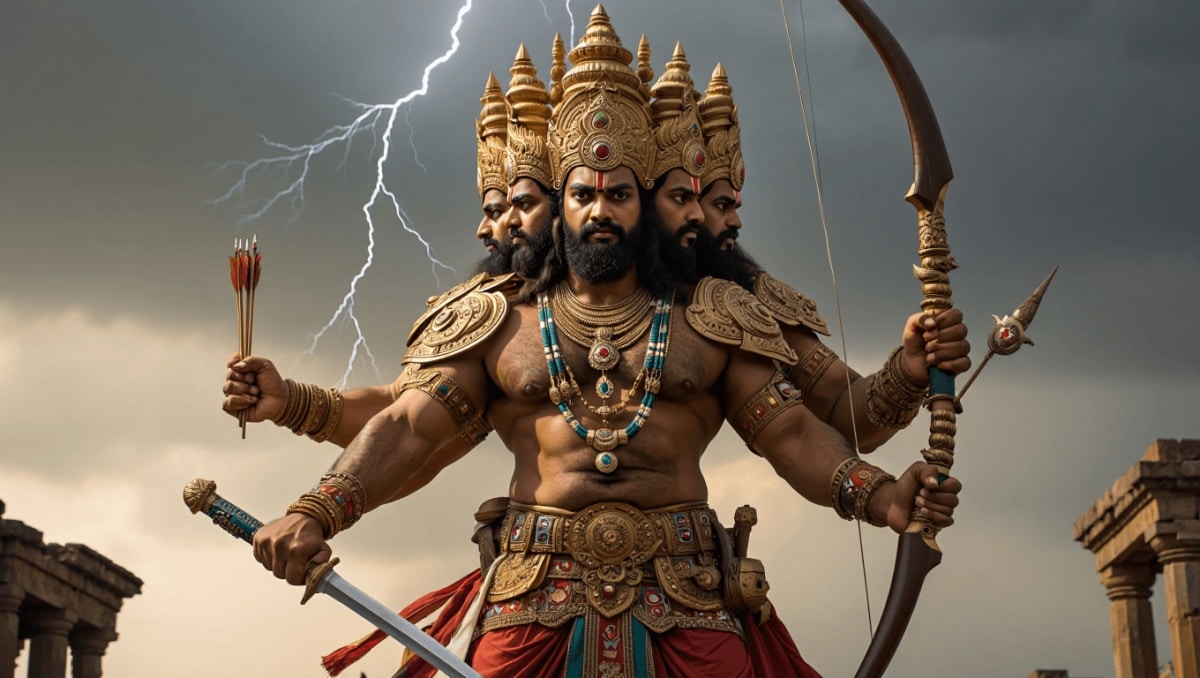
The iconic image of Ravana with multiple heads appears in many tellings, but the narratives differ on its origin. One common motif describes extreme austerities performed to win Shiva’s favor; in some versions, Ravana’s repeated acts of self-sacrifice are rewarded by the multiplication of his heads. The epithet Dashamukha—literally “ten-faced”—became a shorthand for his prodigious intellect and scope of knowledge as much as for his physical form.
Scholars and religious interpreters offer two broad readings of the ten heads. One treats them as a symbol of encyclopedic mastery: an integration of the four Vedas and additional branches of sacred learning. The other reads the motif psychologically, as a map of competing impulses inside a person.
- Kaam — desire or lust
- Krodh — anger
- Moha — attachment or delusion
- Lobh — greed
- Mada — pride
- Maatsarya — envy
- Manas — the mind or emotion
- Buddhi — intellect or discernment
- Chit — consciousness or will
- Ahamkara — ego
These lists are not uniform across sources, but they point to a recurring moral theme in Hindu thought: knowledge alone does not suffice unless aligned with ethical restraint and self-mastery.
Power, talent and downfall
Ravana’s story often functions as a cautionary tale about the dangers of unregulated power. Many narratives emphasize that despite his scholarship and devotion, his inability to control desire and pride led to catastrophic choices—among them the abduction of Sita—that precipitated his defeat. Some versions include an exchange with King Mahabali or other figures who counsel restraint; Ravana’s refusal to renounce certain impulses is portrayed as central to his collapse.
As he dies on the battlefield in these retellings, commentators frequently stress his last regrets: possessing vast knowledge but failing to live by its highest principles.
Why this matters now
Ravana’s ambiguous legacy matters because it resists easy moral categorization. In contemporary debates about culture and identity, his figure is invoked in different ways—sometimes as a symbol of learned resistance, sometimes as an archetype of destructive hubris. Across South Asia and the diaspora, local traditions continue to reinterpret him: in a few places he is venerated, in others firmly vilified, and in many more he is studied as a complex literary and religious personality.
For readers today, the Ravana cycle prompts questions relevant to leadership, the ethics of knowledge, and how communities frame dissenting or hybrid figures in their histories.
Whether viewed as myth, moral lesson or cultural emblem, Ravana’s story endures because it speaks to tensions that remain current: talent without temper, devotion mixed with domination, and the thin line between wisdom and self-deception.