
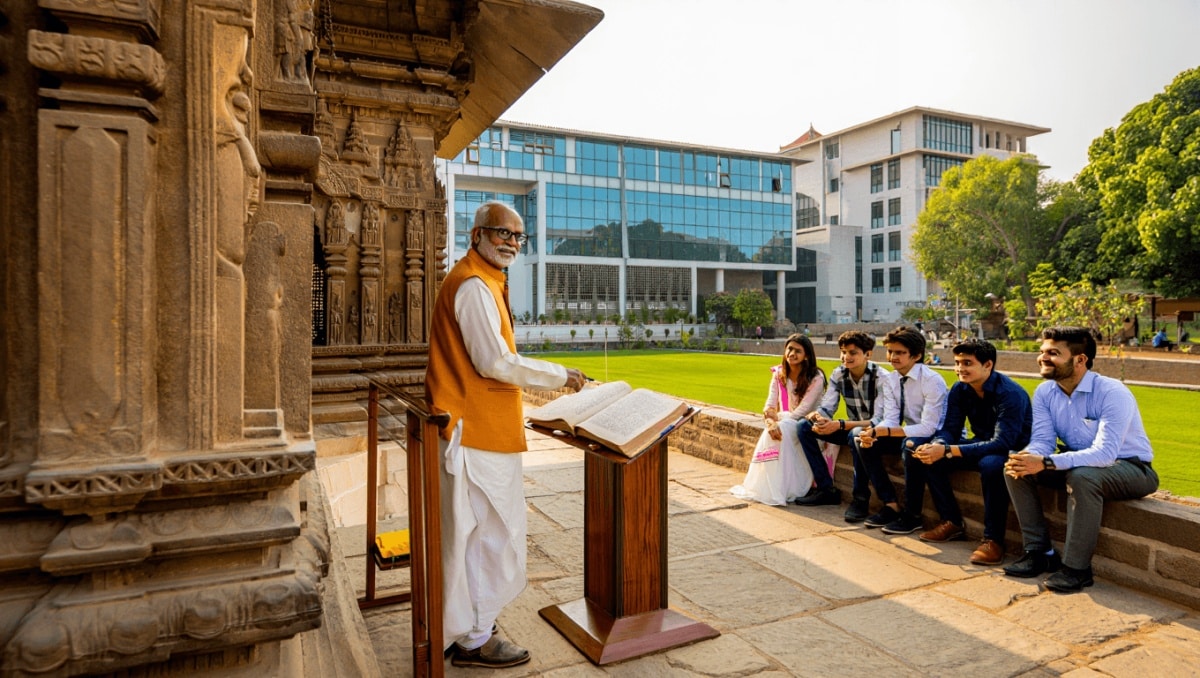
Lucknow — The state cabinet has approved a plan to install dedicated research chairs focused on India’s classical intellectual traditions at older, large universities and colleges, marking a targeted effort to bring traditional knowledge systems into mainstream academic study. The scheme, backed by initial budgetary allocations for the coming financial year, will fund chairs that document, research and teach the scientific and philosophical legacies of Indian thinkers.
The programme targets institutions with a longer institutional record and significant enrolment: only universities and colleges that have been in existence for more than 50 years and enroll at least 5,000 students will qualify. Those selected will host research chairs named after prominent Indian philosophers, scholars and visionaries to promote rigorous scholarship on indigenous knowledge systems.
Financially, the state has set aside an initial outlay of Rs 5 crore for 2026–27. Individual eligible institutions may receive grants of up to Rs 2 crore spread across a five-year period to establish and run these chairs.
Annamalai applauds Bhagwat’s message on Muslim inclusion in India
Navratri in Times Square goes viral: social media splits over Indian celebrations abroad
The chairs are intended to support a range of academic activity: systematic research, archival work, publication and curriculum development that showcases the practical, scientific and philosophical dimensions of traditional Indian learning. Officials say students will be exposed to these systems’ contemporary relevance as part of curricular and extra-curricular work.
Positioned as a complement to national policy, the initiative aligns with the NEP 2020 emphasis on integrating Indian Knowledge Systems into higher education. Backers argue the move could strengthen interdisciplinary study and generate new scholarship that bridges classical knowledge with modern inquiry.
How this may affect campuses and students in practice will depend on implementation details — appointment processes, research agendas, and institutional cooperation. Observers note the potential for increased research funding, new academic appointments, and expanded course offerings, while also flagging the need for transparent governance and scholarly standards.
| Element | Details |
|---|---|
| Eligible institutions | Established for over 50 years and with 5,000+ students |
| Duration of support | Five years per chair |
| Grant per institution | Up to Rs 2 crore over five years |
| State allocation (2026–27) | Rs 5 crore |
| Focus areas | Research, documentation, teaching, dissemination of Indian knowledge traditions |
Expected academic outputs include peer-reviewed studies, translations and annotated editions, course modules, and public seminars. Practical applications may range from new pedagogical materials to contributions in fields such as mathematics, medicine, environmental thought and philosophy where historical Indian sources have relevance.
- Strengthening scholarship on indigenous intellectual history
- Providing institutional funding for long-term projects
- Exposing students to non-Western knowledge frameworks
- Potentially enhancing international academic engagement on traditional knowledge
For readers today, the policy signifies a deliberate push by state authorities to institutionalize study of India’s intellectual heritage at established higher-education centres. The immediate questions for universities will be selection criteria, academic independence, and how chairs balance historical study with contemporary scientific and educational standards.
Officials have framed the move as an academic investment rather than a symbolic gesture; its impact will become clearer as universities design research programmes, appoint scholars and begin to publish work under these newly funded posts.