
Show summary Hide summary
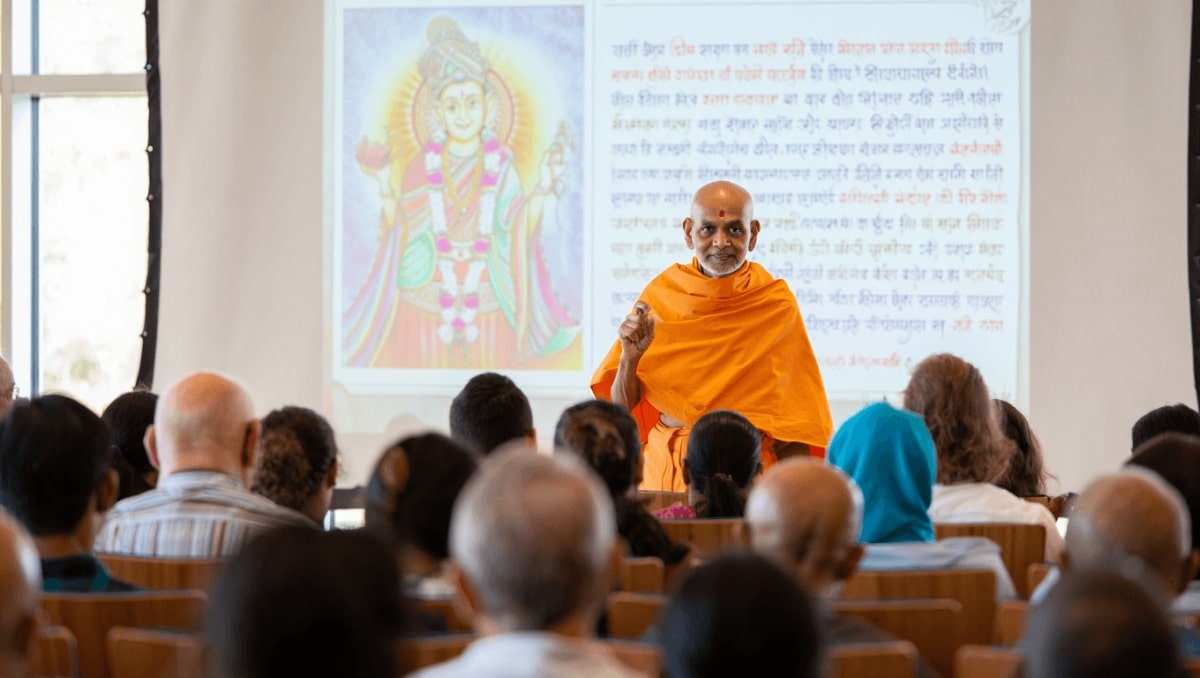
At a recent Chinmaya Mission talk, Swami Swaroopananda offered a compact, practical blueprint for managing stress while pursuing meaningful success — drawing on the Hanuman Chalisa and ancient yogic concepts. His message: centuries-old spiritual stories can translate into clear behavioral lessons for leadership, resilience and ethical achievement today.
Swamiji opened by revisiting the eight exceptional powers known in classical yoga as the ashta siddhi, a set of rare attainments described in Patanjali’s Yoga Sutras. Rather than treating these as supernatural prizes, he reframed them as metaphors for habits and attitudes that reduce friction and sharpen focus in modern life.
What the eight siddhis represent today
- Anima — extreme reduction in physical size: a call to cut the ego, listen, and defer to elders, mentors and colleagues when the situation demands.
- Mahima — vast expansion: think and plan at scale; set ambitious goals that stretch capability rather than retreating to small, safe targets.
- Garima — immovably heavy: cultivate steadiness of principle; be someone whose values do not shift with convenience.
- Laghima — lightness or near-weightlessness: keep a sense of play and perspective; not every setback needs a grave response.
- Prapti — the ability to reach anywhere: concentrate effort and attention so you reliably close on priorities.
- Prakamya — getting what one intends: speak clearly about goals and adopt a truthful, assertive posture instead of hedging in fear.
- Istva — lordship or authority: lead by inspiring others; earn followership rather than demanding it.
- Vastva — influence over minds: build trust and love so people willingly act on your behalf.
Annamalai applauds Bhagwat’s message on Muslim inclusion in India
Navratri in Times Square goes viral: social media splits over Indian celebrations abroad
Instead of treating the siddhis as literal feats, Swamiji walked the audience through concrete examples from the Ramayana, where Hanuman uses particular abilities tactically — shrinking to approach someone without alarming them, or expanding to confront obstacles. Those narrative moments became springboards for practical advice: shrink the ego at the right moments, expand your ambitions when necessary, hold firm to principle, and remain light enough to laugh.
He cautioned that success must be decoupled from simple accumulation of wealth. Money, Swamiji observed, is necessary for sustaining work — including religious and social institutions — but is destructive when pursued by dishonest or greedy means. Generosity and stewardship, he argued, are essential parts of a healthy life and community.
Swamiji drew on the symbolic relationship between Vishnu and his consort, Goddess Lakshmi, to make a point about attachment and entitlement. In the epic, Sita (seen as an incarnation of Lakshmi) is taken by Ravana through desire and possession, a path that leads to ruin. By contrast, Hanuman’s service to Rama — acting without self-seeking — earns him blessings that are not about riches but about sustained purpose and proximity to the ideal.
Why this matters now
Levels of workplace stress, burnout and leader-driven scandals make these reframed teachings relevant beyond a religious setting. The practical takeaways — humility, vision, ethical steadiness, playfulness, focused effort, truthful speech, inspirational leadership and empathetic influence — map directly onto modern organizational needs and personal well-being.
For readers looking for short, applicable guidance, Swamiji’s talk can be boiled down to a few actionable nudges:
- Reduce ego-driven responses; ask more questions.
- Set a bolder target this quarter and outline one concrete step toward it.
- Identify one principle you will not compromise this month.
- Schedule brief moments for lightness or humor daily.
- State your goal aloud without immediately qualifying it; practice honest affirmation.
- Use influence to serve others’ growth, not just to advance yourself.
Swamiji concluded with a wry observation: decades of ascetic practice might earn some of the old siddhis, but for everyday seekers there is a simpler option — emulate Hanuman’s single-minded service and humility. The result, he said, is success that carries less stress and greater social value.
Whether one frames these ideas as spiritual disciplines or practical habits, the talk underscored a durable point: ancient language and stories can still shape how people manage ambition, ethics and mental health in the present day.