Show summary Hide summary
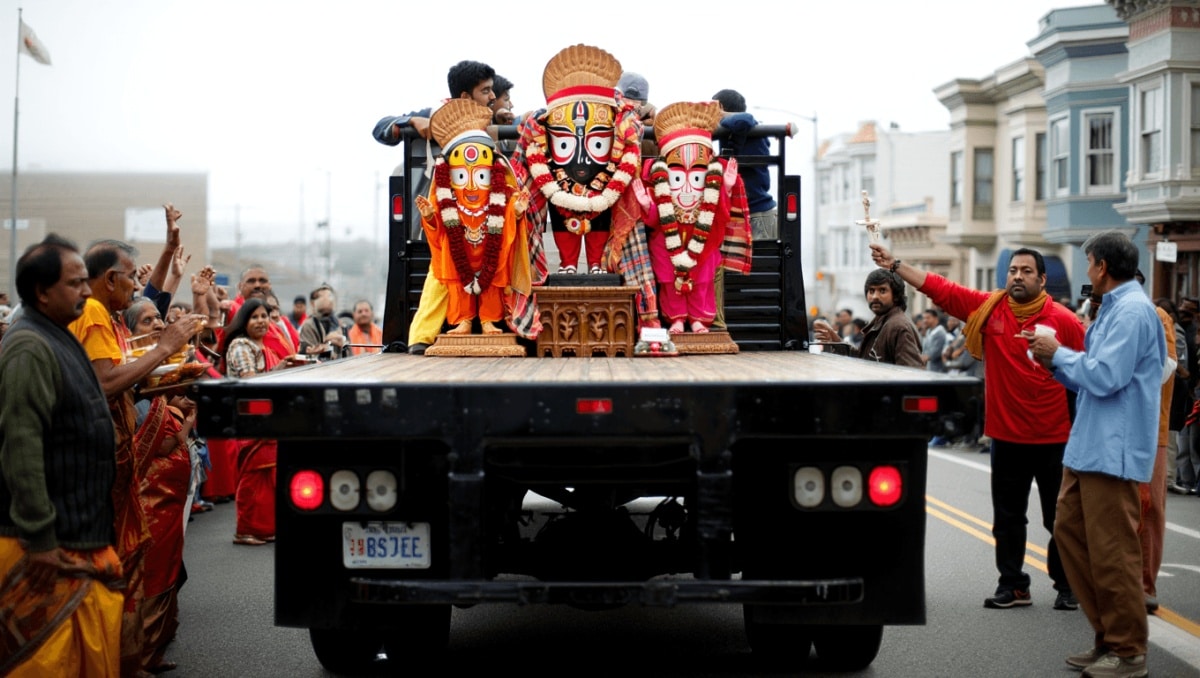
On a foggy San Francisco morning decades ago, a rented flatbed truck became an improvised temple chariot, carrying three wooden deities through crowded streets to the Pacific — an event devotees say marked the first Ratha Yatra held outside India. The impromptu procession, organized amid illness and improvisation, would become a defining moment for Hindu public life in the United States and a practical lesson in how religious traditions adapt far from their places of origin.
What followed that day reads like a small-scale adventure: a spiritual leader recovering from a stroke, volunteers turning carpentry sketches into a makeshift cart, traffic being halted by police as drums and singing filled the air, and a stalled engine that nearly turned the parade into a crisis. For the people who organized it, the festival proved that devotion, community energy, and a willingness to improvise could transplant an ancient ritual onto American streets.
A festival reimagined on a flatbed
Annamalai applauds Bhagwat’s message on Muslim inclusion in India
Navratri in Times Square goes viral: social media splits over Indian celebrations abroad
The core of the celebration was the ancient Jagannatha tradition in which three deities — **Jagannatha**, **Baladeva**, and **Subhadra** — are placed on towering wooden carts, drawn by thousands in a public procession. In India the practice is as much a social event as a religious one, intended to allow wide public viewing and to re-enact pastimes associated with Krishna.
Far from the temple precincts of Orissa, a small group of San Francisco devotees translated that idea into what they could manage: a 20-foot open-sided flatbed truck fitted with a deck and a pyramid-shaped canopy. The design left space for the deities at the rear while accommodating musicians and singers up front.
Illness, improvisation, and a community on edge
Weeks before the planned festival, rumors of the spiritual leader’s ill health spread from New York. When reports confirmed that he had suffered a serious stroke, the temple community reacted with all-night chanting and prayers. Relief came when messages and letters indicated he was stabilizing and expected to return in time for the festival — a promise that re-ignited the volunteers’ determination.
With permits to secure, posters to print, food donations to arrange and a sound system to rent, devotees divided tasks and pushed forward. Two carpentry-skilled volunteers sketched and built the truck platform, following a simple drawing their guru had once shown: a small, motored rath that would carry the deities and the singing devotees to the beachfront.
The procession and a near-accident
On the day, speakers blared continuous kirtan as hundreds gathered along the route. Police rerouted traffic, and the parade began its climb toward Ocean Beach. Midway up a hill, the engine stalled. The truck lurched backward a few feet — a heart-stopping moment amid dancing crowds, children and dogs — before restarting and then moving forward to relieved cheers. No injuries were reported; the bump had been caused by a pothole.
At the end point, hours of singing and devotional music gave way to a night-time drive to the spiritual leader’s rented house on the coast. The twenty-five-mile return trip through dark, windy roads became another test of trust and perseverance: devotees clung to the truck bed not just for safety but to share the story with their recovering guru.
- Why the festival mattered: It made an Indian temple ritual visible in a North American civic space, signaling religious pluralism in practice.
- Practical ingenuity: A flatbed truck and volunteer carpentry re-created the essence of a rath when building full wooden carts was impossible.
- Community resilience: The event succeeded despite the leader’s illness, last-minute improvisation, and a mechanical scare.
- Legacy: For the devotees involved, the day confirmed that service and devotion could sustain a community wherever it settled.
What this episode tells us now
The story is not only a colorful anecdote about a street parade; it also illustrates how immigrant religious communities negotiate identity and visibility. Public celebrations like Ratha Yatra create a space where ritual becomes civic performance, inviting onlookers into a living tradition and testing the capacity of urban infrastructure to accommodate unfamiliar forms of worship.
As the United States reflects on its 250th anniversary, moments like this — modest, improvised and local — reveal how faith traditions were carried, adapted and established in everyday American life. They also show that cultural transplantation often depends less on elaborate resources than on committed volunteers willing to convert a truck into a chariot and a neighborhood into a temporary temple.
For the devotees who organized that first urban rath, the takeaway was simple and enduring: rituals survive and thrive when communities invest love, labor and a readiness to improvise. The festival’s rough edges did not diminish its meaning; they became part of its story.