Show summary Hide summary
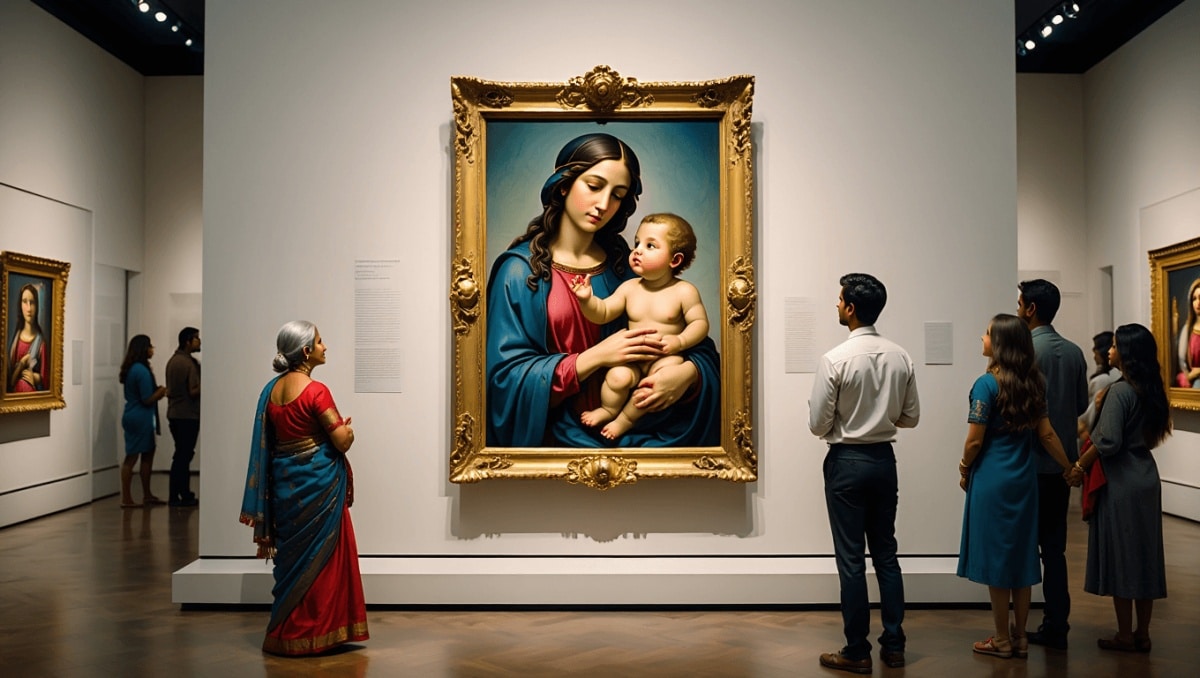
Sandro Botticelli’s tender tempera of the Madonna and Child has crossed continents for the first time, arriving in New Delhi to anchor a new show that traces two millennia of maternal images across Italy and India. The painting’s presence makes the exhibition both an art-historical moment and a diplomatic milestone, arriving amid deeper cultural ties between the two countries.
Botticelli, who returned repeatedly to the Madonna and Child throughout his career, treated the subject as psychological portrait rather than formal icon. His depictions often convey a quiet, inward grief and an intimate bond that anticipates the fate of the child—qualities that make the Florence loan from the Museo Stibbert a striking focal point for the exhibition.
What the exhibition does
One Mother, Many Mother Tongues opens at the Humayun’s Tomb Museum on June 22 and sets out to disrupt the idea of a single, universal image of motherhood. Instead, the curators map diverse traditions and eras—ancient goddesses, Buddhist protectors, medieval Madonnas and regional sculptures—side by side to show how maternal forms travel, transform and take root in new contexts.
Annamalai applauds Bhagwat’s message on Muslim inclusion in India
Navratri in Times Square goes viral: social media splits over Indian celebrations abroad
The curators—art historian Naman P Ahuja and Andrea Anastasio of the Italian Cultural Centre in India—position the show as both scholarly investigation and cultural conversation. It is also timed with renewed India–Italy cooperation after a recent upgrade in bilateral relations, creating momentum for a shared year of culture and tourism on the near horizon.
Key works and cross-cultural echoes
The exhibition highlights are intentionally comparative. On the Indian side, viewers encounter large Gandharan sculptures of the maternal guardian figure Hariti, Kushan-period examples from Mathura and Andhra Pradesh, and a sixth-century Skandamata from a temple near Thaneshwar. From Italy come representations of the ancient Roman goddess Mater Matuta, often shown seated with infants on her lap.
Placing these objects together reveals recurrent visual solutions: seated mothers with children, enthroned female figures, and iconographies that shift meaning depending on belief and geography. Hariti’s story—once a child-stealer, later converted into a protector by the Buddha—encapsulates that trajectory from menace to maternal guardian, illustrating how a figure can be recast by new religious and social contexts.
The Gandharan sculpture in particular matters because Gandhara was a crossroads of South Asia, Central Asia and Mediterranean influences; it demonstrates how iconography circulated across regions and adapted to local languages of devotion.
Why it matters now
Beyond art history, the show speaks to contemporary debates about identity and cultural exchange. The curatorial argument is that migration and local adaptation have always produced hybrid, plural traditions—and that awareness of this past can temper anxieties about cultural change today. Co-curator Naman Ahuja frames the exhibition as evidence that antiquity itself was constantly reshaped by movement and reinterpretation.
- Diplomatic context: The loan arrives as India and Italy deepen cultural cooperation, underlining museums’ role in soft diplomacy.
- Cross-cultural scholarship: Objects from different faiths and eras are paired to show formal resonances, not to collapse distinct meanings.
- New perspectives: Lesser-discussed figures—such as Jyeshta and regional Skandamata sculptures—are foregrounded to broaden narratives of maternal power.
- Public programme: The show will travel, extending its reach and offering continuing dialogue between museums and audiences.
Who contributed
More than a dozen institutions from both countries have lent works, reflecting the collaborative nature of the project. Lenders include major Indian museums and regional collections as well as Italian institutions such as Museo Stibbert, Museo Etrusco in Rome, and Museo Provinciale Campano di Capua.
The exhibition thus functions as a cultural exchange: artworks travel physically while their meanings are tested through juxtaposition—inviting visitors to consider how motherhood has been visualised, venerated and reinvented across time and place.
One Mother, Many Mother Tongues opens at the Humayun’s Tomb Museum on June 22 and will later travel to the National Gallery of Modern Art in Bengaluru, continuing the conversation between past practices and present perspectives.