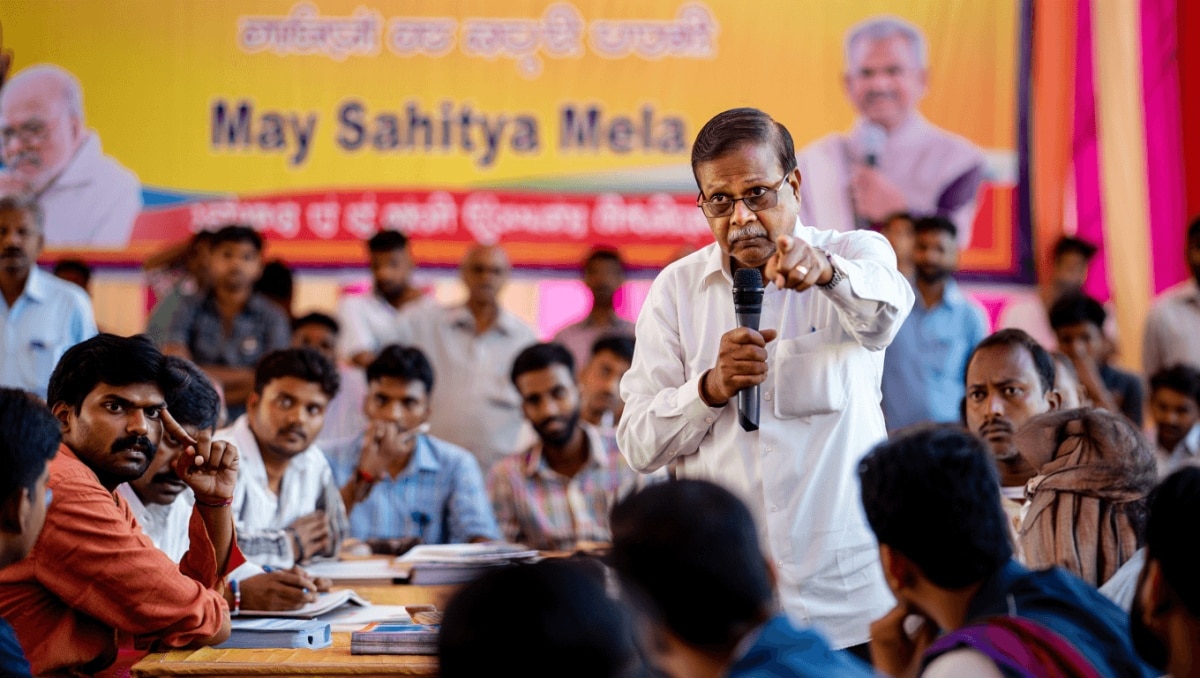
At the opening of the 12th May Sahitya Mela in Hubballi on Saturday, veteran Telugu writer Pani warned that recent political currents are endangering the rights of marginalised communities and shrinking democratic space. Speakers at the literary gathering framed the debate as not only cultural but also deeply political, with direct consequences for who gets to vote and who can speak out.
Pani, delivering the event’s guiding address, accused right-wing groups of using religious rhetoric to silence dissent and undermine protections for Dalits, tribal communities, labourers and women. He said such forces were working systematically to push parts of the electorate to the margins.
“These are not isolated incidents,” Pani told the audience, arguing that similar tactics had been visible elsewhere and were part of a broader shift from pluralist governance toward centralised authority. He recalled the long tradition of writers and reformers opposing such trends, and urged literature rooted in local experience to remain defiant.
Annamalai applauds Bhagwat’s message on Muslim inclusion in India
Navratri in Times Square goes viral: social media splits over Indian celebrations abroad
Speakers’ main claims
- Pani: political groups are weaponising religion to curtail civil liberties and exclude voters from the democratic process.
- K Neela (writer-activist): the Constitution — authored by Dr B.R. Ambedkar — faces threats from a rising sense of national superiority that translates into social and economic repression.
- Neela also warned of growing wealth concentration and targeted pressure on the poor, which she described as a new form of mass-driven authoritarianism.
- Both speakers invoked the historical role of regional literary movements in resisting oppression, urging contemporary writers to continue that legacy.
Neela emphasised the historical stakes behind the debate. Pointing to the Constitution’s origins in anti-caste struggle, she said the current political climate risks reversing hard-won gains in equality and representation. Her remarks connected contemporary inequalities to longer-running patterns of exclusion.
That historical thread was highlighted again with references to Basavanna and the 12th-century tradition of Vachana literature — devotional and social poems that emerged as a form of resistance to rigid hierarchy. Speakers argued that these literary traditions were born from the need to contest social orthodoxy and remain relevant as tools of dissent today.
Asked about regional examples, Pani suggested some models of exclusion had already taken root elsewhere, a point he used to warn of possible local consequences if cultural and political pressures go unchecked. He urged writers and citizens to safeguard grassroots literary spaces from coercion.
Why this matters now: if civic participation is narrowed and public debate constrained, the effects will ripple beyond culture into elections, social services and everyday rights. The speakers framed literature not as an aesthetic refuge but as a frontline in the defence of democratic norms.
The Sahitya Mela brought together poets, activists and readers to weigh those risks in public. As the festival continued, organisers and participants signalled a renewed commitment to protect open expression and to use storytelling as a means of holding power to account.