Show summary Hide summary
- Why this week matters now
- Layers of sanctity at Somnath
- A millennium of cycles: destruction and rebuilding
- The 20th‑century revival and the 1951 consecration
- The Somnath you will see
- Somnath Swabhiman Parv: what’s being observed
- Beyond worship: the temple as an institutional actor
- What Somnath asks of visitors now
- Practical notes for visitors
May 11, 2026, has been marked on calendars across India not simply as a ceremonial date but as a moment where two long arcs of history converge. On that day the Somnath temple on Gujarat’s Saurashtra coast will be the focal point of official observance as the nation marks both a millennium since the first recorded attack on the site and the 75th anniversary of its post‑Independence consecration.
Why this week matters now
The convergence of a 1,000‑year timeline of assaults and a 75‑year story of reconstruction gives immediate public resonance to this observance. The prime minister’s scheduled visit on May 11 and a year‑long program of events frame the moment as more than ritual: it is being presented as a national reflection on heritage, resilience and civic memory.
Annamalai applauds Bhagwat’s message on Muslim inclusion in India
Navratri in Times Square goes viral: social media splits over Indian celebrations abroad
Layers of sanctity at Somnath
Somnath is the opening shrine in the Dwadasha Jyotirlinga litany and is routinely described in texts as the original, or Aadi Jyotirlinga, linking it to ancient Purana narratives. Its religious significance spans devotional streams: it is a principal site for Shaiva worship, connected by local tradition to episodes from Krishna’s life that resonate with Vaishnavism, and associated with the worship of the Devi within the Shakta tradition.
This convergence of traditions helps explain the site’s enduring place in the subcontinent’s sacred geography: it is not solely a Shiva shrine but a locus where several devotional worlds meet.
A millennium of cycles: destruction and rebuilding
Archival accounts record the first attack on Somnath in January 1026. Over the next several centuries the temple was repeatedly sacked and reconstructed. Local chronicles, temple records and regional histories note successive restorations by rulers and communities across eras.
The pattern is striking: whether under a 12th‑century king, a 13th‑century regional patron, a 14th‑century defender remembered in local lore, or an 18th‑century Maratha queen, the impulse to rebuild recurs. That continuity of restoration—across linguistic, political and cultural boundaries—has become central to how Somnath is narrated today.
The 20th‑century revival and the 1951 consecration
After Independence, the ruined site drew the attention of national leaders who framed reconstruction as a symbol of cultural renewal. The temple completed in the early 1950s was funded largely through public donations, reconstructed in a traditional architectural idiom, and consecrated in May 1951. This act of rebuilding is frequently invoked as a civic as well as religious milestone in post‑colonial India.
The Somnath you will see
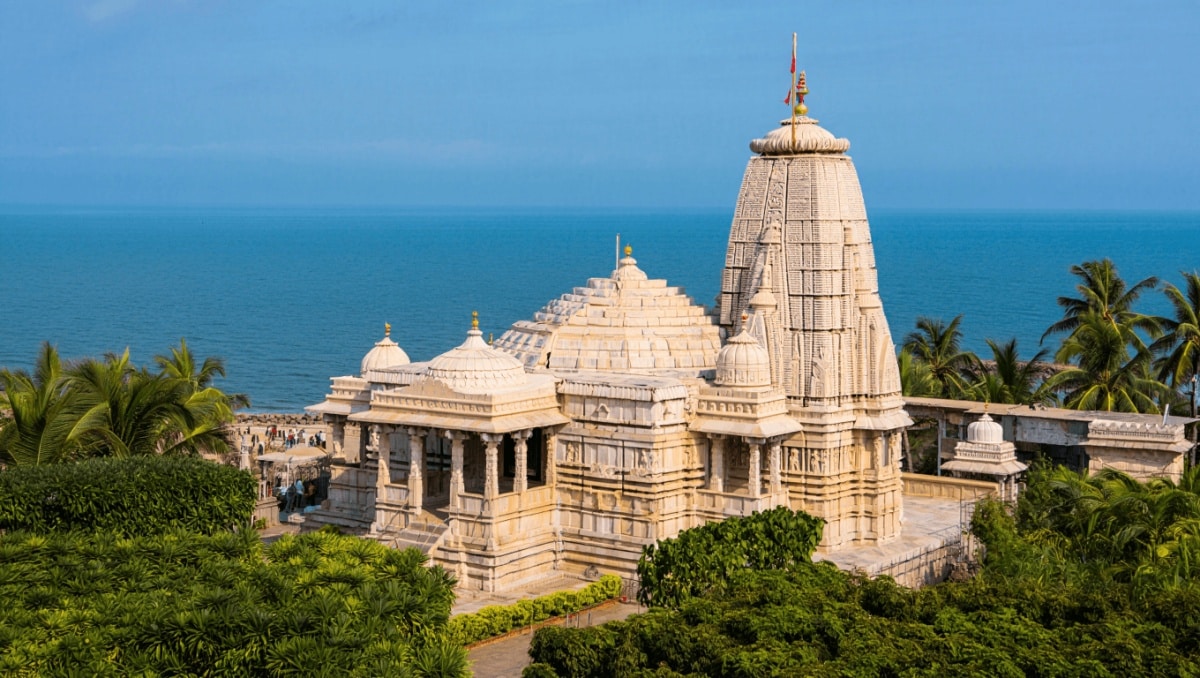
The contemporary complex presents an imposing skyline to the Arabian Sea. Features cited by the temple trust include a tall shikhara, a prominent dhwajastambha, numerous ornamental kalash and flag installations, and purpose‑built mandapas following classical prescriptions.
| Feature | Detail |
|---|---|
| Shikhara | Approximately 150 feet, topped with a heavy kalash |
| Annual footfall (trust figures) | Reportedly around 9–10 million devotees per year |
| Cultural elements | Light & Sound show, regular festivals and revived dance traditions |
Somnath Swabhiman Parv: what’s being observed
The events around 2026 have been organized under the banner of the Somnath Swabhiman Parv, a year‑long observance extending into 2027. Organizers have scheduled a mix of ritual, cultural and commemorative programs that include pilgrim yatras, public chanting, and cultural performances intended to tie the ancient site to contemporary civic narratives.
- January 2026: Extended chanting and a symbolic equestrian yatra held to open the observance year.
- End of April–May 2026: Special pilgrim trains and yatra convoys reached the temple ahead of the May 11 commemoration.
- May 11, 2026: High‑profile visit and formal events to mark the 75th anniversary of the 1951 consecration.
Beyond worship: the temple as an institutional actor
The Shree Somnath Trust oversees a range of social and environmental programs that go beyond liturgy. The trust reports initiatives in education, vocational training, waste management and community welfare intended to make the temple a local development anchor.
- Vocational and digital skills training, plus scholarships for students after secondary school.
- Waste‑to‑resource programs: composting floral offerings, converting plastic into building pavers, and rainwater harvesting systems.
- Conservation efforts including a large afforestation project and water purification work, and programs that prioritize women’s employment within temple operations.
- Crisis support: financial and material relief deployed during recent public‑health emergencies, according to trust releases.
What Somnath asks of visitors now
Sites of deep historical layering often invite two responses: spectacle or reflection. Somnath’s current framing emphasizes the latter. Organizers and some commentators describe the shrine as a repository of collective memory—not a prompt for grievance but an occasion to consider persistence and recovery.
That emphasis shapes the tone of public programming this year: ceremonies that recall loss alongside narratives of reconstruction and civic participation.
Practical notes for visitors
- Best season: October to March for mild weather, though the commemorative year extends beyond the immediate dates.
- Nearby sites: Bhalka Tirth, Triveni Sangam and other local tirthas can be combined into a multi‑day route.
- Must‑see: Evening aarti and the light & sound presentation that contextualizes the temple’s history.
- Accommodation: Local towns and trust‑run yatri facilites offer options; book ahead during festival spikes.
- Timing: If traveling from afar, allow 3–5 days to include nearby destinations like Dwarka and Gir.
May 11, 2026, will therefore read as both a commemorative anchor and a prompt for broader public discussion: how the nation’s sacred places are preserved, how communities around them are sustained, and what continuity means in a landscape shaped by centuries of change.
For many visitors the acts of arriving, offering and listening at the seafront shrine will be as significant as any official program—an encounter with a site whose story has been written and rewritten by generations.