
Show summary Hide summary
Uttar Pradesh’s chief electoral officer says the Election Commission does not collect voter information by religion or caste, challenging the basis of recent claims about Hindu and Muslim representation on the state’s rolls. He also cautioned that the gap between the state’s estimated adult population and its registered voters cannot be treated as a count of people removed during the latest revision.
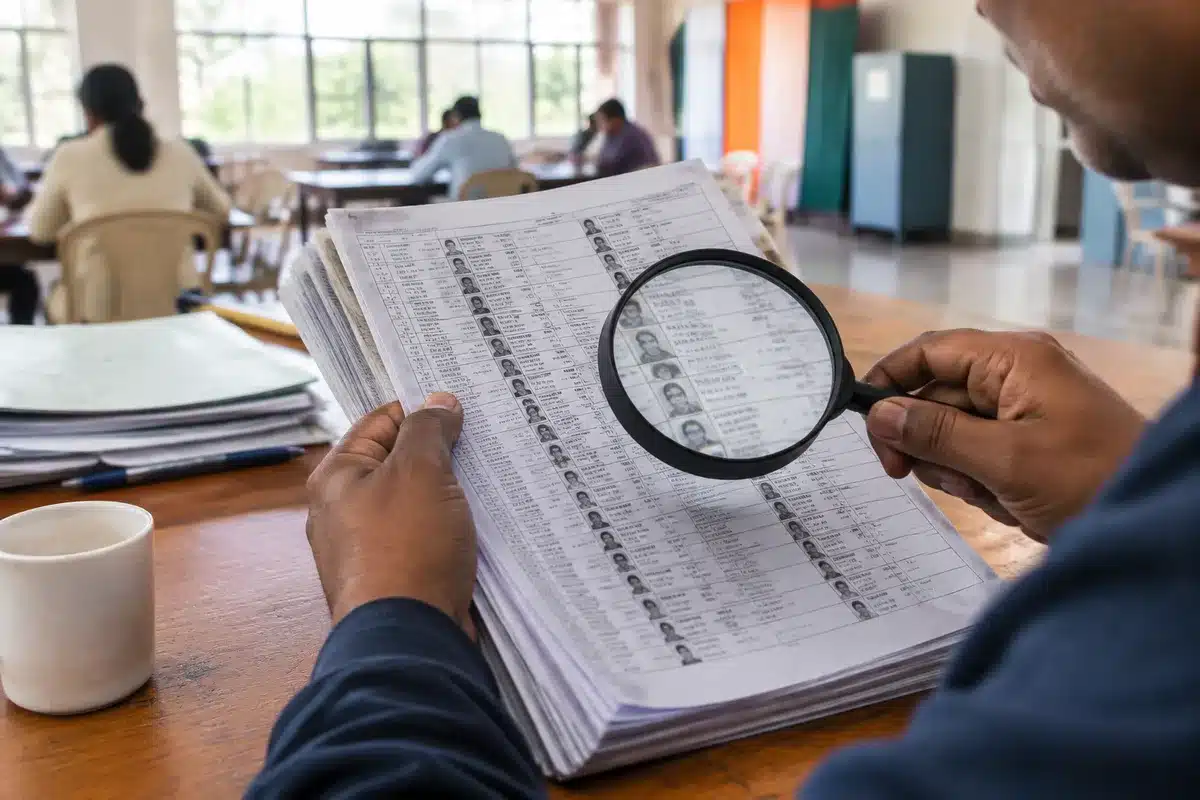
Chief Electoral Officer Navdeep Rinwa said the commission’s records include details such as voters’ names, age, gender, relationship information and house numbers, but no data on religious or caste identity. The clarification came after publication of the draft electoral roll under the Special Summary Revision 2027.
Chief Minister Yogi Adityanath had said that 1.27 crore Hindu voters were missing from the rolls and that the Muslim electorate had grown by 1.65% following a Special Intensive Revision. Samajwadi Party president Akhilesh Yadav questioned how those figures had been produced if the commission does not publish religion-based voter statistics.
Election Commission voter records omit caste and religion, UP chief says
Shankar series wraps as B.K. Modi sees global potential in Indian storytelling
How outside analyses may be produced
Rinwa said organisations could download electoral rolls made available as PDFs, convert them into databases and use software to classify names by likely religious affiliation. Such results would be estimates based on names, not official Election Commission data, he said.

The same kind of analysis could be attempted using gender, though the commission officially releases voter information by age and gender, according to Rinwa. He did not endorse the religion-based figures cited in the political claims.
He also rejected allegations that voters were being excluded on the basis of religion, caste or community. The distinction, he said, is important when interpreting the difference between the projected adult population and the number of registered voters: someone described as “missing” may never have enrolled, rather than having been deleted.
A local example shows why the numbers differ
Rinwa cited a verification exercise in Makhdumpur gram panchayat in Rae Bareli, where the panchayat voter list contained 1,987 names while the assembly constituency roll had 1,539. The comparison followed a public interest petition before the Lucknow bench of the Allahabad High Court.
Door-to-door checks found several explanations for the mismatch:
- Some people had died or moved away.
- Some women had changed residence after marriage.
- Some voters were registered at nearby polling stations.
- Some eligible residents appeared on the panchayat roll but not on the assembly list.
Officials identified 92 eligible residents in the last category and helped them submit Form 6 applications to register. Rinwa said checks showed that these voters had not been on the assembly roll even before the intensive revision, illustrating why the overall difference should not automatically be counted as deletions.
The chief electoral officer estimated that around 84% to 85% of eligible people are registered in Uttar Pradesh. Voter enrolment in India is voluntary, he said, and depends on citizens as well as booth-level officers, election officials and political parties.
Officials plan to step up efforts during the ongoing revision to identify eligible residents who are not registered and help them enrol ahead of the 2027 Uttar Pradesh Assembly elections.