This year’s wave of city proclamations recognizing Hindu life and festivals across Greater Sacramento illustrates a quieter, practical side of community advocacy: formal acknowledgement that shapes civic belonging and public awareness. For residents and public officials alike, these gestures have immediate consequences—from visibility for local charities to a platform to address Hinduphobia and support minority rights.
As California regional director for the Hindu American Foundation (HAF), I joined municipal ceremonies and neighborhood celebrations this fall, and what stood out was how routine civic rituals—mayor’s proclamations, council resolutions, a packed Diwali gathering—translate into tangible community outcomes.
My first assignment with HAF brought me to a Sacramento-area roundtable at the BAPS Hruday Milan forum, where leaders emphasized Hinduism’s diversity and shared beliefs. The discussion underscored a recurring theme across the events I later attended: cultural pluralism does not dilute civic contribution; it often strengthens it.
Kashi to Kedarnath costs revealed: how much a Sawan pilgrimage will set you back
Hinduism gains ground in Africa: new communities reshape culture and commerce
Over several weeks HAF helped secure formal recognition for October as Hindu American Awareness and Appreciation Month (HAAAM) across multiple jurisdictions, and also supported municipal proclamations for Diwali. Those proclamations are more than symbolic. Presented at city council meetings, they offer a public stage for community groups to present service projects, connect with officials and raise concerns.
- Where proclamations were issued: Davis, West Sacramento, Sacramento, Folsom, Rancho Cordova, Citrus Heights and Rocklin (seven HAAAM proclamations), plus multiple Diwali proclamations across the region.
- Notable civic partners: Elected officials such as Rancho Cordova councilmember Siri Pulipati and Sacramento councilmembers who joined events to present proclamations and participate in community activities.
- Community organizations present: Hindu Swayamsevak Sangh (HSS), Chinmaya Mission, Swadhyay, FOGS, Sewa and Annapoorna Foundation—groups active in service and outreach.
- Measured community impact: SewaDiwali’s month-long food drive distributed 8,528 lbs of food to 18 pantries across 16 cities in seven counties.
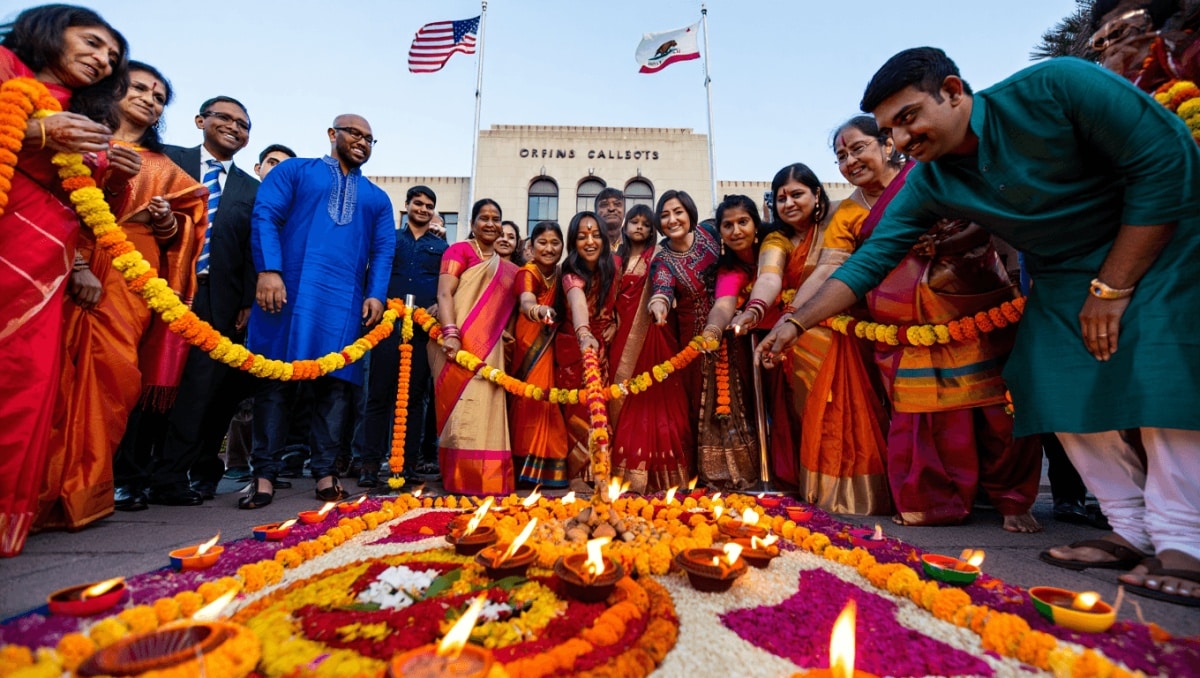
- Major cultural event: Elk Grove’s Diwali ceremony, organized with community leader Bhavin Parikh, drew roughly 900 attendees and included city officials and a community meal.
At Rancho Cordova, receiving a proclamation felt especially meaningful because the presenter—councilmember Siri Pulipati—represents a new wave of elected officials whose backgrounds reflect the region’s changing demographics. In Davis, conversations with UC Davis students highlighted another effect: young Hindu Americans are using these civic moments to assert identity on campus and in public life.
The work also extended beyond U.S. borders. HAF hosted Ramesh Jaipal, a Pakistani Hindu human-rights activist, during a U.S. visit timed with Navratri. His presence at a Rancho Cordova proclamation and later at Garba and Dandiya events brought cross-border connections into local civic ceremonies—an important reminder that cultural advocacy often intersects with human-rights concerns.
These occasions blended ceremony and service. Officials joined community volunteers for Diwali festivities and for the Samarop closing of SewaDiwali; they ate the same meals, took the same photos and publicly commended the region’s charitable efforts. Those gestures help normalize participation across communities and create opportunities to address discrimination in public forums.
Looking ahead to 2024, community advocates see several practical priorities: expand awareness campaigns, deepen partnerships with city governments, and continue documenting local service work so that proclamations are followed by measurable support for minority groups. The events this fall created momentum; turning recognition into policy and sustained engagement will be the next test.
Why this matters now: Municipal proclamations and public celebrations provide immediate visibility when national debates about identity and minority rights remain active. For Hindu Americans in California—many of whom are civic professionals, students and volunteers—these recognitions reduce marginalization, strengthen local networks and create routine channels to raise concerns.
As someone early in a regional advocacy role, the experience has reinforced a core lesson: civic honors—when paired with concrete service and outreach—can shift how communities are seen and treated. That combination of visibility and action is what advocacy organizations will need to sustain in the months ahead.