Show summary Hide summary
The site in Ayodhya where a new temple to Lord Ram is rising has long been central to Indian history and politics. Recent construction and the 2019 Supreme Court decision have turned an archaeological and legal dispute into a live issue with real consequences for communal relations, heritage claims and local life.
What the excavations say
Surveys carried out under the Archaeological Survey of India, with observers representing different parties to the dispute, uncovered structural remains and artifacts consistent with long-standing ritual use. Findings include carved sandstone fragments, architectural pillars and ritual objects that scholars interpret as evidence of significant sacred constructions predating the modern era.
Kashi to Kedarnath costs revealed: how much a Sawan pilgrimage will set you back
Hinduism gains ground in Africa: new communities reshape culture and commerce
Those layers, which researchers date to several centuries before the common era through the medieval period, are central to arguments that the location known to many as Ram Janmabhoomi functioned as a place of worship for a long span of time. Excavators also reported masonry suggesting a large temple complex immediately beneath the foundations of the structure later identified as the Babri Masjid.
A long-running legal and political dispute
Conflicts over the site did not begin in the age of mass media. Records show contested claims stretching back into the 19th century, and courts have heard competing petitions for more than a century.
During British rule, certain outer parts of the precinct were accessible to Hindu and Sikh worship, while inner areas remained in use for Muslim prayer. In 1949, after a murti was placed inside the mosque, authorities closed the compound and treated it as a disputed property; from that point onward formal Muslim prayers at the location ceased.
Decades of litigation and political mobilization culminated in a large rally at the site in December 1992, when the mosque was demolished. The event sparked widespread violence across India and marked a turning point in how the location was framed in public life. In 2019, India’s Supreme Court directed the disputed land to a trust to build a Hindu temple and allotted alternate land nearby for a new mosque.
Key dates and turning points
- Circa 2000 BCE — Archaeological layers indicate ritual occupation in antiquity.
- 1520s — Archaeological and historical accounts point to medieval-era temple construction followed by the erection of a mosque at the site.
- 1820s–1850s — Local records note claims and ceremonial activity asserting the site’s association with Lord Ram.
- 1885–1960s — Multiple civil suits and petitions filed by Hindu and Muslim parties over possession and worship rights.
- 1949 — A murti was installed inside the mosque; authorities declared the compound disputed and closed it for regular Muslim prayer.
- 1992 — A mass rally escalated into the demolition of the mosque and subsequent communal violence across India.
- 2019 — The Supreme Court awarded the main plot for a Hindu temple and ordered separate land to be provided to Muslims for a mosque.
What comes next
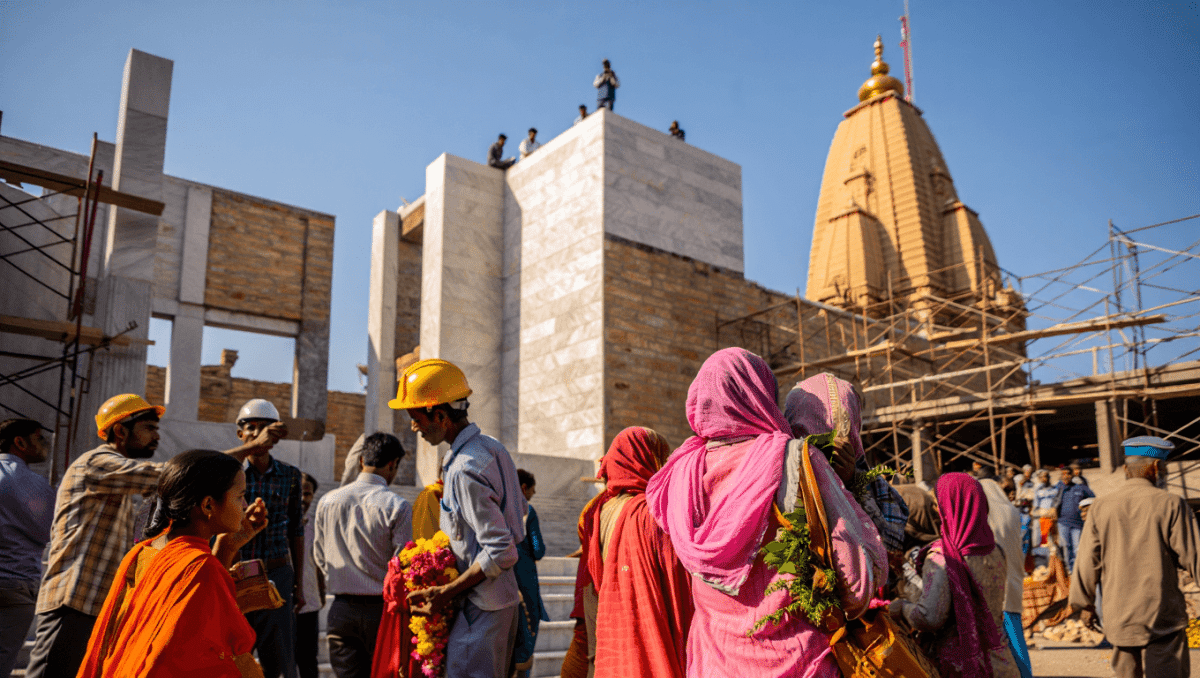
Work on the temple complex is expected to take several years. Nearby, plans for a new mosque—referred to in official statements as the Masjid Muhammad Bin Abdullah—anticipate a large capacity, with authorities saying it will be one of the largest mosques in the country when finished.
The outcome matters beyond construction timelines. For many Hindus the rebuilding represents a form of restorative recognition of a long-grievanced history; for many Muslims the loss of a historic place of worship and the political fallout remain sources of grievance. The site’s recent legal resolution does not erase those social and emotional legacies.
Broader implications
The Ayodhya case illustrates how archaeological evidence, legal processes and mass politics can intersect to reshape contested heritage sites. It also highlights several practical consequences that will play out locally and nationally: increased pilgrim traffic, security and policing needs, and continued scrutiny of how state institutions manage communal claims.
While construction progresses, observers caution that the deeper challenge is social: creating frameworks that allow competing historical attachments to be acknowledged without escalating into renewed conflict. How communities, civil society and government navigate that balance will determine whether the present chapter leads to longer-term reconciliation or further polarization.
Rendering of the planned temple complex.