Show summary Hide summary
As debates about moral authority and public purpose echo across democracies in 2026, the life of Siddhartha Gautama — who became known as the Buddha — offers a compact map of questions many societies still face: how to respond to suffering, how to balance personal comfort with social responsibility, and how ideas travel from a single life into global movements. The contours of his story, preserved in centuries of tradition, continue to shape practices from mindfulness courses to statecraft rhetoric.
- Born into privilege: traditional accounts place his birth in a ruling family on the Nepalese frontier about 2,500 years ago.
- Renunciation: confronted by illness, aging and death, he left palace life to seek a lasting solution to suffering.
- Awakening via the Middle Way: after years of austerity he discovered a path between extremes, summarized by the Four Noble Truths and the Noble Eightfold Path.
- A teacher for life: he spent roughly four decades traveling and instructing disciples across northern India.
- Long reach: patronage and later adaptations helped Buddhism spread across Asia and into the modern global religious landscape.
Shah Rukh Khan used the name Abinav to ease in-law worries: Gauri adopted Ayesha during nikaah
Javed Akhtar hails Hindu festivals as cultural glue: throwback of atheist celebrating resurfaces
Origins and early life
Accounts compiled in later centuries describe Siddhartha as the son of Suddhodana, a tribal ruler, born near Lumbini on a full-moon day of Vaisakha. Those narratives emphasize circumstances meant to keep him insulated — palaces built for different seasons, a luxurious education, and early marriage — framing his later choices against a backdrop of privilege and protection.
Scholars treat such details cautiously; they are best read as elements of a religious biography that highlight the contrast between the sheltered court and the realities that would prompt his leaving.
Seeing the world beyond the palace
Traditional stories place pivotal moments in a series of encounters outside the palace gates: an elderly person, a sick person, a corpse, and finally an ascetic who had renounced worldly ties. These “four sights” are presented as the triggers for Siddhartha’s radical break with the life planned for him.
One night, while his family slept, he cut his hair, shed princely garments, and walked away from home — an act that signals the seriousness of his search for a solution to human suffering rather than a symbolic dramatic gesture.
From austerity to the Middle Way
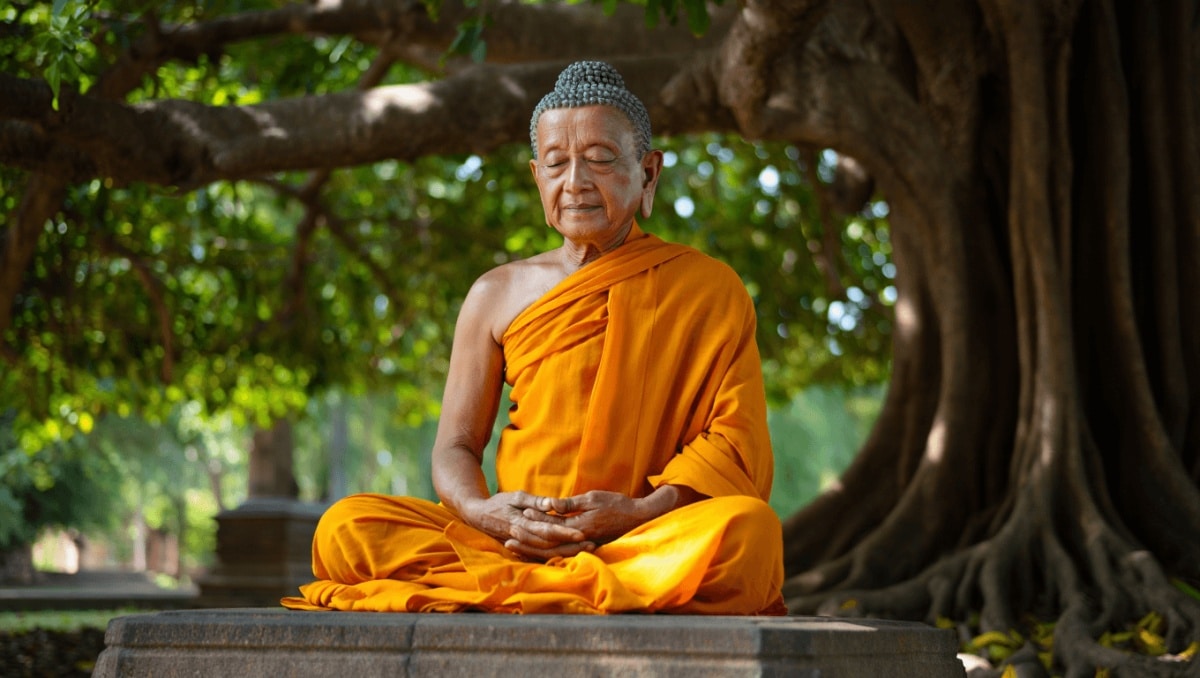
After studying with established meditation teachers and subjecting himself to extreme ascetic practices, Siddhartha concluded that neither luxury nor self-starvation offered a permanent end to suffering. Sitting beneath a pipal (fig) tree, he resolved not to rise until he found what he called enlightenment.
His awakening is traditionally described in stages — recollection of past lives, insight into the workings of karma, and finally the realization now summarized as the Four Noble Truths. Out of that insight came the practical program known as the Noble Eightfold Path, a balanced approach later called the Middle Way.
Teaching and institution building
After his awakening, he did not remain solitary. He turned to those who had known him earlier and then to new followers, gradually organizing an order of monks and nuns to preserve and transmit his teachings. Over roughly forty-five years he traveled across regions now in northern India and Nepal, preaching, advising rulers and ordinary people, and attracting students who themselves became teachers.
That lifetime of teaching created a living tradition: oral transmission, community structures, and ritual practices that allowed the message to outlast its founder.
From local movement to global religion
Political patronage played a decisive role in the expansion of Buddhism. In the third century BCE, the Mauryan emperor Ashoka embraced Buddhist principles after the costly Kalinga campaign and promoted the faith across his realm through monuments, monasteries, and missionary activity.
Over the following centuries, Buddhism diversified into many schools and spread through trade routes and imperial networks to Central and Southeast Asia, East Asia, and later the West. Today, with roughly half a billion adherents and widespread cultural influence, Buddhist ideas inform not only religious life but also secular practices such as mindfulness-based therapies.
The modern reach of these teachings shows how a set of practical reflections on suffering and ethical conduct can be reinterpreted across eras and societies.
What the story means now
Why revisit this biography in 2026? For readers confronting institutional distrust, public-health crises, climate-related anxieties or growing inequality, the Buddha’s journey underscores two enduring points: first, that personal insight is often forged by confronting uncomfortable truths; second, that individual discoveries can become collective frameworks when institutionalized — for better and for worse.
Contemporary discussions about mental health, nonviolence, and ethical leadership borrow language and techniques from these traditions. Observances such as Vesak keep the life-cycle of the Buddha visible, while secular adaptations of meditation have entered clinical and corporate settings, raising fresh questions about cultural transmission and fidelity.
Whether treated as religious heritage or a source of practical tools, the narrative of Siddhartha’s life remains a concise case study in how ideas travel from a single life into institutions that reshape centuries of thought and practice.