Show summary Hide summary
- Arriving with low expectations and leaving surprised
- Getting there and what the walk feels like
- The Sangam and the mood on the banks
- Rituals, smoke and the evening aarti
- In the camps: sadhus, akhadas and everyday devotion
- Practical takeaways for visitors
- What the Kumbh reveals about governance and culture
The Maha Kumbh Mela in Prayagraj is not just a religious festival—it is one of the largest human gatherings on earth, a test of logistics, faith and endurance. With official tallies putting attendance in the hundreds of millions this season, the event offers urgent lessons about mass movement, public health and cultural continuity that resonate beyond India.
Arriving with low expectations and leaving surprised
I went intending to document the experience as a photographer and observer, uncertain whether a single visit could match the hype. Many of the moments that seemed likely to move me—brief blessings, ritual hugs, staged ceremonies—felt as thin as postcards in the past. What changed, unexpectedly, was the cumulative power of being in that place: proximity, pace and the sheer human tide turned otherwise ordinary impressions into something quietly affecting.
Shah Rukh Khan used the name Abinav to ease in-law worries: Gauri adopted Ayesha during nikaah
Javed Akhtar hails Hindu festivals as cultural glue: throwback of atheist celebrating resurfaces
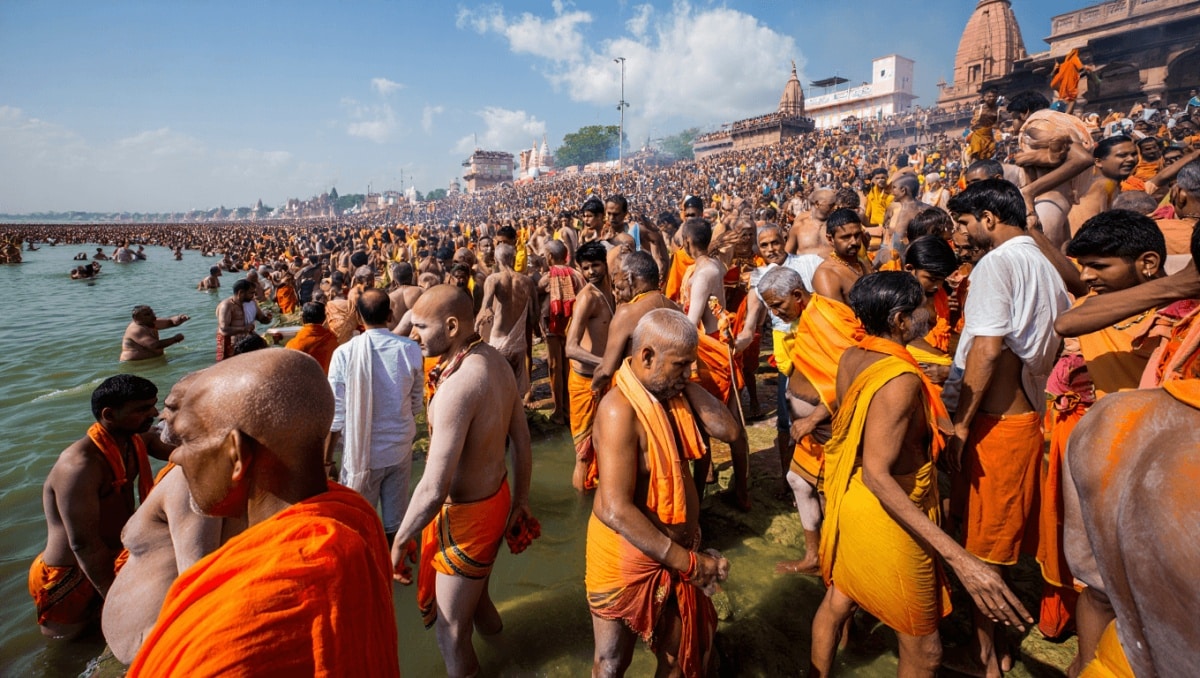
The official estimate released after the festival—roughly 660 million visits, counting repeat attendances—helps explain why ordinary elements become extraordinary when multiplied: rows of tents, endless streams of pilgrims, dozens of simultaneous rites. When millions converge, small gestures and routine rituals acquire a broader gravity.
Getting there and what the walk feels like
Prayagraj’s mela grounds are deceptively large. From the nearest vehicle access point to the river’s edge is often more than a mile, and moving between spiritual camps can eat up another two miles at a stretch. On a full day of exploring it’s common to walk 8–10 miles without realizing it.
Paths change character as you progress: paved approaches lined with vendors, then dirt tracks, then sand and reeds near the ghats. The crowds thin and swell unpredictably; sometimes you’re in a market-like throng, other times in quieter channels that lead to the water.
The Sangam and the mood on the banks
Close to the confluence—where the Ganga and Yamuna meet and the rituals are centered—the tone shifts. The sand has a different texture, the air a cooler, river-scented hush. Spontaneous chants and shouts of devotion punctuate the landscape, but they coexist with laughter and children playing in the shallows.
At the water’s edge the atmosphere varied from solemn puja to something almost like a seaside picnic. Pilgrims filled bottles of river water, scooped handfuls of sand to carry home, or simply waded and socialized. Floating barriers and local volunteers kept a loose order along the current, which moves faster than you might expect.
Rituals, smoke and the evening aarti
Each evening, ghats organize aarti—fire-lit river ceremonies that draw large crowds. One prominent group that I watched mixed music, Sanskrit and vernacular addresses, and a call to reduce single-use plastics. Given the scale of the event, however, serenity must often be found in one’s own head rather than in the surroundings.
Elsewhere, the sensory landscape was raw: smoke from incense and ritual fires, clouds of dust from unpaved lanes, and the pungent, lingering smoke from cow-dung pyres used in some ascetic practices. These fires are central to some sadhus’ sadhana but can be harsh on the eyes and lungs for casual visitors.
In the camps: sadhus, akhadas and everyday devotion
Visits to akhadas—the traditional monastic camps—reveal a range of lifestyles. Some sadhus are approachable and talkative; others seem aloof by custom. For many pilgrims, interactions are brief: a token donation, a brush of a peacock feather, a short blessing and then on to the next site. But spending time in a camp changes that dynamic, exposing how materially austere and rhythmically different these lives can be.
At one akhada, ritual smoking paraphernalia circulated freely, and communal bhajan singing drew a small cluster of visitors into an intimate, almost private, exchange of devotion and song. In another corner, ascetics sat in meditative postures amid columns of smoke from cow-dung fires—an endurance test that underlines how layered and demanding some practices are.
Practical takeaways for visitors
- Expect to walk a lot—plan comfortable footwear and limit how much ground you try to cover in a single day.
- Air quality varies—carry a mask if you’re sensitive to dust, smoke or pollution.
- Bring small denominations—most interactions and offerings involve modest sums.
- Water and hygiene—drink bottled or treated water and keep hand sanitizer handy; sanitation teams do a huge job, but conditions can be basic.
- Respect diversity—rituals range from meditative to celebratory; observe, ask permission before photographing individuals or private rites.
What the Kumbh reveals about governance and culture
Beyond its spiritual charge, the Kumbh is a logistical achievement and a stress test for municipal services, health systems and crowd management. Authorities deploy volunteers, sanitation crews and safety measures, yet the event also exposes limits—ongoing air and water quality challenges, strain on local infrastructure and the difficulty of maintaining order across such a dispersed site.
For policymakers, the mela underlines the need for sustained investment in public health, waste management and transport planning; for cultural observers, it demonstrates how ritual practice adapts under pressure. Pilgrimage, in this context, is both a personal act and a massive public event with real-world consequences.
Leaving Prayagraj, the image that stays is not one dramatic tableau but the steady rhythm of people arriving, performing brief acts of devotion, and moving on—an immense, recurring movement that is part faith, part social theater, and entirely human.