Show summary Hide summary
A short drive from Haridwar lands you in Rishikesh, where the river defines both ritual life and local priorities. Recent visits reveal a town balancing spiritual tourism with a stronger public push toward environmental stewardship — a shift with practical consequences for visitors and residents alike.
Staying at Parmarth Niketan
Invited by friends who work there, I spent several days at Parmarth Niketan, one of Rishikesh’s larger ashrams. The community emphasizes care for the environment in daily practice, and its teachings, led by the resident guru, place the river at the center of devotion. Greetings here often include a shared salute to the Ganga.
Shah Rukh Khan used the name Abinav to ease in-law worries: Gauri adopted Ayesha during nikaah
Javed Akhtar hails Hindu festivals as cultural glue: throwback of atheist celebrating resurfaces
The complex is orderly but alive: a prominent Hanuman statue greets pilgrims, courtyards ring with temple bells, and a large banyan anchors a calm open space lined with smaller tree shrines, including a Navagraha sanctum. Meals are communal and straightforward, and the schedule follows a steady rhythm.
Days at the ashram begin before dawn with group sadhana and include morning and evening Hatha sessions alongside regular satsangs. Each evening ends with a riverside ritual — the Ganga Homa — where attendees gather at sunset.
Why the river matters
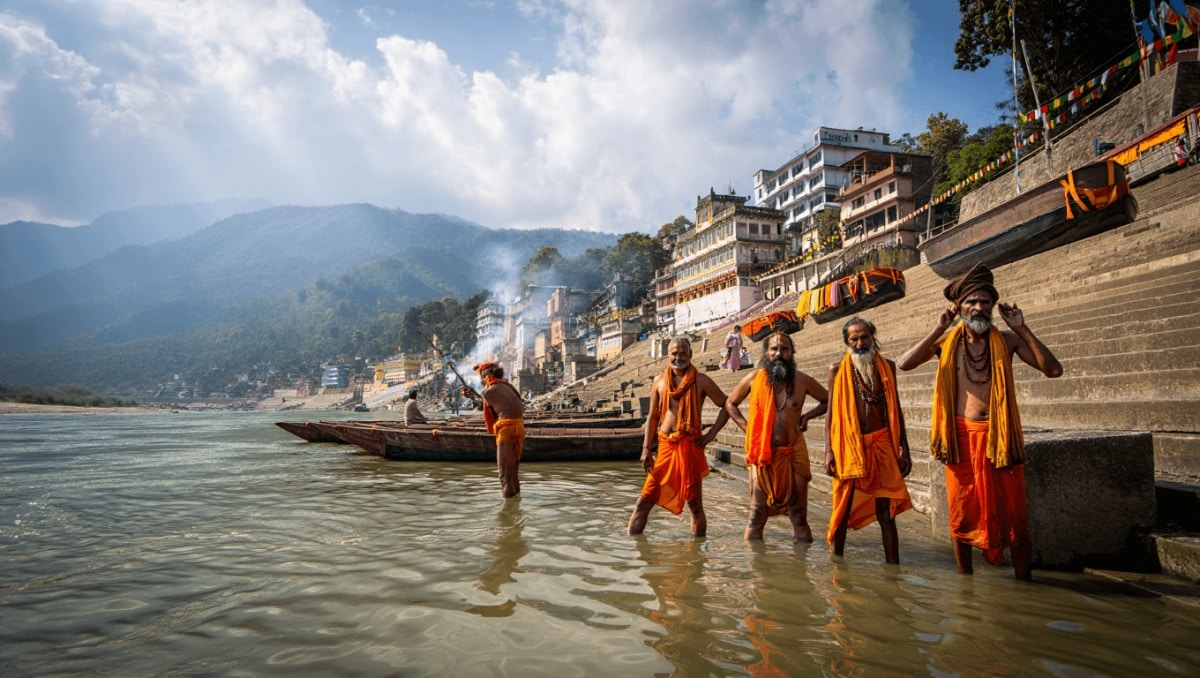
The spiritual identity of Rishikesh is inseparable from the river that flows through it. Spending time along the banks makes that clear: people come to bathe, to pray, and simply to listen to the current. Even the town’s informal markings — paint on bridge railings and messages along the ghats — testify to a local, deep attachment to the water.
Beyond the ghats, the landscape is lush: side streams and small waterfalls feed the main channel, tropical foliage creates pockets of shade, and long-tailed langurs move through the trees in noisy bands. Dozens of temples and ashrams line the river, staffed by pujaris and apprentices who keep ritual life moving from dawn to dusk.
On the morning of October 10, following a local recommendation, I climbed the tower at Bhootnath Temple to watch the sunrise over the town. From that vantage the river and the surrounding hills reveal how closely faith and geography are intertwined here.
Into the hills: Neelkanth Mahadev and Yamkeshwar
Leaving the town, we rose into the Himalayan foothills to the Yamkeshwar area of Pauri Garhwal. The drive crosses heavily wooded slopes — stands of kadamba and other less-common trees — and valleys threaded by vivid rivers and terraced fields. It’s a landscape often described as an earthly paradise for its lushness and quiet.
At our destination, Neelkanth Mahadev, a spring-fed temple sits in a shaded hollow. Bathing in the clear stream there felt like stepping into a long-lived local tradition; the water, and the temple that frames it, carry an unmistakable sense of history and ritual continuity.
On the return descent we paused at Kali Kund, a small sacred pool known locally for its significance and scenic setting. It proved a calm counterpoint to the busier ghats below.
The abandoned Maharishi ashram: nature’s reclamation
One of the most striking stops was the derelict ashram once led by Maharishi Mahesh Yogi. Largely abandoned since the 1970s, the compound has been taken back by the forest. Stone-and-mud meditation huts — once home to hundreds of residents and visitors — are now wrapped in vines and punctuated by new murals and local artworks.
In its heyday the place drew international figures and artists. Names associated with the ashram underscore its global reach, but today the site reads as a quiet, overgrown archive of that history: crumbling walls, 108 small meditation cells, and the slow work of rainforest restoration. Management by a government conservation body means parts of the area are now maintained and again open to visitors, but the mood remains one of gentle, haunted memory.
- What to expect: early-morning rituals, communal meals, and simple accommodations at major ashrams.
- Practicalities: steep climbs and narrow roads outside town — allow extra travel time and confirm transport options in advance.
- Etiquette: modest dress at temples and ashrams, and respect requests around photography during rituals.
- Conservation: many communities emphasize zero-litter practices and river protection — support these efforts by following local rules.
Visiting Rishikesh and the nearby hills offers both active pilgrimage and a close-up look at how spiritual practice and environmental concerns intersect. For travelers interested in contemporary religious life, conservation efforts, or simply dramatic river-and-mountain scenery, the region rewards slow, attentive travel.
Note: This trip took place in autumn 2022. The article’s site and temple details were checked and are current as of mid-2025, but practical arrangements such as transport and opening hours can change quickly; verify logistics before you go. All photographs accompanying this piece are credited to Devala Rees.