Show summary Hide summary
A short drive from Uttarkashi leads to a small, seldom-discussed lake whose story reaches back into the Upanishads and still shapes local pilgrimage and culture today. For travelers and readers interested in Himalayan heritage, Nachiketa Tal offers a rare mix of ancient myth, quiet high‑forest hiking and practical travel logistics worth knowing before you go.
The ancient story behind the lake
The lake takes its name from the Vedic tale of Nachiketa, found in the Kathaka Upanishad of the Krishna Yajurveda. In the legend, a young boy challenges his father over the sincerity of a sacrificial gift and is sent to the doorstep of Yama, the god associated with death. Nachiketa waits at Yama’s gate for three days and, in return for the delay, is offered three boons.
Shah Rukh Khan used the name Abinav to ease in-law worries: Gauri adopted Ayesha during nikaah
Javed Akhtar hails Hindu festivals as cultural glue: throwback of atheist celebrating resurfaces
He first asks for reconciliation with his family, then for instruction in a sacred fire ritual, and finally for knowledge of what lies beyond death. Rejecting worldly temptations, Nachiketa persists and receives the teaching of the Self — the Upanishadic core often referred to as Atma Vidya. Tradition says he returned enlightened and established an ashram by a nearby lake now called Nachiketa Tal, where serpent‑deity myths — including a local belief in a resident Naga — later became attached to the site.
On the ground: what the place feels like
From Uttarkashi the journey is short — roughly 26 kilometres into the Dunda hills — reaching the small settlement of Chauranghi Khal, which remembers a line of Nath yogis through a modest temple and the name of Guru Chauranghi Nath.
The trail to the lake climbs about five kilometres through a dense stand of rhododendron and moss‑slicked logs. The forest is hushed in a way that contrasts sharply with the constant roar of the Ganges farther down the valley; birdsong is sparse and the quiet can feel unexpectedly heavy.
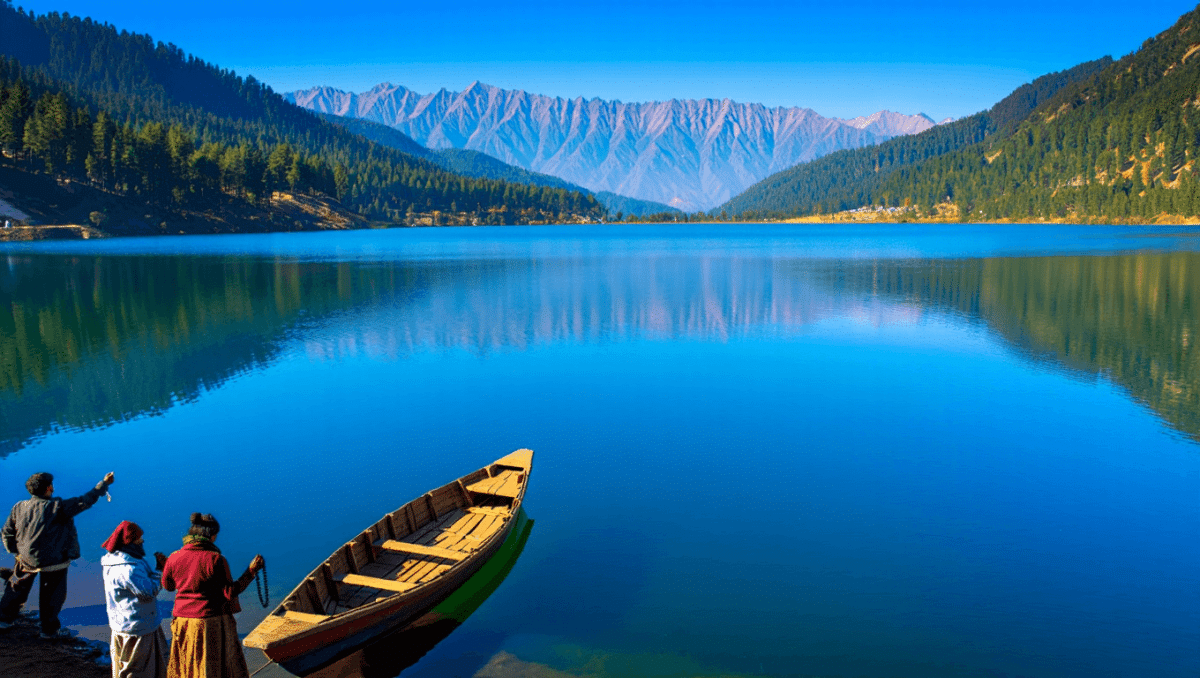
At the shoreline, the lake sits ringed by old rhododendrons, one tree branching into five massive trunks like columns. Waterfowl were scarce, but the lake was teeming with fish; locals feed them from the shore. A small temple dedicated to a snake deity stands near the water and is tended by an elderly sadhu. The overall mood of the place struck me as solemn rather than festive — some visitors describe it as eerie, others as quietly sacred.
Villagers in the area were welcoming: we were offered chai without any hint of solicitation. English is uncommon; Hindi and local dialects are used. While exploring hilltops above the forest we met goatherds lounging in the shade — a vivid reminder of how different life here feels from urban routines. They pointed the way to a sunken pit in a nearby field said to be the entrance to Yama’s realm, a short walk from the lake.
Practical details for visitors
- Distance and travel time: Approximately 26 km from Uttarkashi; plan around an hour by road depending on conditions.
- Hike: About 5 km one way through uneven, sometimes slippery forest terrain — moderate fitness required.
- Facilities: Minimal. A small temple and a few village homes; carry water, snacks and basic first‑aid supplies.
- Language: Hindi and local dialects are spoken; English is uncommon among villagers.
- Best time to go: Clear autumn and spring months for safer roads and better visibility. Monsoon brings sudden rain and slippery trails.
- Local etiquette: Respect temple spaces, ask before photographing people, and accept hospitality with modesty.
On our return we narrowly missed a sudden mountain downpour — a reminder that weather can change quickly above 2,000 metres. Cell coverage is patchy in places, and road or trail conditions can vary from season to season, so leave extra time in your itinerary.
Note: This account is based on a trip taken in autumn 2022; the descriptive and logistical details have been checked and are current as of mid‑2025. Conditions such as access roads and local services can change, and travellers should verify the latest information before visiting. All photos credited to Devala Rees.