Show summary Hide summary
Mentioned in ancient Tamil literature and celebrated across South Asia and the diaspora, Murugan remains a living symbol of regional identity and spiritual tradition. From hill shrines in southern India to large public ceremonies at Batu Caves and cities abroad, his festivals and myths continue to shape community life and cultural diplomacy today.
Roots in a landscape-based faith
Early Tamil writings organized sacred life around distinct environments — shore, field, forest, dry land and hills — each with its own guardian deity. Of these, the mountain god rose to particular prominence among Tamil-speaking communities and became widely known as Murugan, a youthful figure embodying strength, fertility and vitality.
Shah Rukh Khan used the name Abinav to ease in-law worries: Gauri adopted Ayesha during nikaah
Javed Akhtar hails Hindu festivals as cultural glue: throwback of atheist celebrating resurfaces
That regional imprint remained resilient as broader Hindu traditions absorbed and reinterpreted local beliefs. Murugan’s bond with the hills and rivers of southern India explains both his iconography and why temple rituals often emphasize pilgrimage and seasonal cycles tied to the land.
More than a warrior: multiple roles across traditions
Colonial-era descriptions sometimes reduced Murugan to a “war god,” but his role in lived practice is far more nuanced. Different sects and communities emphasize different aspects of his persona:
- Shaiva: a meditative master guiding aspirants toward Shiva.
- Shakta: a protective, energetic presence in the service of the Goddess.
- Vaishnava: a champion of dharma and devotion.
- Smarta: a figure exemplifying unity within diversity.
He is also known by many names — including Skanda, Subrahmanya and Senthil — each highlighting a different attribute. In Sri Lanka, Buddhists revere a local manifestation under the name Kataragama Deviyo, reflecting his cross-religious appeal.
Birth, the spear, and transformation
Classical narratives describe Murugan as the son of Shiva and Parvati, born under extraordinary circumstances to confront a tyrant who threatened cosmic order. According to these accounts, Shiva’s sparks were nurtured into divine children and ultimately merged into a single, six-faced youth.
Parvati’s gift to him — the Vel, a celestial spear — becomes the symbol of discernment and truth rather than mere martial prowess. In the decisive confrontation with the demon Surapadman, the story culminates not only in victory but also in transformation: enemies become a peacock and a rooster, adopted as Murugan’s vehicle and emblem. The tale underlines a recurring theme — restraint, restoration and the subduing of ego rather than gratuitous violence.
Two consorts, one cultural statement
Murugan’s marriages are told in ways that mirror social synthesis. One consort, Devayani, links him to classical Vedic and courtly spheres; the other, Valli, is rooted in hill-country tribal life. Their stories — one formal and ritualized, the other spontaneous and earthy — are often interpreted as metaphors for the blending of institutionalized religion with local, folk practices.
Together they represent how ritual discipline and spontaneous devotion each have a place in spiritual life: rules and celebrations, ceremony and longing, the settled and the wild.
Festivals and public practice
Murugan’s calendar is rich, but a few observances stand out for scale and public visibility. Pilgrims and devotees travel long distances to participate, sometimes under extreme physical austerities, which are understood as modes of spiritual purification.
- Vaikasi Visakam — marks his birth or manifestation.
- Skanda Sashti — commemorates his victories over demonic forces.
- Panguni Uttiram — associated with his marriages.
- Thaipusam — the most widely observed, noted for processions, the carriage of offerings and acts of self-discipline.
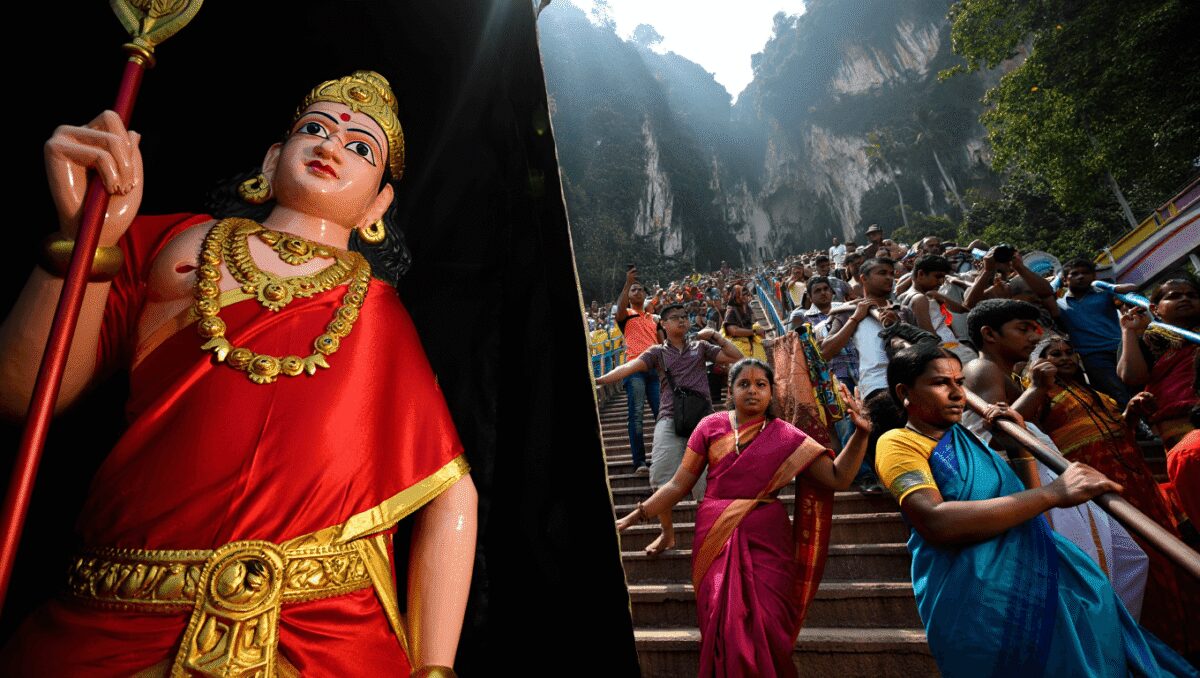
Thaipusam in particular draws global attention. Celebrations range from intimate village rites to mass pilgrimages such as the annual climb to the hill shrine at Batu Caves, where a towering golden statue marks the modern face of an ancient devotion. Central to many observances is the practice of carrying a kavadi — a ceremonial burden meant to imitate earlier mythic acts of service and endurance.
Why Murugan matters now
In an era of increased migration and cultural exchange, Murugan’s traditions are part of how communities preserve identity while engaging public life abroad. Temples and festivals serve both religious and social functions, transmitting language, music, cuisine and ritual knowledge across generations.
At the same time, the deity’s stories — about guidance, moral courage and turning hostility into service — continue to be cited in contemporary conversations about reconciliation, heritage preservation and community cohesion.
Quick reference: Names and themes
- Murugan / Kumara — youthfulness and vitality.
- Skanda — agility and swiftness, often linked to martial leadership.
- Subrahmanya — spiritual transparency and purity.
- Vel — symbol of wisdom, discernment and liberation.
- Kavadi — embodied devotion through bearing ritual load.
Murugan’s narrative and festival life offer more than mythic spectacle: they provide living frameworks for meaning, belonging and ethical imagination across a wide and changing world.