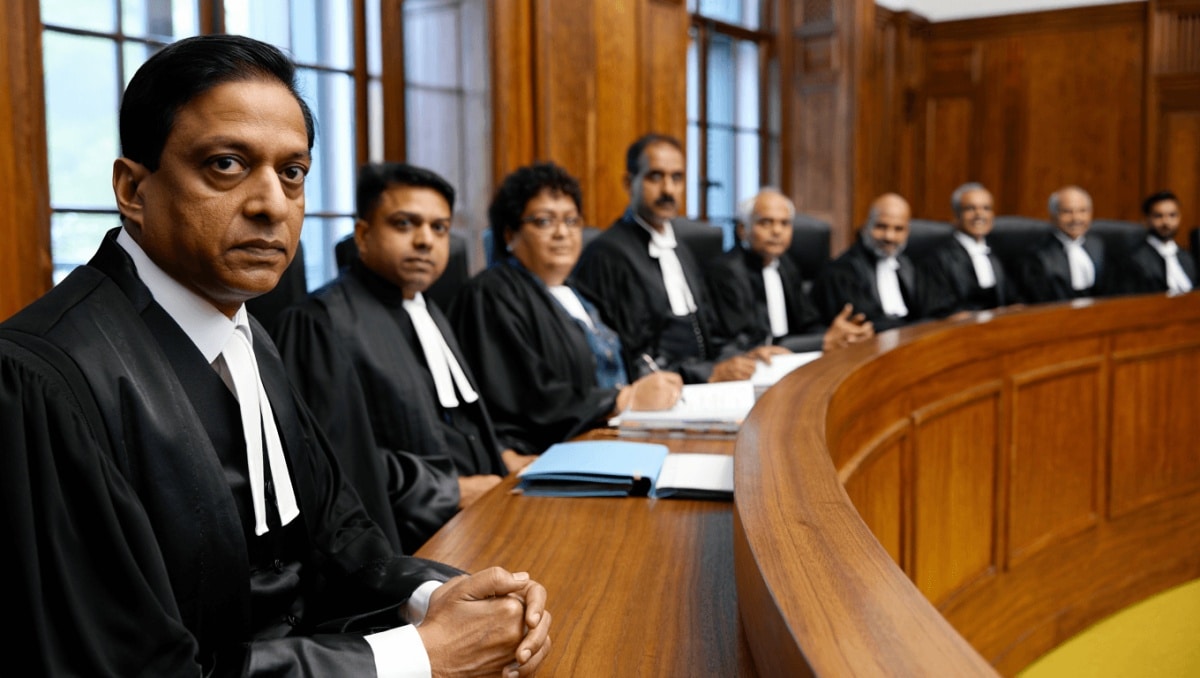
The Supreme Court’s nine-judge bench, led by Chief Justice Surya Kant, signaled on Tuesday that courts should tread carefully before intervening in religious customs — saying substantial changes to faith-based practices are better left to elected bodies. That stance could shape how future challenges to temple rules and community rites are resolved, and it heightens the stakes for ongoing disputes such as the Sabarimala entry controversy.
The bench — which includes Justices B.V. Nagarathna, M.M. Sundresh, Ahsanuddin Amanullah, Aravind Kumar, A.G. Masih, P.B. Varale, R. Mahadevan and Joymalya Bagchi — made the observations during the 14th day of a broader hearing on the conflict between religious freedom and fundamental rights.
Chief Justice Kant urged restraint, noting that courts are not well placed to rework a wide array of religious customs across the country. He said that if citizens, through their legislators, call for social reform and Parliament or a state assembly enacts a law, courts will accept that exercise of democratic authority; but if such a law is challenged as an improper intrusion into religion, the judiciary will then test its legality.
Annamalai applauds Bhagwat’s message on Muslim inclusion in India
Navratri in Times Square goes viral: social media splits over Indian celebrations abroad
Senior advocate Jaideep Gupta, appearing for the Kerala government, told the court that when a religious practice is disputed, the court must decide whether that practice is essential to the faith. He argued that the inquiry should be anchored in the religion’s own tenets rather than judged solely by constitutional norms.
Justices Nagarathna and Aravind Kumar responded by drawing a distinction between secular processes tied to religious institutions and strictly religious qualifications. They observed that while the method of appointing temple priests can be seen as a secular administrative matter, the criteria defining who may serve as a priest are essentially religious.
- Practical limits: The bench highlighted the difficulty of evaluating thousands of local rituals and practices across different faiths.
- Legislature first: Major changes to religious customs, the court suggested, should originate from Parliament or state assemblies reflecting public will.
- Judicial review: If lawmakers pass reform measures that are later challenged, courts will examine whether those laws unlawfully interfere with religion.
- Case examples: The Sabarimala dispute — which involves restrictions on women aged roughly 10–50 entering the Ayyappa temple — and debates over hereditary appointment of archakas were discussed as concrete illustrations of these tensions.
The bench’s comments came as the Kerala government shifted its position on the Sabarimala practice, underscoring how political decisions can alter the legal battleground for religious customs. Chief Justice Kant emphasized the judiciary’s limited capacity to assess the “essentiality” of diverse rites across multiple shrines and communities.
Arguments in the case were expected to continue, with counsel and justices probing where the line should fall between constitutional protections and religious freedom. The outcome will have clear consequences for how future claims — whether challenging caste-based practices, hereditary temple posts or gender-based restrictions — are pursued: through legislation, litigation, or a mixture of both.
In the short term, watch for two concrete developments: whether the court adopts a narrower test for judicial intervention in religious practices, and how it frames the role of democratically enacted laws in permitting or curbing reforms tied to faith.