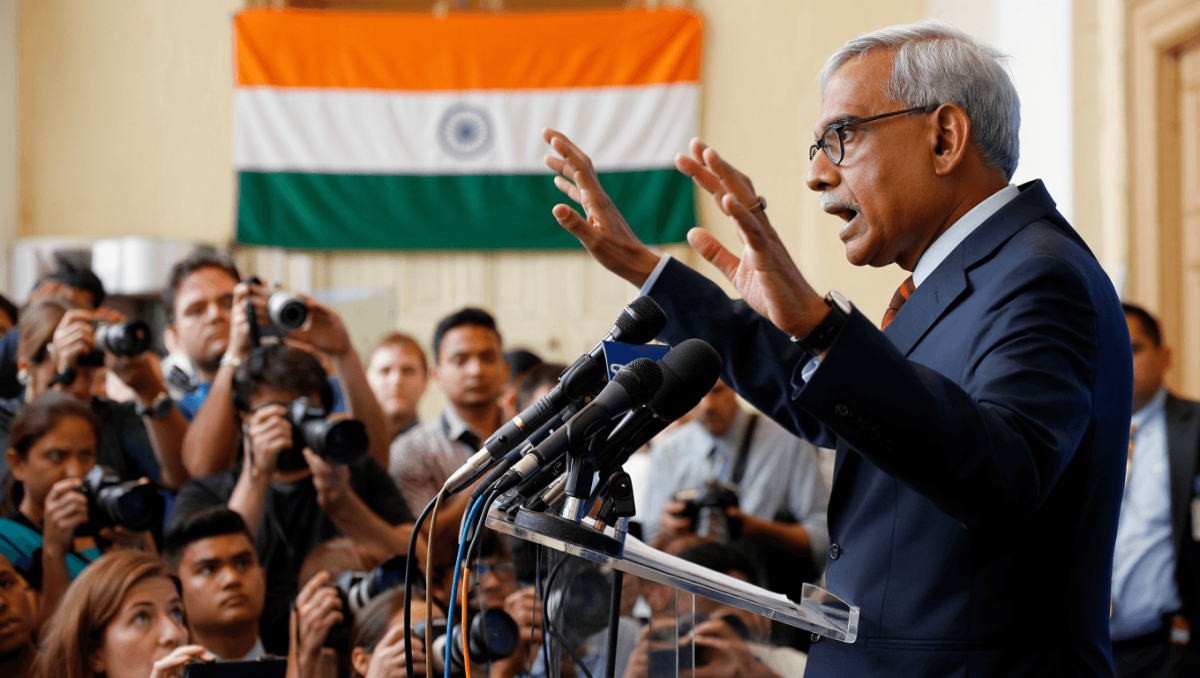
India’s foreign ministry rejected recent foreign criticism of its record on minority rights and media freedom at a press briefing in The Hague, saying such concerns reflect misunderstandings about the country’s history and institutions. The response from MEA secretary (West) Sibi George aims to push back on international scrutiny at a moment when India’s global profile — diplomatic and economic — is rapidly expanding.
Speaking to journalists and observers, George framed India as a deeply plural society shaped by millennia of religious and linguistic diversity. He stressed that multiple faiths and languages continue to exist across the country and described India’s democratic practices as robust and openly contested.
To underline his point about broad public participation, he cited a very high turnout in the most recent elections and pointed to the widespread use of mobile technology — including roughly 900 million smartphones — as enabling active public debate and information flow. “Our democracy is noisy,” he said, adding that this volume of voices is a sign of strength rather than weakness.
Shah Rukh Khan used the name Abinav to ease in-law worries: Gauri adopted Ayesha during nikaah
Javed Akhtar hails Hindu festivals as cultural glue: throwback of atheist celebrating resurfaces
On the question of minority protections, George argued that minority populations in India have grown since independence, noting that the share of minorities rose from about 11 percent at independence to more than 20 percent today. He asked critics to consider that trajectory when assessing the country’s social fabric.
He also offered historical context for the presence of different religions in India: that several major faiths originated on the subcontinent and that communities such as Jewish, Christian and Muslim groups have a long-standing presence and, in his view, have experienced continuity rather than systemic exclusion.
- Democratic participation: George cited high voter turnout and vibrant public debate as evidence of open civic space.
- Media and expression: The MEA official emphasized freedom of expression and press freedom as central to Indian democracy.
- Minority trends: He pointed to an increase in minority population share since 1947 as a counter-argument to claims of marginalisation.
- Historical continuity: George referenced centuries-long religious coexistence to underscore pluralism.
He also linked India’s political model to its economic performance, arguing that sustained growth was achieved without abandoning democratic norms — a claim he used to contrast India’s trajectory with development models that rely on force or coercion.
The minister concluded by inviting sceptics and foreign observers to visit India and witness the country’s daily life and institutions firsthand, framing direct observation as the best test of competing narratives.
Why this matters now: an official rebuttal at an EU capital underlines how domestic debates in India are spilling into diplomatic channels, affecting bilateral conversations with European partners and shaping international media coverage. The exchange is likely to influence how foreign governments and investors assess social stability and governance in India going forward.
Observers will watch whether the rebuttal narrows the gap between external criticism and official explanations or whether it intensifies scrutiny — particularly around press freedom and minority rights — in forums where India’s human rights record is debated.