Show summary Hide summary
Two of Kolkata’s foremost museums will mark International Museum Day on May 18 by opening a series of rare manuscripts and objects—many never shown to the public—alongside live performances and educational programmes. The twin exhibitions aim to trace how India’s mythic and intellectual traditions have been visualised across centuries, while testing new ways museums can engage visitors today.
The centerpiece of the citywide initiative is a joint display called Namami Bharatam: Many Forms, One Truth, curated across the 212-year-old Indian Museum and the Victoria Memorial Hall. Organisers say the project maps a continuous visual and textual thread from ancient philosophical iconography to modern artistic reinterpretations.
What visitors will see
At the Indian Museum, curators have assembled artifacts and images that foreground early religious and philosophical expression. Exhibits include sculptural and pictorial portrayals of Shaiva forms, a seldom-seen depiction of a Mother Goddess, and compound iconographies such as Ardhanārīśvara and Somaskandha. Paintings and prints—ranging from devotional portrayals of Shri Ram to works by Abanindranath Tagore—lead into a sequence of objects connected to the life and legacy of the Buddha.
Kashi to Kedarnath costs revealed: how much a Sawan pilgrimage will set you back
Hinduism gains ground in Africa: new communities reshape culture and commerce
Across the lawns at Victoria Memorial Hall, the narrative continues into the modern period. That gallery will present important pieces by artists who reworked traditional subjects for a new age, including Raja Ravi Varma, Jamini Roy and Gaganendranath Tagore, framing how classical stories were translated into modern visual languages.
Manuscripts, performance and digital plans
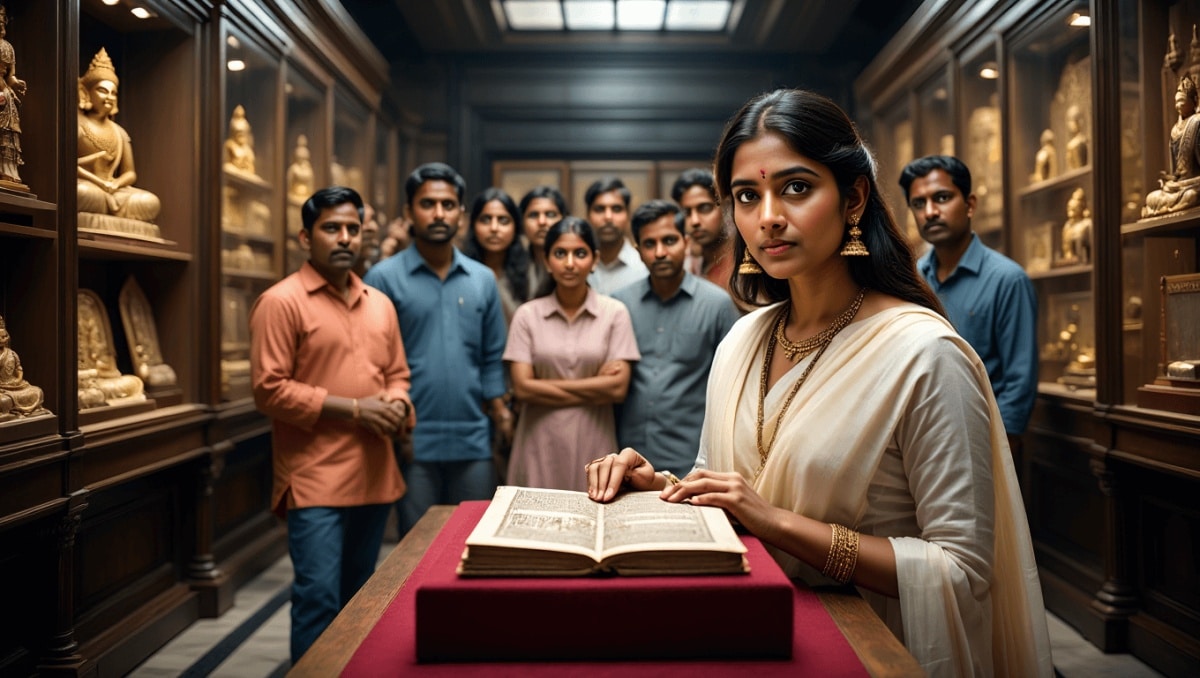
Under the central government’s cultural push known as the Gyan Bharatam initiative, both institutions are staging a special pavilion titled Gyan–Lipi–Grantha: The Written Soul of Bharat, which brings together fragile folios and handwritten texts that document religious and literary traditions.
Selected manuscript highlights on display include:
- At Indian Museum: folios from Krttibas Ojha’s version of the Ramayana, selections from the Chandimangala, and passages from the Harivamsa.
- At Victoria Memorial Hall: pages from the Bhagwat Maha Puran, the Bhakti-Lila Amrita, and the Persian-language Majme ul Baharin.
The museums have also programmed a strand of cultural activity under the banner Vande Mataram: Nyaya, Nrtya, and Nation, timed to coincide with the 150th anniversary of India’s national song. Events scheduled over the festival include cross-genre instrumental recitals, a classical dance production by the Shivranjani Odissi Cultural Association, a performance by Gaudiya Charukala Bharati, and interactive historical role-play sessions for children.
In a sign of how heritage institutions are adapting, the Indian Museum will sign a memorandum of understanding with Brainware University to pilot the use of artificial intelligence, augmented reality and virtual reality for conservation, collection management and digital archiving. Organisers say these tools will make fragile material accessible to wider audiences while supporting long-term preservation.
On May 19 the two sites will jointly roll out Jadughar: Shared Histories, Shared Futures, a curated scavenger hunt for schoolchildren designed to encourage close-looking, storytelling and museum literacy.
Why this matters now
By pairing seldom-seen manuscripts with community programmes and immersive technology, museum leaders are attempting more than a temporary exhibition. This initiative tests models for public engagement that could expand how cultural memory is taught, digitised and experienced—especially for younger audiences who expect interactive formats.
Sayan Bhattacharya, who heads the Indian Museum and serves as secretary and curator of the Victoria Memorial Hall, described the collaboration as a deliberate effort to make museums into forums for ongoing conversation about heritage and national identity. He framed the project as consistent with broader policy goals linking development and preservation.
The dual-site approach also invites visitors to compare historical continuities: how ancient texts and icons were interpreted in later centuries, and how modern artists reshaped those inherited forms. For scholars, teachers and families, the exhibitions offer a compact route through centuries of cultural production, now married to contemporary display techniques and educational programming.