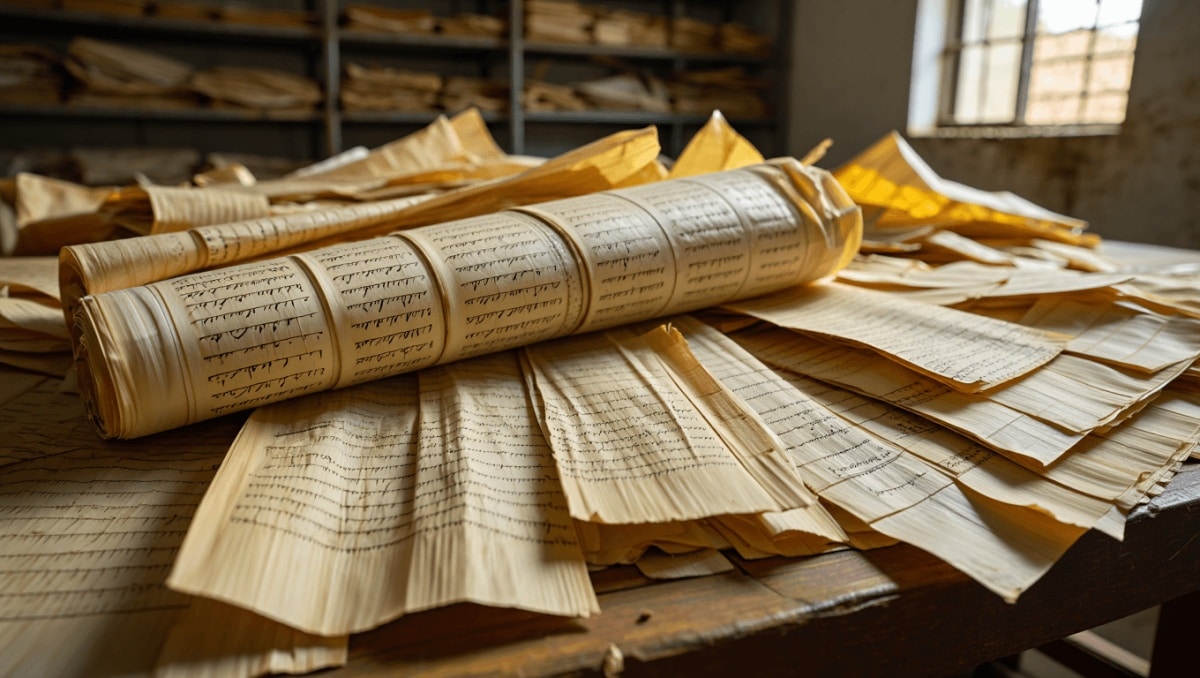
For centuries, thin strips of dried palm served as India’s library: durable, portable and written on with a sharp stylus. Today those fragile rolls — containing Puranas, local histories, treatises on war, astronomy and ritual — are fast disappearing, and scholars warn that loss of these manuscripts means more than missing pages; it erases whole strands of cultural memory.
Families once copied a damaged leaf by hand and cast the original into a river during flood rites such as the Tamil observance of Patinettam Per, when the Kaveri swells in midsummer. Over the last century, however, many households discarded palms without copying them, a change that has left gaps in the textual record and spurred a recovery effort by libraries, scholars and preservationists.
Palm-leaf material was made from the midrib of the palm or plantain leaf; a split rib produced two writing surfaces known in Tamil as edu. Characters were scratched into the surface and then darkened with ink — a durable technique, but one vulnerable to insects, humidity and fire. Manuscripts moved along river currents, and their physical journeys are reflected in place-names: a cache of Tevaram hymns washed up on the Vaigai is remembered in the name Tiruvedakam, where the local shrine is sometimes called Patrika Paramesvara — literally, the lord associated with paper or leaf.
Kashi to Kedarnath costs revealed: how much a Sawan pilgrimage will set you back
Hinduism gains ground in Africa: new communities reshape culture and commerce
Across South India, royal patrons and religious institutions once acted as stewards of these texts. The Sarasvati Mahal Library in Tanjavur preserves a notable collection assembled by local rulers; likewise, the Adyar and Oriental Manuscripts libraries in Madras grew into major repositories through both local and international efforts. Missionary societies, colonial officials and visiting scholars also collected leaves — sometimes rescuing works that might otherwise have been lost, though the export of manuscripts to foreign collections remains a contentious legacy.
The stakes are not limited to religious literature. Several palm-leaf codices record technical knowledge: treatises on architecture, water management, astronomy and even text on military engineering. Works such as the Samarangana Sutradhara and sections collected by Varahamihira capture a synthesis of arts and sciences that structured premodern knowledge systems. When a manuscript vanishes, it can erase evidence of indigenous practices and intellectual exchange.
Loss has multiple causes: environmental decay, casual disposal by owners who no longer recognize the material’s value, and deliberate destruction during conflicts. Historical accounts note episodes in which libraries were targeted as acts of cultural violence; in other moments, quick thinking saved collections — for example, a pragmatic appeal to invaders noting the presence of Qur’anic copies reportedly spared a library from being burned. Such incidents underscore that manuscripts were perceived not only as scholarly resources but as potent symbols of identity and authority.
In recent decades there has been a partial reversal: cataloguing and digitization projects have accelerated, and specialist libraries have mounted conservation programs. Yet many texts — especially local Sthala Puranas (temple histories) and smaller compilations — remain scattered in private households or have already disappeared. Recovery requires both fieldwork and careful conservation, along with scholarly comparison to reconstruct fragmented traditions.
- Key repositories: Sarasvati Mahal (Tanjavur), Adyar Theosophical Society Library (Chennai), Oriental Manuscripts Library (Chennai) — important centers for cataloguing and preservation.
- Representative manuscripts: Samarangana Sutradhara (architectural and mechanical treatises), Varahamihira’s compilations (astronomy, astrology, natural history), regional Puranas and Sthala Puranas.
- Threats today: environmental decay, loss of transmission practices, dispersal to private collections, incomplete cataloguing, and the historical export of texts abroad.
What does this mean for readers now? First, the disappearance of these manuscripts narrows the source base for scholars reconstructing South Asian intellectual history. Second, it matters for communities whose rituals, local histories and legal traditions are embedded in these texts. Finally, the manuscripts can contain practical knowledge — from irrigation to metallurgy — that may have contemporary relevance if studied and interpreted responsibly.
Scholars recommend a two-track approach: locate and catalogue surviving leaves through field surveys and community outreach, and stabilize fragile items through conservation and digitization so they can be studied without further handling. Comparative study across collections can reveal variant readings and regional continuities; where texts survive only in fragments, cross-referencing other manuscripts may restore lost passages.
Stories that surround the leaves — why a text was copied at a particular riverbank, how a library survived a crisis, which rulers patronized preservation — are themselves important cultural evidence. They show that manuscript culture was interactive and adaptive: copying, re-binding, and local custody kept texts alive for centuries. Understanding those practices helps modern conservators decide what to preserve and how to make it accessible.
Recovering this material is not merely an antiquarian pursuit. It is a search for missing chapters in the history of ideas, technology and belief — a task that relies on cooperation between communities, librarians, conservators and researchers. Preserved and properly contextualized, these fragile leaves can still speak across centuries.