
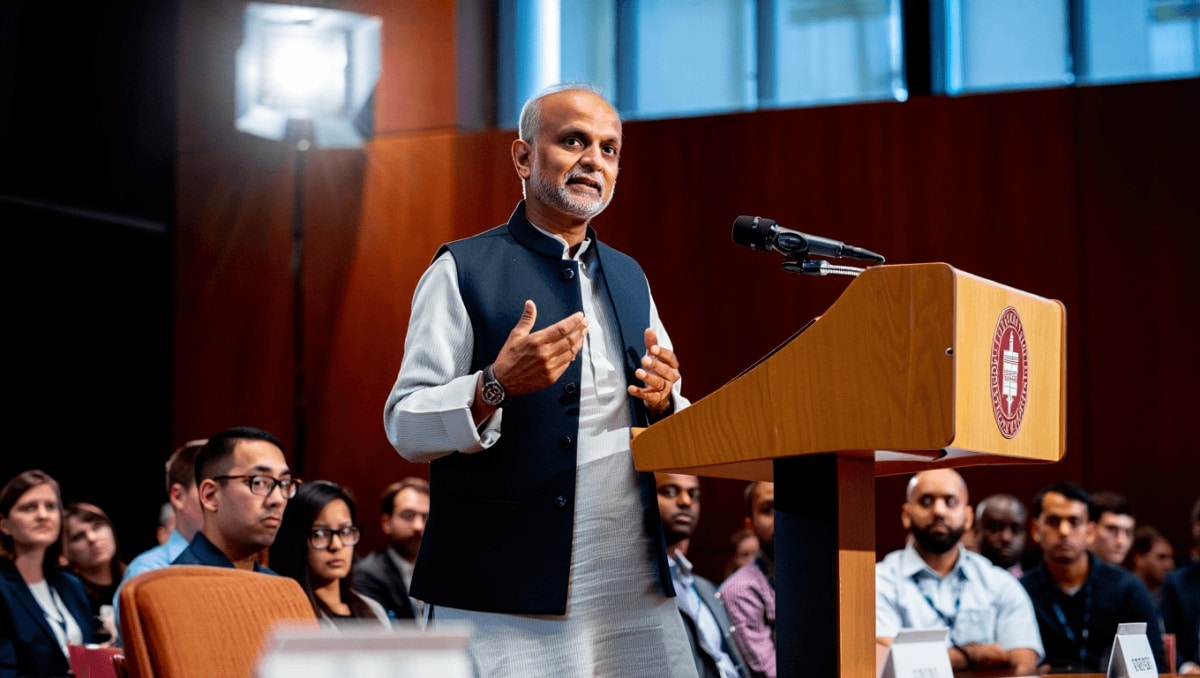
At a Stanford forum this week, a senior Indian leader warned that unchecked tech-driven growth risks deepening social divides and could turn innovation into a source of instability rather than shared progress. His remarks underscored a growing conversation about how artificial intelligence and other breakthroughs must be judged by more than economic output alone.
Speaking at the Thrive 2026 conference, Dattatreya Hosabale, general secretary of the Rashtriya Swayamsevak Sangh (RSS), urged policymakers and technologists to evaluate advances through the lens of economy, equality and ethics. He argued that without deliberate effort, the benefits of new technologies tend to concentrate, widening gaps in education, earnings and opportunity.
On a panel about science and civilizational leadership, Hosabale placed Indian intellectual traditions alongside contemporary research, suggesting they offer models where scientific inquiry coexists with spiritual practice. He described traditional disciplines—such as yoga—as systematic studies of the body and mind, rather than mere ritual.
Kashi to Kedarnath costs revealed: how much a Sawan pilgrimage will set you back
Hinduism gains ground in Africa: new communities reshape culture and commerce
“Scientific progress cannot be abstracted from social consequences,” he said, adding that weak public education and misreading of traditional knowledge may cause valuable historical learning to be dismissed as superstition.
He also raised broader geopolitical and social concerns, warning that rising tensions between nations, religious conflict and fraying family and community bonds are as consequential as any technological risk. “Healthy families support healthy societies,” he said, framing social cohesion as a foundation for national stability.
Addressing the Indian diaspora, Hosabale urged a clear priority: maintain loyalty to host countries while preserving cultural ties with India. He invoked the spirit of Vasudhaiva Kutumbakam—the world-as-one-family idea—as compatible with civic allegiance abroad.
- Inequality risk: Rapid adoption of new technologies can amplify educational and income divides unless access and training are broadened.
- Cultural continuity: Traditional knowledge systems can inform modern science, but only if they are accurately studied and contextualized.
- Geopolitical stakes: Social fragmentation and international tensions may interact with technological disruption to increase instability.
- Policy balance: Innovation should be steered to protect environmental integrity and social cohesion, not override them.
Panelists from major tech and academic institutions joined Hosabale in discussing these themes, highlighting the need to combine technical stewardship with ethical frameworks. The exchange reflected an emerging consensus among some leaders: technological progress requires governance that anticipates social fallout as much as economic promise.
For readers, the immediate takeaway is practical: debates about AI and other advances are not purely technical. They shape who benefits, how communities hold together, and whether progress is sustainable. Ensuring wide access to education, protecting environmental limits, and strengthening civic bonds were among the policy priorities implied by the discussion.
As nations and companies push new technologies into everyday life, Hosabale’s message was blunt: growth that ignores social and ethical dimensions risks becoming a driver of division. Aligning innovation with long-term social stability and environmental care, he argued, must be part of any responsible agenda.