Show summary Hide summary
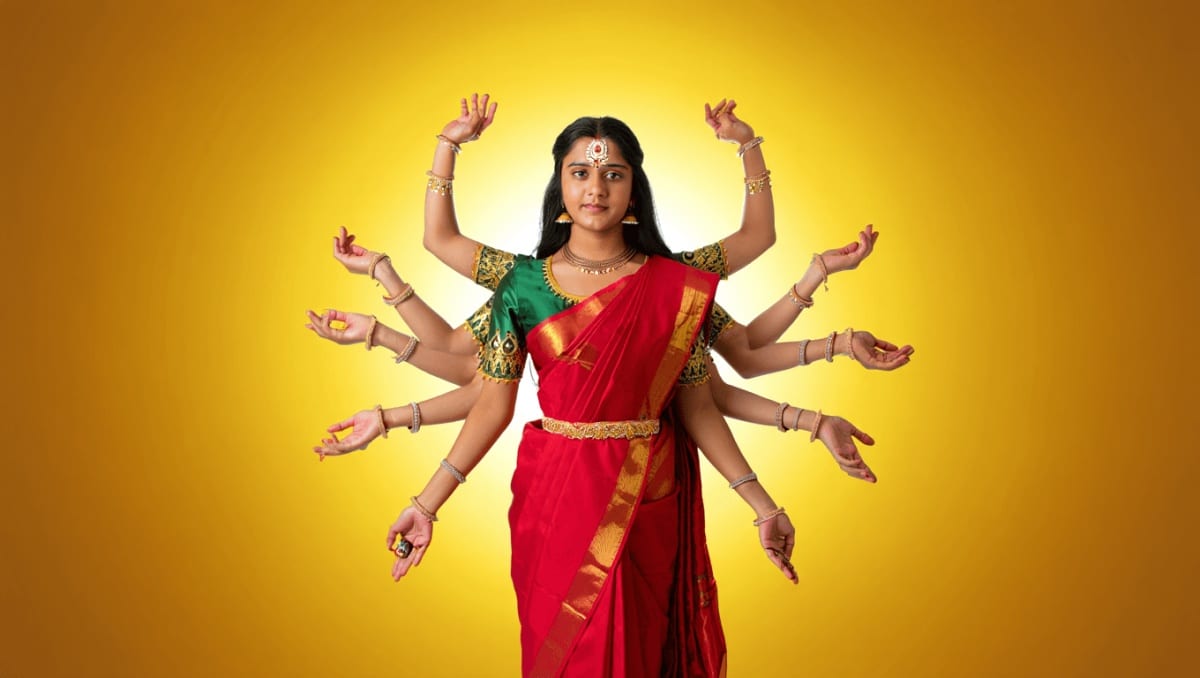
Goddess Chandraghanta’s striking depiction—with ten arms instead of the two shown in earlier forms—speaks plainly to the realities of contemporary family life: multiple tasks, simultaneous demands and the need to act with both force and insight. Her iconography is not decorative; it is a visual lesson about balance, authority and partnership that still resonates as more households juggle careers, caregiving and emotional labor.
Art and theology often compress complex ideas into a single image. Where earlier manifestations of the Mother appear simple and contained, Chandraghanta’s expanded form suggests a person moving in several directions at once, yet remaining composed. That steadiness under pressure is the image’s central claim: responsibility can multiply without breaking the one who carries it.
Tools of responsibility
Eight of her hands hold symbolic implements; two gesture outward. Together they sketch a model of what household and social responsibility require—strength, direction, continuity and reflection. Read as practical cues, these attributes mirror modern demands like managing time, setting priorities, and protecting relationships.
Shah Rukh Khan used the name Abinav to ease in-law worries: Gauri adopted Ayesha during nikaah
Javed Akhtar hails Hindu festivals as cultural glue: throwback of atheist celebrating resurfaces
- Trident, mace, sword — instruments of force and protection, signaling decisive action when circumstances demand it.
- Bow and arrow — symbols of focus and intention, the ability to aim toward a clear objective.
- Lotus — a reminder of dignity, restraint and actions rooted in principle rather than impulse.
- Kamandal (water vessel) — continuity and the small, daily habits that sustain life.
- Rosary — persistence, rhythm and the inner practices that steady decision-making.
- Abhay mudra — the gesture of protection, offering reassurance and refuge to those in her care.
- Gyan mudra — the sign of knowledge, indicating that power without wisdom is incomplete.
Read together, these items argue that responsibility is not merely brute strength. It requires targeted action, steady routines and a reflective center.
The goddess also bears a third eye, a conventional sign in South Asian iconography for heightened awareness or intuition. In everyday terms, that points to quick, informed judgment: the kind of inner compass that lets someone act decisively when there isn’t time for extended deliberation.
Her chosen mount shifts the tone further. Where a gentler figure might travel on foot or by a docile vehicle, Chandraghanta rides a lion or tiger—an animal that demands confident command. The image suggests a posture appropriate to difficult circumstances: not frantic force, but calm mastery.
Partnership encoded in symbolism
One quiet detail often overlooked is the crescent moon she wears on her brow, mirrored by the crescent on her consort’s crown. When the two crescents come together they form a whole—an emblem for shared responsibility rather than unilateral perfection. It’s an implicit argument for mutual support: stability in a household flows from joined effort, not the expectation that one person will supply everything.
That philosophy is timely. Debates about the distribution of domestic labor and the intangible “mental load” show that many families are still negotiating who holds which tasks—and how power and care should be balanced. Chandraghanta’s figure offers a framework: combine protection with discernment, energy with direction, and individual effort with partnership.
Practically speaking, the icon invites a few simple lessons:
- Match decisive acts with reflection—use force when needed, but let knowledge guide the choice.
- Build sustaining routines (the kamandal and rosary) to reduce crisis-driven work.
- Share roles so that the “crescent” of responsibility becomes a full circle rather than a burden on one side.
Seen this way, Chandraghanta is not a distant deity but a symbol for modern competence: a reminder that handling multiple duties can be an art—one that mixes strength, aim, steadiness and wisdom.