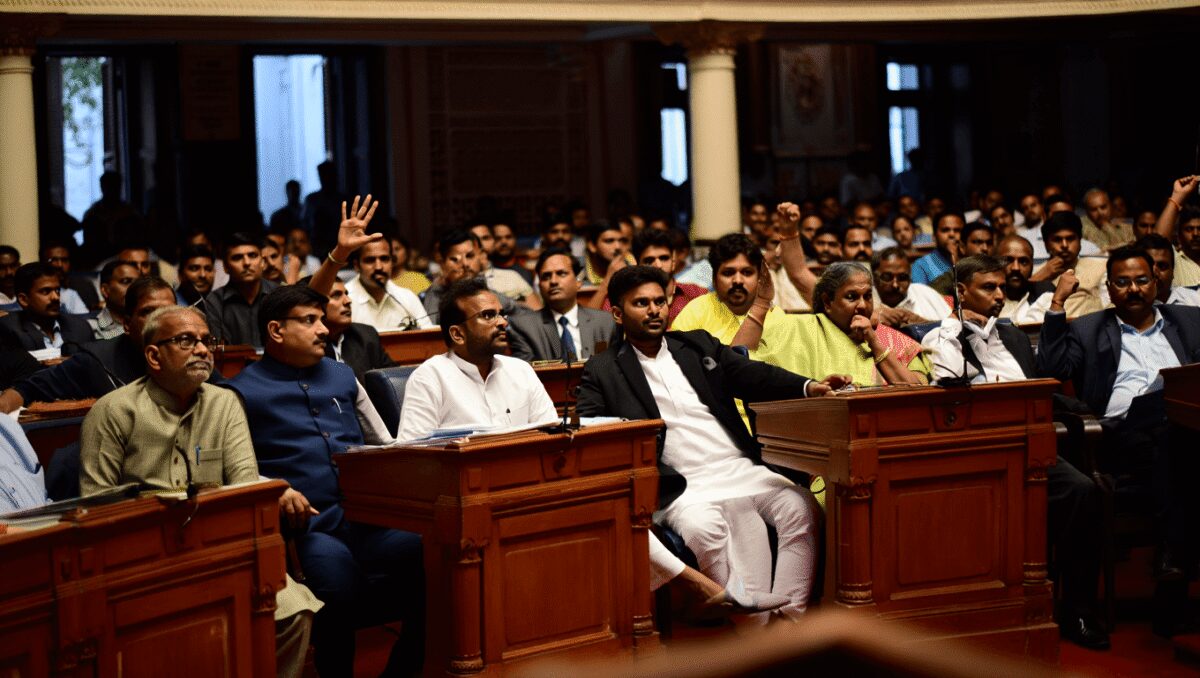
Maharashtra’s legislature late Monday approved a controversial Freedom of Religion Bill, pushing the measure closer to final passage as it heads to the Legislative Council. The move has reignited debates over religious freedom, interfaith marriage and privacy, with government and opposition camps sharply divided over the law’s scope and constitutionality.
The bill, introduced by the ruling Mahayuti coalition, was carried in the Assembly after supporters argued it targets coercive or fraudulent conversions. Opponents — including Congress, NCP (SP), Samajwadi Party and CPI (M) lawmakers — urged a pause and asked that the measure be referred to a joint select committee so the public can submit objections and suggestions.
Devendra Fadnavis, the chief minister, framed the legislation as a protective measure designed to prevent conversions that occur through force, deception or inducement, and stressed it aligns with constitutional protections for religious liberty. He noted that comparable statutes are already on the books in about a dozen other states, naming Odisha, Karnataka, Haryana, Rajasthan and Arunachal Pradesh among them.
Shah Rukh Khan used the name Abinav to ease in-law worries: Gauri adopted Ayesha during nikaah
Javed Akhtar hails Hindu festivals as cultural glue: throwback of atheist celebrating resurfaces
Outside the chamber, Uddhav Thackeray of Shiv Sena (UBT) voiced support, saying the party opposes conversions carried out by duress or exploitation of vulnerable people.
- Who backed the bill: Mahayuti coalition and Sena (UBT) lawmakers.
- Who opposed it: Congress, NCP (SP), Samajwadi Party, CPI (M); several MLAs demanded referral to a select committee.
- Next step: Expected to be tabled in the Legislative Council on Tuesday for further consideration.
- Stated aim: To criminalize conversions obtained by coercion, fraud or inducement and to clarify legal gaps in dealing with such cases.
Government proponents say the bill will reduce recurring law-and-order disturbances tied to contested conversions and interfaith unions by providing specific legal remedies where current penal provisions are interpreted piecemeal. The Assembly motion to adopt the bill was moved by Minister of State Pankaj Bhoyar.
Opposition figures painted a different picture. Several MLAs warned that certain clauses — notably a requirement that converting individuals give prior notice and language that shifts the evidentiary burden onto the accused — could violate privacy rights and constitutional guarantees.
Congress MLA Aslam Shaikh argued the measure would impose an intrusive public declaration on people wishing to change faith and questioned how the law would ensure those individuals’ safety. He cautioned that the provisions risk criminalizing consensual relationships between adults from different faiths.
Other critics described the bill as selectively enforced and likely to be used against particular communities. Samajwadi Party MLA Rais Shaikh called the proposal regressive, while Congress MLA Amin Patel said it conflicted with constitutional norms.
Supporters rebutted those charges by highlighting the government’s intent to draw a clear legal line around what it calls unlawful conversion. Fadnavis insisted the bill is consistent with Article 25’s protection of religious freedom while creating tools to address abuses allegedly carried out in the name of conversion.
What to watch next
The legislation’s passage in the Legislative Council will be the immediate procedural milestone. Beyond that, the debate is likely to continue in courts, in civil-society forums and in the public sphere.
- Legislative timeline: Council consideration expected Tuesday; possible amendments or referral to committee remain options.
- Public response: Opposition parties want a joint select committee to invite submissions from citizens and civil groups.
- Legal scrutiny: Critics warn of constitutional challenge; supporters say the bill follows precedents elsewhere in India.
The measure touches on sensitive and highly personal matters — conversion, marriage and individual autonomy — which is why reactions are intense and immediate. For residents of Maharashtra, the practical effects would be most visible in how local authorities handle interfaith unions and allegations of coerced conversions, and whether the state introduces administrative or protective steps alongside the criminal provisions.
As the bill moves to the upper house, legislators and legal observers will be watching for amendments that address privacy and burden-of-proof concerns, and for any signals that the government will create safeguards for vulnerable individuals who declare a change of faith.