Show summary Hide summary
The LD Museum in Ahmedabad is showing an exhibition that traces how printed religious imagery reshaped everyday devotion in colonial and post‑colonial India. Titled “Porcelain: The Lithographic Mould” and curated by collector‑scholar Anil Relia, the show reveals how mass‑produced prints were transformed into glazed, three‑dimensional objects that entered homes across the subcontinent.
At the center of the display is a bright porcelain figure of Krishna subduing the serpent Kaliya — a scene familiar from Indian devotional art but here rendered in glossy colours and Western ceramic technique. The piece is a striking example of a broader process: images born on lithographic presses moved through global trade networks and factory floors to become tangible objects of worship.
From press to prayer: how images travelled
In the late 1800s and early 1900s, advances in chromolithography made richly coloured prints affordable and widely available. Artists and studios such as Raja Ravi Varma, Calcutta Art Studio, Chor Bagan and Kansari Para produced images that entered popular culture, circulating in shops, calendars and home altars.
Sankalpa 2027: a simple spiritual pledge to reset your year
Vegan diet gets dharmic and animal-welfare backing from producer Nirva Patel

Manufacturers noticed demand. European and Japanese porcelain firms, alongside Indian producers like Bengal Potteries, began producing statuettes and plaques that echoed the compositions and poses familiar from these prints. What began as a two‑dimensional, mass‑market image was translated into a three‑dimensional devotional object.
Crafting a three‑dimensional devotional image
Converting a flat print into porcelain demanded reinterpretation. Modelers working in clay had to rework drapery folds, jewellery, facial expressions and bodily gestures so they worked from every angle. That act of translation changed the way viewers experienced the image: a print you might hang on a wall became a tactile focus for private worship.

The result is not an exact copy but a hybrid object — technically European or Japanese in manufacture, visually and spiritually rooted in Indian iconography. The exhibition pairs prints and their ceramic counterparts to show this creative and commercial exchange.
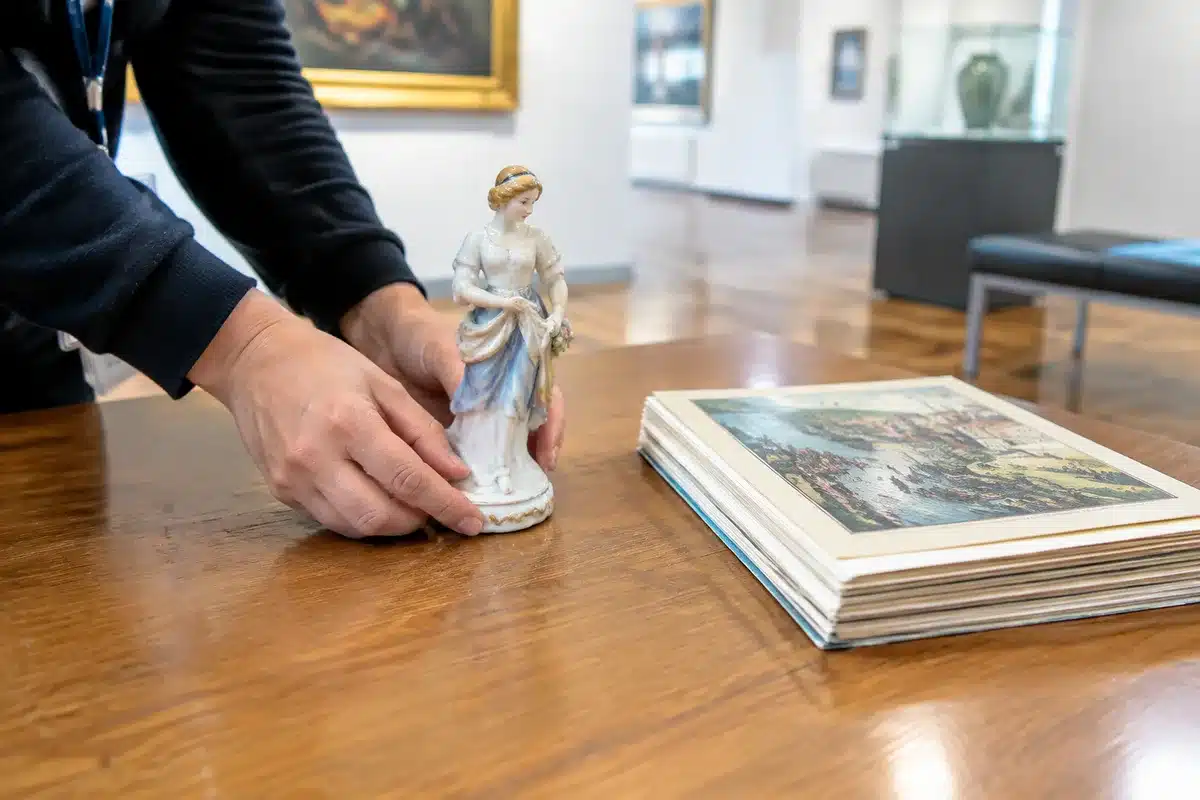
Relia loaned the pieces from his own collection, allowing visitors to compare original lithographs alongside the porcelain they inspired.
Why this matters now
The show speaks to ongoing questions about globalization, cultural exchange and the commodification of religion. It also helps explain why certain devotional images remain so pervasive: print technology amplified particular compositions, and factories turned those images into objects people could own and venerate.
- Visual democratization: Affordable chromolithographs brought high‑quality religious imagery into modest homes.
- Industrial translation: Porcelain makers reinterpreted flat prints as freestanding devotional pieces.
- Cross‑border production: European and Japanese factories, and Indian firms like Bengal Potteries, participated in a shared marketplace.
- Material culture shift: The movement from print to object reshaped private worship and popular visual habits.
The exhibition’s layout deliberately mixes prints and porcelain so visitors can see compositional details migrate from page to figurine. Some displays highlight close matches; others show how potters and modelers introduced new elements or adjusted proportions to suit ceramic production.
Beyond academic interest, the works offer a visual history of everyday faith — how technological change alters what people keep at their domestic altars and how global commerce can reshape local devotional life.
“Porcelain: The Lithographic Mould” remains on view at LD Museum with works drawn from Anil Relia’s collection, presenting a concise narrative about the intersection of print culture, industry and religion in modern India.