Show summary Hide summary
In the middle of the 20th century two Indian musicians quietly altered how Americans heard—and thought about—music. Their work not only introduced North Indian classical traditions to Western audiences but also laid foundations for teaching, archiving and cultural exchange that still shape music education and popular culture today.
What began as a series of chance encounters and concert invitations turned into a lasting presence: public performances, recordings on American labels, collaborations with jazz and rock figures, and institutions dedicated to teaching a complex, centuries-old art form.
How an encounter in India opened America’s doors
In the early 1950s, a famed Western violinist heard performances by two Indian masters and brought that discovery back to the United States. One of the musicians, a virtuoso of the sarod, accepted an American concert invitation in 1955 and became the first to perform Indian classical music on several US platforms—live stages, record labels and television—introducing many Americans to the sounds of the subcontinent for the first time.
Sharad Purnima 2026: moonrise time and rituals for kheer and all-night vigil
Ugadi guide: crucial updates, dates and traditions to know today

Born into a family of court musicians and trained from early childhood by his father—himself a towering teacher—this artist was schooled in a demanding, discipline-driven approach to music. He carried the honorific Ustad, a recognition of mastery in North Indian classical traditions.
From concert halls to classrooms
The sarod master preferred teaching to showmanship. After initial tours and recordings raised public interest, he returned to the subcontinent to found a music college, later reestablishing that school in the United States when the first campus closed. There, he adapted his intense training methods for Western students, emphasizing devotion, respect for the tradition and disciplined practice rather than mere performance techniques.
His efforts went beyond lessons: he helped assemble an archive spanning decades of compositions, lessons and recordings—materials intended to preserve the repertoire and make it accessible to future generations.
The charismatic ambassador
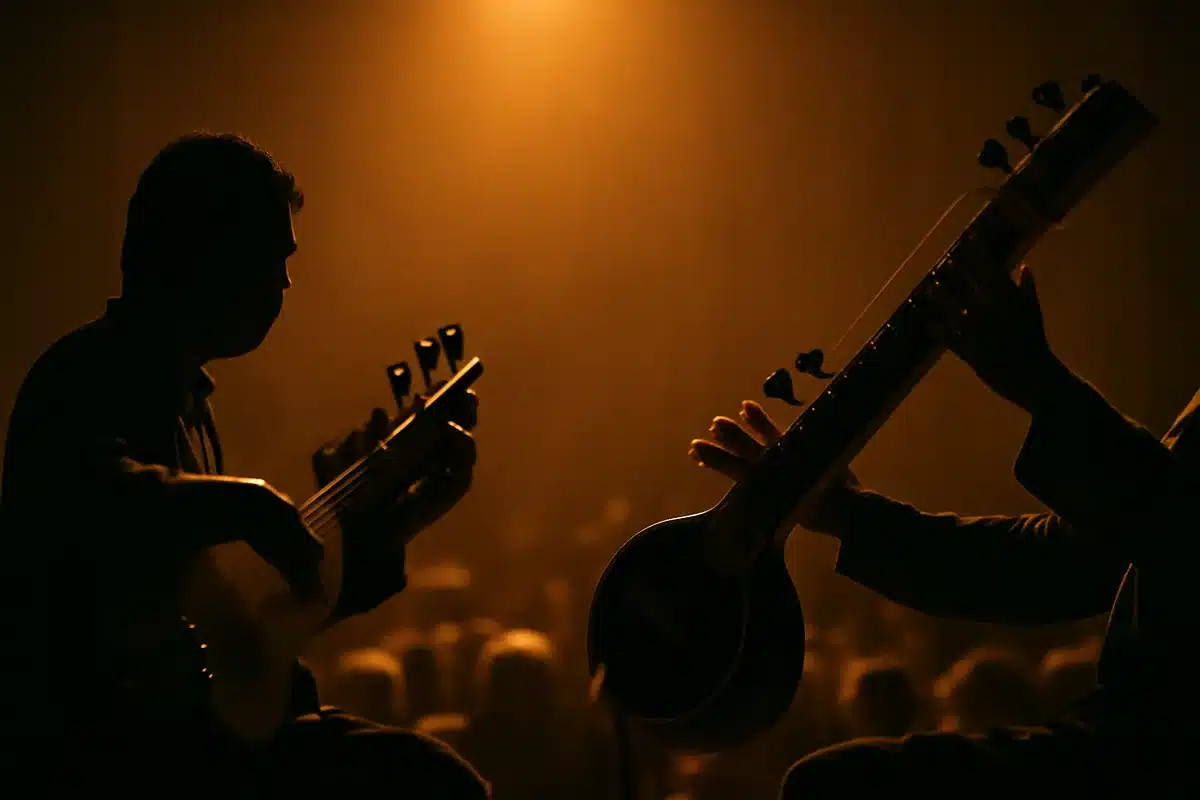
The other figure, a sitarist, arrived in the US a year later and quickly found sympathetic audiences among jazz listeners and then wider popular culture. Unlike his contemporary, he had early experience as a stage performer with an Indian dance troupe and a natural ability to connect with diverse crowds. That combination of technical command and charisma made him an effective cultural bridge.

Record producers who had been working with jazz artists began recording his sessions, leading to collaborations with American musicians across genres—jazz instrumentalists, avant-garde composers, and eventually leading rock figures. A close friendship with a prominent British guitarist in the late 1960s transported the sitar into mainstream pop and solidified Indian classical music’s visibility in the West.
Moments that mattered
- Mid-1950s: First sustained public exposure of North Indian classical music on US stages and airwaves.
- 1950s–60s: Recordings on American labels linked Hindustani music with jazz and experimental scenes.
- 1971: A major benefit concert included an Indian classical segment, introducing tens of thousands to the tradition and raising international awareness.
- Institutions: Colleges and archives were founded to teach and preserve the music, training thousands of Western students over ensuing decades.
These milestones did more than entertain; they created pedagogical pathways and preserved source material for scholars and performers alike.
Why this still matters
Indian classical music’s arrival in America reshaped cross-cultural music-making in three durable ways. First, it altered the sound palette of popular music—hear the timbre of the sitar in late‑1960s rock and the raga-inspired passages in jazz and contemporary composition. Second, it spawned formal schooling models that allowed Western students to learn a complex oral tradition responsibly. Third, archives and recordings created at the time continue to be reference points for researchers and performers worldwide.
Those outcomes carry practical implications: music conservatories, world-music programs and community schools still draw on these mid-century exchanges; artists continue to navigate issues of cultural exchange and preservation that began then; and the conversation about how to present and protect non-Western traditions in global contexts remains active.
A shared legacy, different roles
The two musicians played complementary roles. One was an institutional builder and archivist who prioritized faithful transmission. The other was a public-facing connector whose collaborations and charisma expanded audiences and inspired new musical experiments. Together they transformed a once-insular tradition into an influential global presence without erasing its spiritual and pedagogical aims.
Today, as educators and performers reassess how traditions move across borders, their mid-century work offers a model: combine performance with pedagogy, protect source materials, and cultivate cross-cultural curiosity without flattening the tradition’s meaning. That balance is arguably the clearest thread linking those early introductions to the ongoing global life of North Indian classical music.