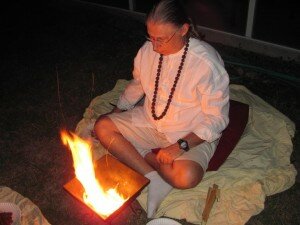
Author – Yogi Baba Prem Yogacharya
By Yogi Baba Prem Yogacharya, Veda Visharada
The term yogi and yoga are amongst the most commonwords from the Hindu tradition to penetrate the western vocabulary. But, it is still somewhat rare that one gives thought to what these terms actually mean, their proper application and what they are referring to; as yoga is commonly confused with ‘stretching’ or some other form of acrobatic activity. On some levels, it is easy to understand, as there are a variety of different meanings given and associated with ‘Yogi’.
Currently the term Yogi, or Yogini for a female practitioner of yoga, is becoming commonly used for anyone that practices yoga. But it might be more correct to use the term ‘Yogin’ to describe a practitioner of yoga, as this is the common correct usage of the term. Again, Yogin is ascribed more to a male, and Yogini is correct when referring to a female practitioner of Yoga. Though this term is often shortened to Yogi within western systems. Regrettably, we do not find a great deal of support within the traditional teachings for this generic application of yogi to anyone that practices yoga; rather the Shiva Samhita (2.1-5) states that a Yogi is someone that that is able to see that the beings that exist in the three worlds are in the body as well, called Brahmanda. The Brahmanda is a reference back to Hiranyagarbha which is also identified as the cosmic egg or source of the universe. Hiranyagarbha is viewed as the source of yoga and the experience of yoga. Additionally, Hiranyagarbha is found within the Vedic Yoga tradition, the oldest recorded yoga in the world.
Within some Siddha traditions, a Yogi is one that knows the 9 chakras, the goal, and the ethers along with a few other qualities. Of course, knowing the 9 chakras is not simplistically knowing their locations, but rather having merged and completely understanding the form and function of the chakra. Likewise, there are also four classifications of yogi’s, as in practitioners of yoga, within the Yoga Bhayasa of Yogin:
1. Neophyte (prathama-kalpika). This is a beginner.
2. Madhubhumika. One who has reached the honey level (madhu) of consciousness on earth (bhumi).
3. Prajnajyoti. One who has reached the light (Jyoti) of wisdom (prajna), sometimes viewed as enlightenment.
4. Atikrantabhavaniya. One who transcended.
Within renunciation traditions, Yogi is often used with the entry levels of those following a path to Sannyasin. Some renuciates begin with the title ‘yogi’, as this is commonly used in some south Indian Shaivite traditions. It may also appear at various levels within some Vedantic traditions, as well.
Yogi, like yoga, comes from the root ‘yuj’ literally meaning to join. This is not literally an act of joining, as in joining a class, but rather is a joining of the finite consciousness with the infinite consciousness. But yuj has a great deal more complexity than these meanings and does not translate well into English. Other qualities associated with ‘yuj’ would be ‘to harmonize’ and ‘harness’. This would be to harmonize the rhythms between the Sun and Moon, the mind and body, ego and soul to name a few examples. Likewise, it is to harness the emotions, so that they drive the body in a healthy direction towards Dharma and realization.
The term Yogini is an even more complex term, as this term is associated with the Divine mother and female saints. The term can also refer to groupings of forms of Durga, an important Goddess. Yogini also has important meanings within the various tantric traditions. Most importantly, is that the term Yogini is strongly associated with Shaktism and worship of the Goddess and feminine expression and relationship with Divinity.
There are numerous additional titles from within the Hindu tradition associated with Yogi and Yoga; these include Yoga-raj or king/lord of yoga. This is often an honorific title given to yoga masters. There is Yoga-ykuta which is a term for a practitioner that has brought their senses and mind under control. Yoga-vid is a knower of yoga. There is also Yogacharya which is commonly viewed as a teacher of yoga. This term also is commonly used as preceptor. Some systems define three types of yogacharya:
1. Codaka-meaning the prompter.
2. Bodaka-meaning the awakener.
3. Mokshada-the liberator.
Yogi does appear within the Buddhist tradition, as Buddhism was born out of Hinduism. It is here that we see the most common or liberal usage of the term, as Yogi can be commonly used to refer to a renunciate or a householder that practices meditation. It is the Buddhist usage that has most likely influenced modern day practitioners of yoga and their usage of the term ‘yogi’. But ironically, often they do not teach within a Buddhist tradition. Furthermore, It is the afore mentioned ‘Neophyte’ classification that most accurately describes the modern usage of the term. Though it doubtful that new practitioners of yoga are thinking of this meaning in their usage of the term.
As practitioners of yoga, it is important to understand the tradition that one’s particular teachings come from, likewise, it is important to use the terms of yoga within their proper context. The current tendency of forcing words to mean what we want them to mean, or what we think they mean, only degrades yoga and the sacred teachings of yoga, as well as propagating ignorance. We have only grazed the surface of the meaning of yogi and yogini, as these words and meanings are quite expansive and eventually transcend language, as they express something that is beyond limited language.